

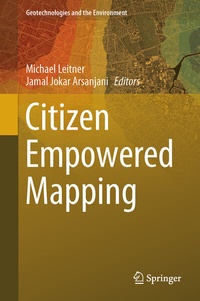
Citizen Empowered Mapping
Description

This book promotes the exploitation of novel and emerging approaches for mapping environmental and urban informatics empowered by citizens. Chapters are grouped in three sections representing the main subjects. The first section describes data acquisition and modeling. The second section focuses on the quality and reliability of data. The final section presents different methods of environmental monitoring and perception. The book includes diverse case studies from Mexico, the United States and Czech Republic.
Topics covered in
Citizen Empowered Mapping
are of interest for research scholars, practitioners, postgraduates, and professionals from a variety of disciplines including geography, environmental science, geographic information science, social science, and computer science.
More details
Other editions
Additional editions
Persons
Jamal Jokar Arsanjani received his doctoral degree in Geographic Information Science (GISc) from the Department of Geography and Regional Research, University of Vienna, Austria. He is currently an Alexander von Humboldt Fellow at the Institute of Geography, Heidelberg University, Germany. His interdisciplinary research interests are in volunteered geographic information and crowdsourcing, geocomputation and spatial planning, remote sensing of the environment, and disaster management. He has published articles in leading international journals of his discipline, including International Journal of Applied Earth Observation and Geoinformation, International Journal of Digital Earth, Transactions in GIS, Cities and single-authored a book on Dynamic Land Use/Cover Change Simulation: Geosimulation and Agent-based Modelling with Springer.
Michael Leitner received a master degree at the Department of Geography and Regional Research, University of Vienna, Austria anda second master and a doctoral degree in GISc at the Department of Geography, State University of New York at Buffalo, US. He is currently a Professor of Geography in the Department of Geography and Anthropology, Louisiana State University, US and a faculty member in the Doctoral College "GIScience" at the University of Salzburg, Austria. He has previously received a Fulbright Scholarship and is the recipient of the 2007 Meredith F. Burrill Award from the Association of American Geographers. His research interests are in GISc and its application to spatial crime analysis, medical geography, and geospatial privacy. He has published two co-authored books, one single-edited book and 40+ refereed articles and book chapters. He is the current editor of Cartography and Geographic Information Science ( CaGIS ).