

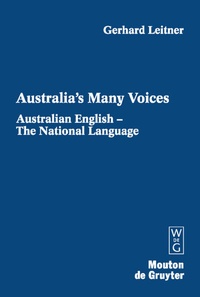
Australian English - The National Language
Description

Australia's English raises many questions among experts and the general public. What is it like? How has English changed by being transplanted to other parts of the world? Does the rise of AusE and other varieties endanger the role of English as a world language? Past studies have often been selective, focusing on the esoteric and non-typical, and ignoring the contact situation in which Australian English has developed.
This book and its companion, Australia's Many Voices. Ethnic Englishes, Indigenous and Migrant Languages. Policy and Education, develop and apply a comprehensive and integrative approach that anchors English in the entire 'habitat' of Australia's languages that it both upset and transformed. Based on a wide range of data and on the assumption that all manifestations of Australian English must cohere as a system, this book retraces the social, psycholinguistic and linguistic history of the language. It locates the contact with indigenous and migrant languages and with American English in the appropriate sociohistorical context and shows how several layers of migration have shaped it. As it stratified, it was gradually accepted and developed into a fully-fledged national variety or epicentre of English that could be raised to the status of national language. Implications on educational policy and attempts to reach out into the Asia-Pacific region have followed logically from national status.
The study is of interest for specialists of English and Australian Studies as well as a range of other disciplines. Its discursive, non-technical style and presentation makes it accessible to non-specialists with no background in linguistics.
Reviews / Votes
"The breadth of information Leitner brings together in this series makes it a perfect ready-reference and springboard for casual enthusiast and scholars of Australian languagues alike."Louisa Willoughby in: Linguist List 16.955 "One can only commend the book's underlying aim, to provide a unified description of Australian English, within a contemporary linguistic paradigm. It brings light sources that will be of interest to future researchers and provides a map of that very large geographical and sociolinguistic landscape."Pam Peters in: Journal of English Linguistics 6/2005 "Leitner is not the first to conceive the idea of relating language developments with the socio-political history of the continent, but he has done it more extensively than earlier writers like Jupp, Ozolins, Clyne and Mitchell. And he is the first to explore the possibility of treating all the major questions within a single overarching concept. And that makes history!"Arthur Delbridge in Zeitschrift für Australienstudien, 19, 2005 "These volumes really are now the standard reference work on the Australian language habitat, past and present; every library should have copies."Scott F. Kiesling in: World EnglishesMore details
Other editions
Additional editions
Person
Content
- Intro
- Acknowledgements
- List of illustrations
- Notational conventions
- Introduction
- Chapter 1 Australia's language habitat
- 1.1 Demographic, cultural and linguistic diversity
- 1.2 Past approaches to Australia's many voices
- 1.3 A unified approach to Australia's many voices
- 1.4 A coherent, inclusive account of Australia's languages
- Chapter 2 The demography of Australia's language habitat
- 2.1 Demography and the demography of Australia
- 2.2 The growth of Australia's population
- 2.3 The composition of the population
- 2.4 A profile of selected communities
- 2.5 Conclusion
- Chapter 3 Australian English: The national language
- 3.1 Attitudes to English: From colonial cringe to epicentre
- 3.2 The British English heritage in mAusE
- 3.3 English in Australia in contact
- 3.4 Internal stratification of mAusE
- 3.5 Standard mAusE and Australia's national language
- 3.6 A social and linguistic history of mAusE
- 3.7 The language repertoire of the speech community of mAusE
- Chapter 4 An epi-centre in the Asia-Pacific region
- References
- Name Index
- Subject Index
