

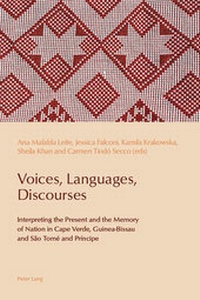
Voices, Languages, Discourses
Description

This volume brings together a selection of interviews with writers and filmmakers from Cape Verde, Guinea-Bissau and São Tomé and Príncipe in order to examine representations and images of national identity in the postcolonial narratives of these countries. It continues and completes the exploration of the postcolonial imaginary and identity of Portuguese-speaking Africa presented in the earlier volume of interviews Speaking the Postcolonial Nation: Interviews with Writers from Angola and Mozambique (2014).
Memory, history, migration and diaspora are core notions in the recreation and reconceptualization of the nation and its identities in Cape Verdean, Guinean and São Tomean literary and cinematographic culture. By assembling different generations of writers and filmmakers, with a wide variety of perspectives on the historical, social and cultural changes that have taken place in their countries, this book makes a valuable contribution to current debates on postcolonialism, nation and identity in these former Portuguese colonies.
More details
Other editions
Additional editions
Persons
Ana Mafalda Leite is Associate Professor at the University of Lisbon. Her areas of research include Mozambican literature, African cultures and literatures in the Portuguese language, oral literature and postcolonial studies. Her publications include Oralidades & Escritas Pós-Coloniais (2012).
Jessica Falconi is a postdoctoral researcher at the Centre for the Study of Africa, Asia and Latin America at the University of Lisbon. Her publications include Utopia e conflittualità. Ilha de Moçambique nella poesia mozambicana contemporanea (2008).
Kamila Krakowska is Assistant Professor at Leiden University Centre for the Arts in Society, where she teaches International and African Studies. Her PhD thesis on travel in the novels of Mário de Andrade and Mia Couto was awarded the prestigious Fernão Mendes Pinto prize.
Sheila Khan is a researcher at the Center for Communication and Society Studies (CECS) at the University of Minho. She is currently a postdoctoral researcher on the project funded by the European Research Council, EXCHANGE. Her publications includes (with Nazir Can and Helena Machado, eds), Racism and Racial Surveillance: Modernity Matters (2020).
Carmen Tindó Secco is Professor of African Literatures in the Portuguese Language at the Federal University of Rio de Janeiro. Her publications include A magia das letras africanas (2003), Brasil/África: como se o mar fosse mentira (2003) and África & Brasil - letras em laços (2010).
Content
CONTENTS: Cape Verde - Arménio Vieira - Corsino Fortes - Dina Salústio - Filinto Elísio - Guenny Pires - Júlio Silvão Tavares - Leão Lopes - Oswaldo Osório - Vera Duarte - Guinea-Bissau - Abdulai Silá - Adulai Jamanca - Flora Gomes - Odete Semedo - Sana Na N'Hada - Tony Tcheka (António Soares Lopes Jr) - Waldir Araújo - São Tomé and Príncipe - Conceição Lima - Rafael Branco - Aíto Bonfim - Ângelo Torres - Januário Afonso
