

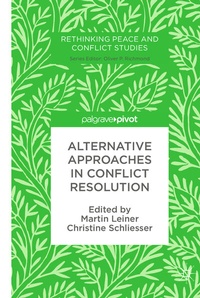
Alternative Approaches in Conflict Resolution
Description

This edited volume brings together alternative and innovative approaches in conflict resolution. With traditional military intervention repeatedly leading to the transformation of entire regions into zones of instability and violence (Afghanistan, Iraq, Libya, Syria), the study of alternative and less violent approaches to conflict resolution has become imperative. Four approaches are presented here: negotiation, religion and gender, reconciliation and forgiveness, and the arts. This volume contains the insights and experiences of fourteen internationally renowned scholars and practitioners from different contexts. Can forgiveness help heal relationships in post-apartheid South Africa? How can art assist dealing with 'unrememberable' events such as the genocide in Rwanda? What transformational resources do women offer in contexts of massive human rights violations? The aim here is twofold: to provide and encourage critical reflection of the approaches presented here and to explore concrete improvements in conflict resolution strategies. In its interdisciplinary and international outlook, this work combines the tried-and-tested approaches from conflict resolution experts in academia, NGOs and civil society, making it an invaluable tool for academics and practitioners alike.
More details
Other editions
Additional editions
Persons
Christine Schliesser is Academic Associate at the Institute for Social Ethics at Zurich University, Switzerland, and Junior Research Fellow at the Center for Religion, Economics and Politics at Basel University, Switzerland.
Content
Chapter 1: Introduction Martin Leiner and Christine Schliesser.- Chapter 2: Introduction to Negotiation Martin Leiner.- Chapter 3 Justice in Negotiations and Conflict Resolution Rudolf Schuessler.- Chapter 4: Beyond Official Negotiations: The Experience of the Community of Sant'Egidio Cesare Zucconi.- Chapter 5: Understanding 'Resistance' to Transitional Justice Julie Bernath, Adou Djane Dit Fatogoma, and Briony Jones.- Chapter 6: Introduction to Gender and Religion David P. Gushee.- Chapter 7: Made for Goodness? Women, Ethnic Conflict, and Reconciliation Carolina Rehrmann.- Chapter 8: Religious Dimensions in Conflict Transformation: A Tentative Approach Towards a Reconciliation Methodology Richard Friedli.- Chapter 9: A Critical Realist Engagement with Glen Stassen's 'Just Peacemaking' Approach David P. Gushee.- Chapter 10: Introduction to Reconciliation and Forgiveness Christine Schliesser.- Chapter 11: Forgiveness is 'The Wrong Word': Empathic Repair and the Potential for Human Connection in the Aftermath of Historical Trauma Pumla Gobodo-Madikizela.- Chapter 12: Alternative and Innovative Approaches to Reconciliation: A South African Perspective Christo Thesnaar.- Chapter 13: The Politics of Reconciliation in Post-Genocide Rwanda Christine Schliesser.- Chapter 14: Introduction to the Arts Mary Zournazi.- Chapter 15: Genocide, Memory, and the Arts: Memorial Projects in Rwanda of 'Upright Men' and 'The Garden of Memory' Bruce Clarke.- Chapter 16: A Notebook on Peace: Reflections on Cinema and Perception Mary Zournazi.- Chapter 17: Conclusion: From Conflict Resolution to Reconciliation Martin Leiner.
