

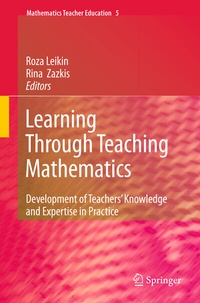
Learning Through Teaching Mathematics
Development of Teachers' Knowledge and Expertise in Practice
1st Edition
Published on 10. April 2010
XII, 300 pages
978-90-481-3990-3 (ISBN)
Description

The idea of teachers Learning through Teaching (LTT) - when presented to a naïve bystander - appears as an oxymoron. Are we not supposed to learn before we teach? After all, under the usual circumstances, learning is the task for those who are being taught, not of those who teach. However, this book is about the learning of teachers, not the learning of students. It is an ancient wisdom that the best way to "truly learn" something is to teach it to others. Nevertheless, once a teacher has taught a particular topic or concept and, consequently, "truly learned" it, what is left for this teacher to learn? As evident in this book, the experience of teaching presents teachers with an exciting opp- tunity for learning throughout their entire career. This means acquiring a "better" understanding of what is being taught, and, moreover, learning a variety of new things. What these new things may be and how they are learned is addressed in the collection of chapters in this volume. LTT is acknowledged by multiple researchers and mathematics educators. In the rst chapter, Leikin and Zazkis review literature that recognizes this phenomenon and stress that only a small number of studies attend systematically to LTT p- cesses. The authors in this volume purposefully analyze the teaching of mathematics as a source for teachers' own learning.
More details
Other editions
Additional editions
Roza Leikin | Rina Zazkis
Learning Through Teaching Mathematics
Development of Teachers' Knowledge and Expertise in Practice
Book
06/2010
Springer
€106.99
Shipment within 15-20 days
Content
Theoretical and Methodological Perspectives on Teachers' Learning through Teaching.- Teachers' Opportunities to Learn Mathematics Through Teaching.- Attention and Intention in Learning About Teaching Through Teaching.- How and What Might Teachers Learn Through Teaching Mathematics: Contributions to Closing an Unspoken Gap.- Learning Through Teaching Through the Lens of Multiple Solution Tasks.- Examples of Learning through teaching: Pedagogical mathematics.- What Have I Learned: Mathematical Insights and Pedagogical Implications.- Dialogical Education and Learning Mathematics Online from Teachers.- Role of Task and Technology in Provoking Teacher Change: A Case of Proofs and Proving in High School Algebra.- Learning Through Teaching, When Teaching Machines: Discursive Interaction Design in Sketchpad.- What Experienced Teachers Have Learned from Helping Students Think About Solving Equations in the One-Variable-First Algebra Curriculum.- Examples of Learning through teaching: Mathematical pedagogy.- Exploring Reform Ideas for Teaching Algebra: Analysis of Videotaped Episodes and of Conversations About Them.- On Rapid Professional Growth: Cases of Learning Through Teaching.- Interactions Between Teaching and Research: Developing Pedagogical Content Knowledge for Real Analysis.- Teachers Learning from Their Teaching: The Case of Communicative Practices.- Feedback: Expanding a Repertoire and Making Choices.
"What Changes in Teachers’ Knowledge Occur Through Teaching? (p. 13-14)
What Changed in Einat’s Knowledge?
The unpredicted turn that the lesson took in relation to the solution of Problem 2 nurtured Einat’s learning of mathematics. According to her plan, Problem 2 was aimed at performing calculations using the Pythagorean theorem. But when a student raised an unforeseen (general) question related to the length of the two paths (Fig. 1d), new mathematical connections were constructed: the paths within the rectangle could be compared using the properties of triangles with equal areas and a constant basis or using the properties of the ellipse.
When Einat moved the internal rectangle from the center of the external one, it became clear to her that the length of the two paths will be different “because the position of the internal rectangle is asymmetric.” This intuitive assumption appeared to be correct for the concrete situation presented in Problem 2, but it was incorrect as a general statement. Einat discovered that not all asymmetrical positions of the internal rectangle resulted in paths of different lengths.
When points E and F are on the ellipse, the paths are equal in length. Thus, an incorrect intuitive assumption was refuted, and incorrect intuitions were replaced with correct mathematical knowledge. The second critical point for Einat’s learning was her intuitive agreement with Opher’s conjecture, which was also refuted. Our additional observation is related to the interrelationship between Einat’s mathematical and pedagogical knowledge. It was her pedagogical sensitivity that encouraged her to formulate new problems that led to mathematical discoveries. At the same time her mathematical knowledge allowed her to evaluate the difficulty of the refutations she had produced, and (again) being attentive to her students she designed a new instructional activity using the Dynamic Geometry software. In sum, in this example, we recognize the development of knowledge in the transformation of intuition into formal knowledge and in the mutual support between pedagogical and subject matter knowledge.
Example 2: Learning from a Student’s Mistake: The Case of Lora
Lora, an experienced instructor in a course for pre-service elementary school teachers, taught a lesson on elementary number theory. The following interaction took place:
Lora: Is number 7 a divisor of K, where K = 34×56? Student: It will be, once you divide by it.
Lora: What do you mean, once you divide? Do you have to divide?
Student: When you go this [points to K] divided by 7 you have 7 as a divisor, this one the dividend, and what you get also has a name, like a product but not a product. . .
Lora’s intention in choosing this example was to alert students to the unique factorization of a composite number to its prime factors, as promised by the Fundamental Theorem of Arithmetic, and to the resulting fact, that no calculation is needed to determine the answer to her question. This later intention is evident in her probing question.
What Did Lora Learn from the Above Interaction? First, she learned that the term “divisor” is ambiguous, and that a distinction is essential between divisor of a number, as a relationship in a number-theoretic sense, and divisor in a number sentence, as a role played in a division situation. She learned further that the student assigned meaning based on his prior schooling and not on his recent classroom experience, in which the definition for “divisor” used in Number Theory was given and its usage illustrated. Before this incident, Lora used the term properly in both cases, but was not alert to a possible misinterpretation by learners. The student’s confusion helped her make the distinction, increased her awareness of the polysemy (different but related meanings) of the term divisor and of the definitions that can be conflicting. This resulted in developing a set of instructional activities in which the terminology is practiced (Zazkis, 1998)."
What Changed in Einat’s Knowledge?
The unpredicted turn that the lesson took in relation to the solution of Problem 2 nurtured Einat’s learning of mathematics. According to her plan, Problem 2 was aimed at performing calculations using the Pythagorean theorem. But when a student raised an unforeseen (general) question related to the length of the two paths (Fig. 1d), new mathematical connections were constructed: the paths within the rectangle could be compared using the properties of triangles with equal areas and a constant basis or using the properties of the ellipse.
When Einat moved the internal rectangle from the center of the external one, it became clear to her that the length of the two paths will be different “because the position of the internal rectangle is asymmetric.” This intuitive assumption appeared to be correct for the concrete situation presented in Problem 2, but it was incorrect as a general statement. Einat discovered that not all asymmetrical positions of the internal rectangle resulted in paths of different lengths.
When points E and F are on the ellipse, the paths are equal in length. Thus, an incorrect intuitive assumption was refuted, and incorrect intuitions were replaced with correct mathematical knowledge. The second critical point for Einat’s learning was her intuitive agreement with Opher’s conjecture, which was also refuted. Our additional observation is related to the interrelationship between Einat’s mathematical and pedagogical knowledge. It was her pedagogical sensitivity that encouraged her to formulate new problems that led to mathematical discoveries. At the same time her mathematical knowledge allowed her to evaluate the difficulty of the refutations she had produced, and (again) being attentive to her students she designed a new instructional activity using the Dynamic Geometry software. In sum, in this example, we recognize the development of knowledge in the transformation of intuition into formal knowledge and in the mutual support between pedagogical and subject matter knowledge.
Example 2: Learning from a Student’s Mistake: The Case of Lora
Lora, an experienced instructor in a course for pre-service elementary school teachers, taught a lesson on elementary number theory. The following interaction took place:
Lora: Is number 7 a divisor of K, where K = 34×56? Student: It will be, once you divide by it.
Lora: What do you mean, once you divide? Do you have to divide?
Student: When you go this [points to K] divided by 7 you have 7 as a divisor, this one the dividend, and what you get also has a name, like a product but not a product. . .
Lora’s intention in choosing this example was to alert students to the unique factorization of a composite number to its prime factors, as promised by the Fundamental Theorem of Arithmetic, and to the resulting fact, that no calculation is needed to determine the answer to her question. This later intention is evident in her probing question.
What Did Lora Learn from the Above Interaction? First, she learned that the term “divisor” is ambiguous, and that a distinction is essential between divisor of a number, as a relationship in a number-theoretic sense, and divisor in a number sentence, as a role played in a division situation. She learned further that the student assigned meaning based on his prior schooling and not on his recent classroom experience, in which the definition for “divisor” used in Number Theory was given and its usage illustrated. Before this incident, Lora used the term properly in both cases, but was not alert to a possible misinterpretation by learners. The student’s confusion helped her make the distinction, increased her awareness of the polysemy (different but related meanings) of the term divisor and of the definitions that can be conflicting. This resulted in developing a set of instructional activities in which the terminology is practiced (Zazkis, 1998)."
