

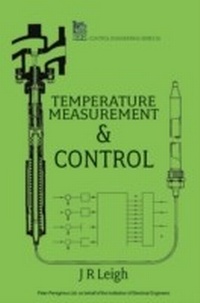
Temperature Measurement and Control
1st Edition
Published on 23. September 2011
208 pages
978-1-84919-336-8 (ISBN)
Description

The temperature on earth varies over a wide range whereas man can only work comfortably in a quite narrow temperature range that has to be artificially maintained. In addition, many industries have extensive requirements for temperature control. Thus control engineers are called upon very frequently to design temperature control loops.
A general knowledge of control engineering is of course useful in designing temperature control loops.However, temperature control has some special features:
(i) asymmetries caused by the usually differing mechanisms of heating and cooling
(ii) complex nonlinear heat-transfer effects
(iii) highly application-dependent measurement problems.
The intention of this book is to treat the theory and practice of temperature measurement and control, and important related topics such as energy management and air pollution, at a level suitable for engineering and science undergraduate and postgraduate students, and in a manner designed to make the book valuable to practising engineers. There are no specific prerequisites for the book although a knowledge of elementary control theory could be useful.
The philosophy of the book is a compromise between fundamentals and practical guidelines. It is the author's firm belief that it is highly desirable to obtain a good insight into theoretical fundamentals (deeper than can be justified on grounds of immediate utility) before embarking on practical applications. The aim has been to produce a practically oriented text within a firm theoretical outline.
The first half of the book is an application oriented survey of temperature measurement techniques and devices. The second half is concerned mainly with temperature control in both simple and complex situations. There are chapters on heat sources, commercially available controllers, temperature control in buildings and energy conservation. The book ends with an appendix that rapidly surveys the underpinning thermodynamic theory.
A general knowledge of control engineering is of course useful in designing temperature control loops.However, temperature control has some special features:
(i) asymmetries caused by the usually differing mechanisms of heating and cooling
(ii) complex nonlinear heat-transfer effects
(iii) highly application-dependent measurement problems.
The intention of this book is to treat the theory and practice of temperature measurement and control, and important related topics such as energy management and air pollution, at a level suitable for engineering and science undergraduate and postgraduate students, and in a manner designed to make the book valuable to practising engineers. There are no specific prerequisites for the book although a knowledge of elementary control theory could be useful.
The philosophy of the book is a compromise between fundamentals and practical guidelines. It is the author's firm belief that it is highly desirable to obtain a good insight into theoretical fundamentals (deeper than can be justified on grounds of immediate utility) before embarking on practical applications. The aim has been to produce a practically oriented text within a firm theoretical outline.
The first half of the book is an application oriented survey of temperature measurement techniques and devices. The second half is concerned mainly with temperature control in both simple and complex situations. There are chapters on heat sources, commercially available controllers, temperature control in buildings and energy conservation. The book ends with an appendix that rapidly surveys the underpinning thermodynamic theory.
More details
Series
Language
English
Place of publication
Stevenage
United Kingdom
Target group
College/higher education
Professional and scholarly
ISBN-13
978-1-84919-336-8 (9781849193368)
Copyright in bibliographic data and cover images is held by Nielsen Book Services Limited or by the publishers or by their respective licensors: all rights reserved.
Schweitzer Classification
Other editions
Additional editions
J.R. Leigh
Temperature Measurement and Control
Book
02/1988
Institution of Engineering and Technology
€115.50
Shipment within 3-4 weeks
Person
Professor Leigh was educated at Sheffield City Grammar School, Sheffield College of Technology (Freshgate Scholarship Prizewinner) and at Cambridge and London Universities, from which he holds higher degrees in both Control Engineering and Pure Mathematics. He has worked in both small and large industrial organisations on the development and application of control systems. His last industrial post was Head of Control Systems Research in the Corporate Engineering Laboratory of the British Steel Corporation. In his current appointment as Post Above Reader in the Polytechnic of Central London, he is concerned with control theory and with industrial control applications. These interests are supported by consultancy on novel control applications, particularly in the biotechnological field. He is an editorial adviser on process control to the journal 'Process Engineering'.
He has published or coauthored over 100 research papers and several books, including 'Essentials of nonlinear control theory', 'Applied control theory', 'Modelling and simulation' and 'Modelling and control of fermentation processes'.
He is active in both the London Biotechnology Centre and in the Institute of Biotechnological Studies of which he is an Honorary Associate. He is a Fellow of the Institution of Electrical Engineers, a Member of the Cambridge University Engineers' Association, a Fellow of the Institute of Mathematics and its Applications and a Member of the London Mathematical Society.
He has published or coauthored over 100 research papers and several books, including 'Essentials of nonlinear control theory', 'Applied control theory', 'Modelling and simulation' and 'Modelling and control of fermentation processes'.
He is active in both the London Biotechnology Centre and in the Institute of Biotechnological Studies of which he is an Honorary Associate. He is a Fellow of the Institution of Electrical Engineers, a Member of the Cambridge University Engineers' Association, a Fellow of the Institute of Mathematics and its Applications and a Member of the London Mathematical Society.
Content
Chapter 1: Definitions of temperature and heat
Chapter 2: Brief review of simple indicating thermometers for low-cost temperature measurement in the -30 degreesC to +400 degreesC range
Chapter 3: Thermocouples
Chapter 4: Resistance thermometers and thermistors
Chapter 5: Radiation thermometry
Chapter 6: New developments in temperature sensors
Chapter 7: Commonly arising industrial temperature-measurement problems
Chapter 8: Heat sources
Chapter 9: Heat sources: Non-combustion aspects
Chapter 10: Temperature control - 1: On-off control
Chapter 11: Temperature control - 2: Criteria and techniques for design of controllers for use with continuously variable actuators
Chapter 12: Temperature control - 3: Control of spatial temperature distribution
Chapter 13: Temperature control - 4: Some illustrative applications
Chapter 14: Commercially available temperature controllers
Chapter 15: Temperature control in buildings
Chapter 16: Energy conservation
Appendix: A review of some basic definitions and some thermodynamic fundamentals
Chapter 2: Brief review of simple indicating thermometers for low-cost temperature measurement in the -30 degreesC to +400 degreesC range
Chapter 3: Thermocouples
Chapter 4: Resistance thermometers and thermistors
Chapter 5: Radiation thermometry
Chapter 6: New developments in temperature sensors
Chapter 7: Commonly arising industrial temperature-measurement problems
Chapter 8: Heat sources
Chapter 9: Heat sources: Non-combustion aspects
Chapter 10: Temperature control - 1: On-off control
Chapter 11: Temperature control - 2: Criteria and techniques for design of controllers for use with continuously variable actuators
Chapter 12: Temperature control - 3: Control of spatial temperature distribution
Chapter 13: Temperature control - 4: Some illustrative applications
Chapter 14: Commercially available temperature controllers
Chapter 15: Temperature control in buildings
Chapter 16: Energy conservation
Appendix: A review of some basic definitions and some thermodynamic fundamentals
