

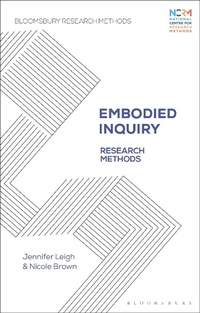
Embodied Inquiry
Research Methods
1st Edition
Published on 20. May 2021
144 pages
978-1-350-11879-9 (ISBN)
Description

Embodied inquiry is the process of using embodied approaches in order to study, explore or investigate a topic.
But what does it actually mean to be 'embodied'? This book explores why and how we use our bodies in order to research, what an embodied approach brings to a research project, and the kinds of considerations that need to be taken into account to research in this way.
We all have bodies, feelings, emotions and experiences that affect the questions we are interested in, the ways in which we choose to approach finding out the answers to those questions, and the patterns we see in the data we gather as a result. Embodied Inquiry foregrounds these questions of positionality and reflexivity in research. It considers how a project or study may be designed to take these into account and why multimodal and creative approaches to research may be used to capture embodied experiences. The book offers insights into how to analyse the types of data emerging from embodied inquiries, and the ethical considerations that are important to consider.
Accounting for the interdisciplinary nature of the field, this book has been written to be a concise primer into Embodied Inquiry for research students, scholars and practitioners alike.
But what does it actually mean to be 'embodied'? This book explores why and how we use our bodies in order to research, what an embodied approach brings to a research project, and the kinds of considerations that need to be taken into account to research in this way.
We all have bodies, feelings, emotions and experiences that affect the questions we are interested in, the ways in which we choose to approach finding out the answers to those questions, and the patterns we see in the data we gather as a result. Embodied Inquiry foregrounds these questions of positionality and reflexivity in research. It considers how a project or study may be designed to take these into account and why multimodal and creative approaches to research may be used to capture embodied experiences. The book offers insights into how to analyse the types of data emerging from embodied inquiries, and the ethical considerations that are important to consider.
Accounting for the interdisciplinary nature of the field, this book has been written to be a concise primer into Embodied Inquiry for research students, scholars and practitioners alike.
More details
Series
Edition
1. Auflage
Language
English
Place of publication
London
United Kingdom
Publishing group
Bloomsbury Publishing PLC
ISBN-13
978-1-350-11879-9 (9781350118799)
Copyright in bibliographic data and cover images is held by Nielsen Book Services Limited or by the publishers or by their respective licensors: all rights reserved.
Schweitzer Classification
Other editions
Additional editions
Book
06/2021
Bloomsbury Academic
€25.00
Shipment within 15-20 days
Persons
Jennifer Leigh is Senior Lecturer in Higher Education and Academic Practice at the Centre for the Study of Higher Education, University of Kent, UK.
Nicole Brown is Lecturer in Education at IOE, UCL's Faculty of Education and Society, University College London, UK, and Director of Social Research & Practice and Education Ltd.
Nicole Brown is Lecturer in Education at IOE, UCL's Faculty of Education and Society, University College London, UK, and Director of Social Research & Practice and Education Ltd.
Content
Series Editors Introduction
1. What is Embodied Inquiry?
2. An Overview of Embodied Inquiry
3. Designing for Embodied Inquiry
4. Data in Embodied Inquiry
5. Analysis in Embodied Inquiry
6. Issues and Challenges of Embodied Inquiry
7. Embodied Inquiry Now and in the Future
References
Index
1. What is Embodied Inquiry?
2. An Overview of Embodied Inquiry
3. Designing for Embodied Inquiry
4. Data in Embodied Inquiry
5. Analysis in Embodied Inquiry
6. Issues and Challenges of Embodied Inquiry
7. Embodied Inquiry Now and in the Future
References
Index
