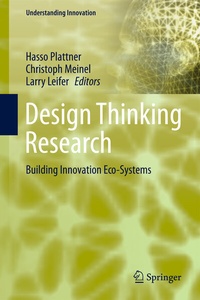
Design Thinking Research
Description

This book summarizes the results of Design Thinking Research carried out at Stanford University in Palo Alto, California, USA, and Hasso Plattner Institute in Potsdam, Germany.
The authors offer readers a closer look at Design Thinking with its processes of innovations and methods. The contents of the articles range from how to design ideas, methods, and technologies via creativity experiments and wicked problem solutions, to creative collaboration in the real world and the connectivity of designers and engineers. But the topics go beyond this in their detailed exploration of design thinking and its use in IT systems engineering fields and even from a management perspective.
The authors show how these methods and strategies work in companies, introduce new technologies and their functions and demonstrate how Design Thinking can influence as diverse a topic area as marriage. Furthermore, we see how special design thinking use functions in solving wicked problems in complex fields.
Thinking and creating innovations are basically and inherently human - so is Design Thinking. Due to this, Design Thinking is not only a factual matter or a result of special courses nor of being gifted or trained: it's a way of dealing with our environment and improving techniques, technologies and life.
Reviews / Votes
From the book reviews:
"The book is divided into four parts, each comprising three to five papers related to design thinking. Interestingly, the titles of all parts are full sentences, informing the reader of specific design thinking activities. . I would recommend it to engineers, managers, and designers for afternoon reading, as well as to scientists who want to grasp the virtues of engineering processes, which actual scientific discoveries may lead to." (Janusz Zalewski, Computing Reviews, July, 2014)More details
Other editions
Additional editions