

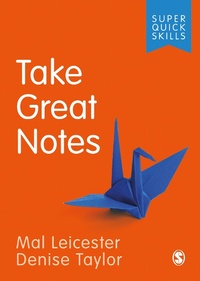
Take Great Notes
1st Edition
Published on 24. June 2019
124 pages
978-1-5297-0110-4 (ISBN)
Description

Whether you're in a lecture or the library, it's easy to get information overload. Take Great Notes helps you figure out which points matter most, and how to digest information efficiently and effectively.
Identify and set good notetaking habits
Take clear concise notes at every study session
Pick the best notetaking method to suit you
Use to improve your assignments right away.
Super Quick Skills provides the essential building blocks you need to succeed at university - fast. Packed with practical, positive advice on core academic and life skills, you'll discover focused tips and strategies to use straight away. Whether it's writing great essays, understanding referencing or managing your wellbeing, find out how to build good habits and progress your skills throughout your studies.
Learn core skills quickly
Apply them right away and see results
Succeed in your studies and in life
Super Quick Skills gives you the foundations you need to confidently navigate the ups and downs of university life.
Identify and set good notetaking habits
Take clear concise notes at every study session
Pick the best notetaking method to suit you
Use to improve your assignments right away.
Super Quick Skills provides the essential building blocks you need to succeed at university - fast. Packed with practical, positive advice on core academic and life skills, you'll discover focused tips and strategies to use straight away. Whether it's writing great essays, understanding referencing or managing your wellbeing, find out how to build good habits and progress your skills throughout your studies.
Learn core skills quickly
Apply them right away and see results
Succeed in your studies and in life
Super Quick Skills gives you the foundations you need to confidently navigate the ups and downs of university life.
Reviews / Votes
This book develops students' understanding of note taking. It is easy to read and engage with: it would be beneficial to students whom are enrolling onto university programmes as preparation material for their course. -- Alice Evans * Journal of Perioperative Practice * Packed with concise information to help students succeed at university. Whether you are an undergraduate student or undertaking a postgraduate programme, you will be able to find a book that will help you develop your study skills.Of the three books I reviewed [Take Great Notes, Find Your Source and Plan Your Essay], all of them were easy to read and follow, with each book providing a 60 second summary before moving onto more detail in each section and providing reasoning throughout. -- Julie Quick * Journal of Perioperative Practice *
More details
Series
Edition
1. Auflage
Language
English
Place of publication
London
United Kingdom
Publishing group
Sage Publications Ltd (Digital)
Target group
College/higher education
ISBN-13
978-1-5297-0110-4 (9781529701104)
Copyright in bibliographic data and cover images is held by Nielsen Book Services Limited or by the publishers or by their respective licensors: all rights reserved.
Schweitzer Classification
Other editions
Additional editions
Mal Leicester | Denise Taylor
Take Great Notes
Book
07/2019
1st Edition
SAGE Publications Ltd
€33.60
Shipment within 15-20 days
Persons
Mal Leicester is Emeritus Professor, University of Nottingham. Mal has taught English in schools, Liberal Studies in Further Education, and Philosophy of Education and Adult Education in universities. She has also been a local authority advisor for Multicultural Education and Director of an antiracist community organisation. Before her retirement, Mal was professor of adult teaching and learning at the University of Nottingham. Since her retirement Mal has written a memoir of her beloved daughter's remarkable life and death-Jane's Journey: a Medical Story of Survival and Hope. Dr Denise Taylor is an environmental and wildlife conservation professional with a focus on large carnivores, and in particular wild canids. She was awarded her PhD as a mature student in 2012 in the field of environmental education from the University of Nottingham. Denise has written books and papers on environmental education and canid conservation, and more recently has been involved in education projects on badger conservation in the UK. As an entrepreneur, Denise is the owner and managing director of Bridge PR & Media Services Limited, where she also delivers educational workshops on marketing strategy, and writing content for press and marketing.
Content
Why and What?
Chapter 1. Why should I take notes?
Chapter 2. What are good notes like?
Chapter 3. How do I take notes in a digital age?
Methods of Notetaking
Chapter 4. What is the Outline Method of notetaking?
Chapter 5. What is the Cornell (layout) Method?
Chapter 6. What is the Charting Method?
Chapter 7. What are Visual Methods of notetaking?
Chapter 8. What are Electronic Methods of notetaking?
Notetaking in Context
Chapter 9. How do I take notes of a lecture or lesson?
Chapter 10. How do I take notes from an article or book?
Chapter 1. Why should I take notes?
Chapter 2. What are good notes like?
Chapter 3. How do I take notes in a digital age?
Methods of Notetaking
Chapter 4. What is the Outline Method of notetaking?
Chapter 5. What is the Cornell (layout) Method?
Chapter 6. What is the Charting Method?
Chapter 7. What are Visual Methods of notetaking?
Chapter 8. What are Electronic Methods of notetaking?
Notetaking in Context
Chapter 9. How do I take notes of a lecture or lesson?
Chapter 10. How do I take notes from an article or book?
