

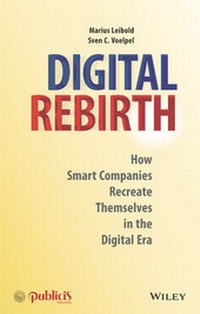
Digital Rebirth
Description

This book presents a clear framework for practical digital rebirth of companies, contrasting it to prevalent "digital transformation" approaches. Aimed at large and medium-sized companies, as well as their subcontractors and service providers, but also at budding entrepreneurs, it should be read and used by company boards, executives, managers, startup leaders and business consultants..
- In every section of the book you will find proven concepts of Digital Rebirth, digital reinvention, collaborative digital practices, combinatorial technologies, digital platforms, digital ecosystems and pointers how to move from obsolete mindsets and left-over baggage to reinvented digitalization minds and processes.
- It shows clearly how some major companies have digitally rebirthed themselves - or are in the process of it - to be or to become a leading player in the digital economy.
- Company (and industry) illustrations are accompanied by descriptions of Digital Rebirth approaches, methodologies and practical tools.
- The book's content is ideal for use in company workshops and executive sessions, as well as business leadership mindset sessions, and has been validated in such activities by the authors, including boards of highly renowned companies on all continents.
- At the end of the book, the unique approach of Digital Rebirth is condensed into a framework of five digital drivers, to assist in the right activities for purposeful and successful company rebirth.
The concept of Digital Rebirth shows clearly that, in the light of recent developments like Internet of Things, Artificial Intelligence, Industry 4.0 and Cloud-based Services, well-established traditional industry and competitive models are not any longer satisfactory to understanding and dealing with digital realities.
More details
Other editions
Additional editions
Persons
SVEN C. VOELPEL is an expert for excellence as Professor of Business Administration at the Jacobs University Bremen, Germany, as well as founding president of the WISE Group and the WDN - WISE Demographic Network. The author of many publications, incl. bestselling books and Harvard Business School case studies, has been serving with guest and honorary professorships at e.g. INSEAD, Tsinghua and St. Gallen as well as with Visiting Fellowships at Harvard University. He is well-experienced in executive workshops, listed among the top 100 entrepreneurs in German-speaking countries by Speakers Excellence, and an internationally renowned keynote speaker.
Content
- Cover
- Imprint
- Authors
- Contents
- Preamble: Why this Book? What is Really Different?
- What Do Leading Executives Say About the Need for Digital Rebirth?
- The 'Valley of Death' Curve: Beyond the Transformation Hype into Company Rebirth & New Life
- Chapter 1: Introduction: The Why of Digital Rebirth
- Chapter 2: What is Really Happening? How Digital Trends and Forces are Causing Digital Company Rebirth
- Chapter 3: The Right Mindsets and Right Questions about Digitalization
- Chapter 4: The Core of Digital Rebirth. Establishing a Company Digital Platform
- Chapter 5: The Widening of Digital Rebirth. From Industries into Ecosystems
- Chapter 6: The Deepening of Digital Rebirth. Using Cloud-based Technologies
- Chapter 7: Digital Rebirth Capabilities. Processes and People/Talent
- Chapter 8: Digital Leadership and Company Repurposing
- Chapter 9: Putting It All Together. The Five Drivers of Successful Digital Rebirth
- Chapter 10: Conclusion
- Endnotes
Chapter 1
Introduction: The Why of Digital Rebirth
"When we started out, we compared ourselves with emerging Fintechs and the startup world and concluded that we have to digitalize completely, not just by putting on digital lipstick." 11
- Piyush Gupta, CEO, DBS Bank, Singapore
The Digital Era is Prompting a Fundamental Change in How a Company Creates, Captures and Delivers Value
This book contends that Digital Rebirth, not mere digital transformation, is essential for company survival in the digital era. The reasons for this phenomenon are:
- Digitalization causes new ways of 'real-time' connectivity of people and organizations, with new types of consumer value being created, captured and delivered. This is entirely different from the traditional value creation processes, with its value chain 'control and ownership' of resources, including R&D;
- Digitalization is currently viewed as mainly an 'efficiency improvement' challenge-in terms of greater speed, agility and real-time customer engagement-and as a 'digitalizing our business model' issue-not as a radical new way of thinking and doing business, i.e. Digital Rebirth, as necessitated by the digital-connectivity era.
We clearly illustrate in this book that digitalization should not be seen as a technological add-on to existing business models, but that the digital era is changing the entire nature of companies-and also entire industries. In addition, it has profound impacts on leaders and all company employees. We describe and motivate in this book how companies can envision and implement Digital Rebirth, not merely digital transformation. We show how company executives are often misled by asking the wrong questions about digitalization, and we illustrate the right questions to ask. For example, a wrong question is "How do we create new value for our company in the digital economy?", while the right question is "How do we enable others to co-create value with our company, and for themselves, in the digital-networked economy?"
The myriad of new connective-intelligence is depicted for example in the 'smart city' concept (Figure 2) or in the concept of 'smart insurance'.
Figure 2 Smart concepts: smart city and smart insurance 12
Smart insurance means
- IoT-insurance-connected home, appliances, health industries, autos and buildings
- Systems of easy, agile engagement and feedback
- Enabling innovative insurance contracts and e-claims
- Artificial intelligence for 24/7 consumer experiences
- Cognitive insurance interfaces: AR, VR, Chatbots, insurance Big Data and smart analytics
- Consumer-insurance predictive behavior
- Innovative insurance revenue models
- Connected risk-reduction applications
The Digital Economy is Radically Different from the Industrial Economy
The digital economy is a network-intelligence economy, which understands that company outsiders-connected with own staff-are now collectively coming into a position of having more creativity, resources and innovation than only own (internal) company staff and resources. The leveraging of outsider and insider 'digital network effects' influence the nature, purpose, goals, processes and innovative capabilities of companies, as well as the growth and benefits for all stakeholders involved. In short, traditional companies and business models cannot just be 'digitally transformed', but have to be 'rebirthed' by establishing a reinvented purpose and basis, that effectively leverages the intelligence of consumers, suppliers, partners, distributors, research agencies and other stakeholders in real-time. The following vignette illustrates how the company Under Armour achieves this.
Under Armour Rebirths Itself into the World's Largest Digital Fitness Platform 13
Under Armour (UA) is often thought of as a sports apparel company, with particular products for athletes and other sport codes. Today, in a digital-connected era, this is incorrect. UA has become a platform for fitness communities around the world whose purpose it is to make all people fitter and healthier, in essence to change how people live to enable fitter and healthier communities and people. Under Armour now has more than 200 million registered users worldwide, and its community numbers continue to expand. It has gained direct relationships with these users, as well as hundreds of suppliers and service collaborators, all digitally connected and leveraged on its company platform. Kurt Kendall, a VP at UA, mentioned that when they started the company, physical products such as shirts, shoes, and other apparel were the sole focus. Currently, it is more about the digital platform from which many related products are branded through the company's ecosystem-connected digital orchestration of participants, including customers' innovative ideas.
After first putting a connected fitness platform in place, it began to incorporate fitness and apparel products into what is now called a digital experience, utilizing fitness products and services. For Under Armour, the shoe, shirt, cap, towel, and health vitamins are a result of its digital platform, which is used to enhance the overall user fitness experience. In a real sense, the physical product and the digital product are not distinguishable outside the company; inside the company, the purpose and focus are on a digitally-integrated user experience, which continually evolves and innovates through a myriad of digitalized networked interactions. Across all of its digital platforms globally, UA already enables more than 10 billion interactions a year, all focused on improving the user experience.
How does this approach differ from the current digital transformation initiatives of many companies? Most companies are still locked into a mindset of their existing business model, with target markets, products, and configured value chains, just adding digitalization as an efficiency mechanism. That is still a 'one-way pipeline' product orientation, with company at one end and customer at the other end. With UA's Digital Rebirth, there has been a clear move away from the mechanistic, one-way business model to a holistic, platform-driven network of value creation, value capture, and value delivery, using the orchestration of many participants' innovation power. If UA had gone for 'business model digitalization', it would have remained part of the traditional fitness 'industry' and its processes. Now it has opened up a dynamic new way of business activity, based on a wider purpose and platform that moves away from the 'fitness industry' towards enhancing the well-being and 'health ecosystem' of communities.
The larger issue here is that the world and its companies are moving from the industrial-value era to the digital-value era, which requires a new leadership mindset, besides new company capabilities and processes. In his recent book, 'World Order', Henry Kissinger argues that the world is at its greatest peril when the international order is moving from one system to another. "Traditional restraints disappear, and the field is open to the most expansive claims and the most implacable actors," he writes. "Chaos follows until a new system of stability is established." It is a sobering warning: although this statement is mentioned in political context, moving from an industrial era to a digital era means upheaval of traditional mechanistic, linear management practices to dynamic, non-linear, combined outside-inside connective processes, with new mindsets, guidelines and restraints. Those companies making sense of what is happening, and realizing that corporate rebirth is required-in mindsets and processes-will survive and prosper. However, mindsets take time to change, and it is little wonder that many executives are apprehensive, resistant and even confused in their approaches to digitalization.
Adopting Digital Technology, on Its Own, does Not Bring Real Digital Rebirth
We hear regularly how companies worldwide are excited about their digital transformation initiatives. Some are developing their own applications, digitizing their business models, analyzing and engaging with their customers' 'journeys', or executing a new digital commerce strategy. Others decide to deploy new 'Big Data' and 'Analytics' tools. The investment is often huge, and there seems to be always great hope for success, e.g. with digital 'hubs', 'accelerators' and 'startups'. Yet, they often fall short in their efforts, because the focus is typically on how technology will transform the traditional business model-not how the enterprise should digitally rebirth to fully embrace the digital innovation impact of technology.
All too often, traditional companies are focused on creating a type of digital 'façade' where it appears to be a digital experience for the customer, but, in reality, the traditional business model is merely transformed and not rebirthed. True Digital Rebirth requires that companies have to decisively change their mindsets, company purpose and organizational processes with a keen focus on collaborative outcomes, not just more efficient or agile infrastructure and technologies.
...