

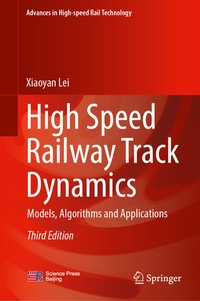
High Speed Railway Track Dynamics
Description

The third edition of this book systematically summarizes the latest research findings on high-speed railway track dynamics over the past decades, made by the author and his research team over the past decade. It explores cutting-edge issues concerning the basic theory of high-speed railways, covering the dynamic theories, models, algorithms and engineering applications of the high-speed train and track coupling system.
Presenting original concepts, systematic theories and advanced algorithms, the book places great emphasis on the precision and completeness of its content. The chapters are interrelated yet largely self-contained, allowing readers to either read through the book as a whole or focus on specific topics. It also combines theories with practice to effectively introduce readers to the latest research findings and developments in high-speed railway track dynamics. It offers a valuable resource for researchers, postgraduates and engineers in the fields of civil engineering, transportation, highway and railway engineering.
More details
Other editions
Additional editions
Previous edition
Person
Dr. Xiaoyan Lei is professor and director of Ministry of Education (MOE) Engineering Research Center of Railway Environmental Vibration and Noise, East China Jiaotong University, Nanchang, China. Prof. Lei was the president of East China Jiaotong University during 2007-2016. He received his M.E. degree from Shanghai Institute of Railway (now Tongji University) in 1984 and Ph.D. degree from Tsinghua University, Beijing in 1989. His research focuses on high-speed railway track dynamics, vibration and noise of rail transit environment, and the theory, test and design of high-speed railway track structure.
Content
Track Dynamics Research Contents and Related Standards-. Analytic Method for Dynamic Analysis of the Track Structure.- Fourier Transform Method for Dynamic Analysis of the Track Structure.- Analysis of Vibration Behavior of the Elevated Track Structure.- Track Irregularity Power Spectrum and Numerical Simulation.- Model for Vertical Dynamic Analysis of the Vehicle-Track Coupling System.- A Cross Iteration Algorithm for Vehicle-Track Nonlinear Coupling Vibration Analysis.- Moving Element Model and Its Algorithm.- Model and Algorithm for Track Element and Vehicle Element.- Dynamic Analysis of the Vehicle-Track Coupling System with Finite Elements in a Moving Frame of Reference.- Model for Vertical Dynamic Analysis of the Vehicle-Track-Subgrade-Ground Coupling System.- Analysis of dynamic behavior of the train-ballast track-subgrade coupling system.- Analysis of Dynamic Behavior of The Train-Slab Track-Subgrade Coupling System.- Analysis of dynamic behavior of the transition section between ballast track and ballastless track.- Analysis of Medium and High Frequency Vibration for Track Structures.- Dynamic Analysis of High-speed Train-Track Space Nonlinear Coupling System.
