

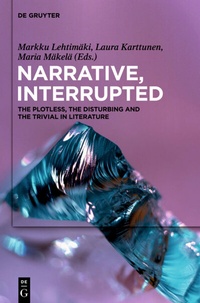
Narrative, Interrupted
Description

Recent postclassical narratology has constructed top-down reading models that often remain blind to the frame-breaking potential of individual literary narratives. Narrative, Interrupted goes beyond the macro framing typical of postclassical narratology and sets out to sketch approaches more sensitive to generic specificities, disturbing details and authorial interference. Unlike the mainstream cognitive approaches or even the emergent unnatural narratology, the articles collected here explore the artifice involved in presenting something ordinary and realistic in literature.
The first section of the book deals with anti-dynamic elements such as dialogue, details, private events and literary boredom. The second section, devoted to extensions of cognitive narratology, addresses spatiotemporal oddities and the possibility of non-human narratives. The third section focuses on frame-breaking, fragmentarity and problems of authorship in the works of Vladimir Nabokov. The book presents readings of texts ranging from the novels of Don DeLillo and Thomas Pynchon to the
Animal Man
comics. The common denominator for the texts discussed is the interruption of the chain of events or of the experiential flow of human-like narrative agents.
More details
Other editions
Additional editions
Persons
Content
2 - Part I: The Still Waters of Narrative: The Boring and the Plotless [Seite 17]
2.1 - Conversational and Authorial Disclosure in the Dialogue Novel: The Case of The Friends of Eddie Coyle [Seite 19]
2.2 - Resistance to Plot and Uneven Narrativity: A Journey from "A Boring Story" to The Rings of Saturn [Seite 40]
2.3 - What Happens When Nothing Happens: Interpreting Narrative Technique in the Plotless Novels of Nicholson Baker [Seite 58]
2.4 - Events Can Be Quoted (and Words Need Not Be) [Seite 73]
2.5 - Pynchon's Poetics of Boredom: Cognitive and Textual Aspects of Novelistic Dreariness [Seite 91]
3 - Part II: A Web of Sense: Interpreting the Disturbing and the Difficult [Seite 107]
3.1 - Toward a Zoonarratology: Storytelling and Species Difference in Animal Comics [Seite 109]
3.2 - Watching a Tree Grow: Terrence Malick's The New World and the Nature of Cinema [Seite 136]
3.3 - Navigating - Making Sense - Interpreting (The Reader behind La Jalousie) [Seite 155]
3.4 - History Impossible: Narrating and Motivating the Past [Seite 169]
3.5 - Unnatural Temporalities: Interfaces between Postmodernism, Science Fiction, and the Fantastic [Seite 190]
3.6 - The Imperfect Is Our Paradise: Intertextuality and Fragmentary Narration in Margaret Atwood's Alias Grace [Seite 208]
3.7 - Fragile Narrative Situations: Conrad Compared to Sebald [Seite 227]
4 - Part III: Shadow of a Tail: Problems of Authorship [Seite 241]
4.1 - Name Change and Author Avatars in Varlam Shalamov and Primo Levi [Seite 243]
4.2 - Stranger than Fiction, or, Jerome David Salinger, Author of Lolita: Real, Implied and Fictive Authorship [Seite 254]
4.3 - Translators, Scoundrels and Gentlemen of Honor: Problems of Nabokov's Loyalty [Seite 270]
4.4 - Affordances of Form in Stanzaic Narrative Poetry [Seite 292]
4.5 - A Shadow on the Marble [Seite 313]
5 - Index [Seite 337]
