

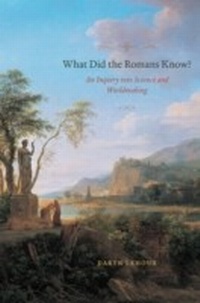
What Did the Romans Know?
An Inquiry into Science and Worldmaking
1st Edition
Published on 31. May 2024
289 pages
978-0-226-47115-0 (ISBN)
Description

What did the Romans know about their world? Quite a lot, as Daryn Lehoux makes clear in this fascinating and much-needed contribution to the history and philosophy of ancient science. Lehoux contends that even though many of the Romans' views about the natural world have no place in modern science-the umbrella-footed monsters and dog-headed people that roamed the earth and the stars that foretold human destinies-their claims turn out not to be so radically different from our own.
Lehoux draws upon a wide range of sources from what is unquestionably the most prolific period of ancient science, from the first century BC to the second century AD. He begins with Cicero's theologico-philosophical trilogy On the Nature of the Gods, On Divination, and On Fate, illustrating how Cicero's engagement with nature is closely related to his concerns in politics, religion, and law. Lehoux then guides readers through highly technical works by Galen and Ptolemy, as well as the more philosophically oriented physics and cosmologies of Lucretius, Plutarch, and Seneca, all the while exploring the complex interrelationships between the objects of scientific inquiry and the norms, processes, and structures of that inquiry. This includes not only the tools and methods the Romans used to investigate nature, but also the Romans' cultural, intellectual, political, and religious perspectives. Lehoux concludes by sketching a methodology that uses the historical material he has carefully explained to directly engage the philosophical questions of incommensurability, realism, and relativism.
By situating Roman arguments about the natural world in their larger philosophical, political, and rhetorical contexts, What Did the Romans Know? demonstrates that the Romans had sophisticated and novel approaches to nature, approaches that were empirically rigorous, philosophically rich, and epistemologically complex.
Lehoux draws upon a wide range of sources from what is unquestionably the most prolific period of ancient science, from the first century BC to the second century AD. He begins with Cicero's theologico-philosophical trilogy On the Nature of the Gods, On Divination, and On Fate, illustrating how Cicero's engagement with nature is closely related to his concerns in politics, religion, and law. Lehoux then guides readers through highly technical works by Galen and Ptolemy, as well as the more philosophically oriented physics and cosmologies of Lucretius, Plutarch, and Seneca, all the while exploring the complex interrelationships between the objects of scientific inquiry and the norms, processes, and structures of that inquiry. This includes not only the tools and methods the Romans used to investigate nature, but also the Romans' cultural, intellectual, political, and religious perspectives. Lehoux concludes by sketching a methodology that uses the historical material he has carefully explained to directly engage the philosophical questions of incommensurability, realism, and relativism.
By situating Roman arguments about the natural world in their larger philosophical, political, and rhetorical contexts, What Did the Romans Know? demonstrates that the Romans had sophisticated and novel approaches to nature, approaches that were empirically rigorous, philosophically rich, and epistemologically complex.
All prices
More details
Other editions
Additional editions
Book
02/2012
University of Chicago Press
€99.20
Article not available at the moment
Person
Daryn Lehoux is professor of classics at Queen's University in Kingston, Ontario. He is the author of Astronomy, Weather, and Calendars in the Ancient World.
Content
- Intro
- Contents
- Acknowledgments
- 1. The Web of Knowledge
- 2. Nature, Gods, and Governance
- 3. Law in Nature, Nature in Law
- 4. Epistemology and Judicial Rhetoric
- 5. The Embeddedness of Seeing
- 6. The Trouble with Taxa
- 7. The Long Reach of Ontology
- 8. Dreams of a Final Theory
- 9. Of Miracles and Mistaken Theories
- 10. Worlds Given, Worlds Made
- 11. Conclusion
- Appendix: Lemma to the Mirror Problem
- Reference List
- Index
