

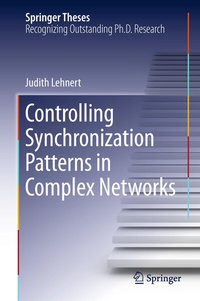
Controlling Synchronization Patterns in Complex Networks
Description

This research aims to achieve a fundamental understanding of synchronization and its interplay with the topology of complex networks. Synchronization is a ubiquitous phenomenon observed in different contexts in physics, chemistry, biology, medicine and engineering. Most prominently, synchronization takes place in the brain, where it is associated with several cognitive capacities but is - in abundance - a characteristic of neurological diseases. Besides zero-lag synchrony, group and cluster states are considered, enabling a description and study of complex synchronization patterns within the presented theory. Adaptive control methods are developed, which allow the control of synchronization in scenarios where parameters drift or are unknown. These methods are, therefore, of particular interest for experimental setups or technological applications. The theoretical framework is demonstrated on generic models, coupled chemical oscillators and several detailed examples of neural networks.
More details
Other editions
Additional editions
Person
Judith Lehnert studied physics at Humboldt Universität zu Berlin, Technische Universität Berlin, Germany, and the University of Leeds, UK. Her studies were supported by a scholarship for academic excellence of the German National Academic Foundation. She received her Diploma in 2010 for which she was awarded the Physics Study Award of the Wilhelm and Else Heraeus Foundation and the Clara von Simson Award. In 2010 and 2012, she visited St. Petersburg State University, Russia, supported by the German-Russian Interdisciplinary Science Center. Judith Lehnert received the Dr. rer. nat. degree from Technische Universität Berlin in 2015. Her research interests include nonlinear dynamics, complex networks, adaptive control, zero-lag and cluster synchronization, delay differential equations and neural dynamics.
