

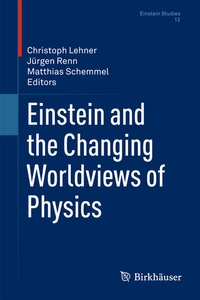
Einstein and the Changing Worldviews of Physics
Description

This volume reviews conceptual conflicts at the foundations of physics now and in the past century. The focus is on the conditions and consequences of Einstein's pathbreaking achievements that sealed the decline of the classical notions of space, time, radiation, and matter, and resulted in the theory of relativity. Particular attention is paid to the implications of conceptual conflicts for scientific views of the world at large, thus providing the basis for a comparison of the demise of the mechanical worldview at the turn of the 20 th century with the challenges presented by cosmology at the turn of the 21 st century.
Throughout the work, Einstein's contributions are not seen in isolation but instead set into the wider intellectual context of dealing with the problem of gravitation in the twilight of classical physics; the investigation of the historical development is carried out with a number of epistemological questions in mind, concerning, in particular, the transformation process of knowledge associated with the changing worldviews of physics.
The contributions explore various aspects of the emerging relativistic views in modern physics by giving an historical, philosophical, and mathematical account of Einstein's work, as well as the work of other distinguished physicists in the field. Taken as a whole, the book is focused on the interplay between mathematical concepts and physical ideas throughout history by studying today's scientific world and how it continues to redefine physics in the 21st century .
More details
Other editions
Additional editions
Content
Introduction.- Part I: At the Limits of the Classical Worldview.- Theories of Gravitation in the Twilight of Classical Physics.- The Newtonian Theory of Light Propagation.- Mach and Einstein, or, Clearing Troubled Waters in the History of Science.- Part II: Contexts of the Relativity Revolution.- Tilling the Seedbed of Einstein's Politics: A Pre-1905 Harbinger?.- The Early Reception of Einstein's Relativity among British Philosophers.- Science and Ideology in Einstein's Visit to South America in 1925.- The Reception of Einstein's Relativity Theories in Literature and the Arts (1920-1950).- Part III: The Emergence of the Relativistic Worldview.- Hilbert's Axiomatic Method and his "Foundations of Physics": Reconciling Causality with the Axiom of General Invariance.- Not Only Because of Theory: Dyson, Eddington and the Competing Myths of the 1919 Eclipse Expedition.- Peter Havas (1916-2004).- Peter Bergmann and the Invention of Constrained Hamiltonian Dynamics.- Thoughts About a Conceptual Framework for Relativistic Gravity.- Part IV: A New Worldview in the Making.- Observational Tests of General Relativity: An Historical Look at Measurements Prior to the Advent of Modern Space-Borne Instruments.- Primordial Magnetic Fields and Cosmic Microwave Background.- Singularity Theorems in General Relativity: Achievements and Open Questions.- The History and Present Status of Quantum Field Theory in Curved Spacetime.- The Border Between Relativity and Quantum Theory.- The Issue of the Beginning in Quantum Gravity.
