

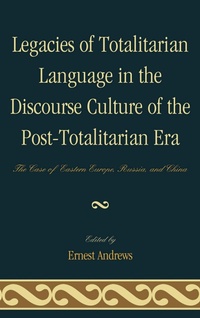
Legacies of Totalitarian Language in the Discourse Culture of the Post-Totalitarian Era
The Case of Eastern Europe, Russia, and China
Lexington Books (Publisher)
1st Edition
Published on 19. May 2011
230 pages
979-8-216-28533-5 (ISBN)
Description

This book is unique in its kind. It is the first scholarly work to attempt a comprehensive and fairly detailed look into the lingering legacies of the communist totalitarian modes of thought and expression in the new discourse forms of the post-totalitarian era. The book gives also new and interesting insights into the ways the new, presumably democratically-minded political elites in post-totalitarian Eastern Europe, Russia, and China manipulate language to serve their own political and economic agendas. The book consists of ten discrete discussions, nine case-studies or chapters and an introduction.
Chapter 1 discusses patterns of continuity and change in the conceptual apparatus and linguistic habits of political science and sociology practiced in the Czech Republic before and after 1989. Chapter 2 analyzes lingering effects of communist propaganda language in the political discourse and behavior in post-communist Poland. Chapter 3 analyzes the legacy of Soviet semantics in post-Soviet Moldovan politics through the prism of such politically contested words as "democracy," "democratization," and "people." Chapters 4 and 5 discuss the way in which communist patterns of thought and expression manifest themselves in the new political discourse in Romania and Bulgaria, respectively. Chapter 6 examines phenomena of change and continuity in the socio-linguistic and socio-political scene of post-Soviet Latvia. Chapter 7 analyzes the extent to which the language of the post-communist Romanian media differs from the official language of the communist era. Chapter 8 examines the evolution of Russian official discourse since the late eighties with a view of showing "whether or not new phenomena in the evolution of post-Soviet discourse represent new development or just a mutation of the value-orientations of the old Soviet ideological apparatus." Chapter 9 gives a detailed and lucid account of the evolution of both official and non-official discourse in China since the end of the Mao era.
Chapter 1 discusses patterns of continuity and change in the conceptual apparatus and linguistic habits of political science and sociology practiced in the Czech Republic before and after 1989. Chapter 2 analyzes lingering effects of communist propaganda language in the political discourse and behavior in post-communist Poland. Chapter 3 analyzes the legacy of Soviet semantics in post-Soviet Moldovan politics through the prism of such politically contested words as "democracy," "democratization," and "people." Chapters 4 and 5 discuss the way in which communist patterns of thought and expression manifest themselves in the new political discourse in Romania and Bulgaria, respectively. Chapter 6 examines phenomena of change and continuity in the socio-linguistic and socio-political scene of post-Soviet Latvia. Chapter 7 analyzes the extent to which the language of the post-communist Romanian media differs from the official language of the communist era. Chapter 8 examines the evolution of Russian official discourse since the late eighties with a view of showing "whether or not new phenomena in the evolution of post-Soviet discourse represent new development or just a mutation of the value-orientations of the old Soviet ideological apparatus." Chapter 9 gives a detailed and lucid account of the evolution of both official and non-official discourse in China since the end of the Mao era.
More details
Edition
1. Auflage
Language
English
Place of publication
United States
Publishing group
Bloomsbury Publishing Plc
Target group
Professional and scholarly
ISBN-13
979-8-216-28533-5 (9798216285335)
Copyright in bibliographic data and cover images is held by Nielsen Book Services Limited or by the publishers or by their respective licensors: all rights reserved.
Schweitzer Classification
Other editions
Additional editions
Ernest Andrews
Legacies of Totalitarian Language in the Discourse Culture of the Post-Totalitarian Era
The Case of Eastern Europe, Russia, and China
Book
05/2011
Lexington Books
€133.00
Shipment within 10-20 days
Persons
Ernest Andrews is a visiting scholar at the Russian-Eastern European Institute at Indiana University.
Content
Chapter 1 Introduction
Chapter 2 Chapter 1: The Absent Past: The Language of Czech Sociology Before and After 1989
Chapter 3 Chapter 2: The Linguistic Legacy of the Communist Propaganda in Post-Communist Thought Patterns: The Case of Poland
Chapter 4 Chapter 3: What Does Democracy Mean in Moldova? Political Discourse Around Contested Words in the Disputed Elections of 2009
Chapter 5 Chapter 4: The Language of Romanian Post-Communist Politics Twenty Years After: Linguistic Memories of a Communist Past
Chapter 6 Chapter 5: Newspeak in the Language of Politics in the Post-Totalitarian Era: The Case of Bulgaria
Chapter 7 Chapter 6: Intertwining Legacies: Language and Socio-Cultural Change in Post-Soviet Latvia
Chapter 8 Chapter 7: The Language of the Media in Post-Communist Romania:Changes and Continuities
Chapter 9 Chapter 8: Official Ideological Discourse in Pre-Transition and Post-Communist Russia: What Have Really Changed Since the Communist Period?
Chapter 10 Chapter 9: Language, State and Society in Post-Mao China: Continuity and Change
Chapter 2 Chapter 1: The Absent Past: The Language of Czech Sociology Before and After 1989
Chapter 3 Chapter 2: The Linguistic Legacy of the Communist Propaganda in Post-Communist Thought Patterns: The Case of Poland
Chapter 4 Chapter 3: What Does Democracy Mean in Moldova? Political Discourse Around Contested Words in the Disputed Elections of 2009
Chapter 5 Chapter 4: The Language of Romanian Post-Communist Politics Twenty Years After: Linguistic Memories of a Communist Past
Chapter 6 Chapter 5: Newspeak in the Language of Politics in the Post-Totalitarian Era: The Case of Bulgaria
Chapter 7 Chapter 6: Intertwining Legacies: Language and Socio-Cultural Change in Post-Soviet Latvia
Chapter 8 Chapter 7: The Language of the Media in Post-Communist Romania:Changes and Continuities
Chapter 9 Chapter 8: Official Ideological Discourse in Pre-Transition and Post-Communist Russia: What Have Really Changed Since the Communist Period?
Chapter 10 Chapter 9: Language, State and Society in Post-Mao China: Continuity and Change
