

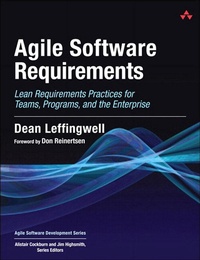
Agile Software Requirements
Lean Requirements Practices for Teams, Programs, and the Enterprise
1st Edition
Published on 27. December 2010
560 pages
978-0-321-68540-7 (ISBN)
Description

"We need better approaches to understanding and managing software requirements, and Dean provides them in this book. He draws ideas from three very useful intellectual pools: classical management practices, Agile methods, and lean product development. By combining the strengths of these three approaches, he has produced something that works better than any one in isolation."
-From the Foreword by Don Reinertsen, President of Reinertsen & Associates; author of Managing the Design Factory; and leading expert on rapid product development
Effective requirements discovery and analysis is a critical best practice for serious application development. Until now, however, requirements and Agile methods have rarely coexisted peacefully. For many enterprises considering Agile approaches, the absence of effective and scalable Agile requirements processes has been a showstopper for Agile adoption. In Agile Software Requirements, Dean Leffingwell shows exactly how to create effective requirements in Agile environments.
Part I presents the "big picture" of Agile requirements in the enterprise, and describes an overall process model for Agile requirements at the project team, program, and portfolio levels
Part II describes a simple and lightweight, yet comprehensive model that Agile project teams can use to manage requirements
Part III shows how to develop Agile requirements for complex systems that require the cooperation of multiple teams
Part IV guides enterprises in developing Agile requirements for ever-larger "systems of systems," application suites, and product portfolios
This book will help you leverage the benefits of Agile without sacrificing the value of effective requirements discovery and analysis. You'll find proven solutions you can apply right now-whether you're a software developer or tester, executive, project/program manager, architect, or team leader.
-From the Foreword by Don Reinertsen, President of Reinertsen & Associates; author of Managing the Design Factory; and leading expert on rapid product development
Effective requirements discovery and analysis is a critical best practice for serious application development. Until now, however, requirements and Agile methods have rarely coexisted peacefully. For many enterprises considering Agile approaches, the absence of effective and scalable Agile requirements processes has been a showstopper for Agile adoption. In Agile Software Requirements, Dean Leffingwell shows exactly how to create effective requirements in Agile environments.
Part I presents the "big picture" of Agile requirements in the enterprise, and describes an overall process model for Agile requirements at the project team, program, and portfolio levels
Part II describes a simple and lightweight, yet comprehensive model that Agile project teams can use to manage requirements
Part III shows how to develop Agile requirements for complex systems that require the cooperation of multiple teams
Part IV guides enterprises in developing Agile requirements for ever-larger "systems of systems," application suites, and product portfolios
This book will help you leverage the benefits of Agile without sacrificing the value of effective requirements discovery and analysis. You'll find proven solutions you can apply right now-whether you're a software developer or tester, executive, project/program manager, architect, or team leader.
More details
Edition
1. Auflage
Language
English
Place of publication
Hoboken
United States
Publishing group
Pearson Education (US)
Target group
College/higher education
File size
26,58 MB
ISBN-13
978-0-321-68540-7 (9780321685407)
Copyright in bibliographic data and cover images is held by Nielsen Book Services Limited or by the publishers or by their respective licensors: all rights reserved.
Schweitzer Classification
Other editions
Additional editions
Dean Leffingwell
Agile Software Requirements
Lean Requirements Practices for Teams, Programs, and the Enterprise
Book
02/2011
Addison Wesley
€54.00
Shipment within 10-20 days
Person
Dean Leffingwell, a thirty-year software industry veteran, has spent his career helping software teams achieve their goals. A renowned methodologist, author, coach, entrepreneur, and executive, he founded Requisite, Inc., makers of RequisitePro, and served as its CEO. As vice president at Rational Software (now part of IBM), he led the commercialization of the Rational Unified Process. As an independent consultant and as an advisor to Rally Software, he has helped entrepreneurial teams and large, distributed, multinational corporations implement Agile methods at scale. He is the author of Scaling Software Agility: Best Practices for Large Enterprises (Addison-Wesley, 2007) and is the lead author of Managing Software Requirements, Second Edition (Addison-Wesley, 2003), which has been translated into five languages.
Content
Chapter 1: A Brief History of Software Requirements Methods
Chapter 2: The Big Picture of Agile Requirements
Chapter 3: Agile Requirements for the Team
Chapter 4: Agile Requirements for the Program
Chapter 5: Agile Requirements for the Portfolio
Chapter 6: User Stories
Chapter 7: Stakeholders, User Personas, and User Experiences
Chapter 8: Agile Estimating and Velocity
Chapter 9: Iterating, Backlog, Throughput, and Kanban
Chapter 10: Acceptance Testing
Chapter 11: Role of the Product Owner
Chapter 12: Requirements Discovery Toolkit
Chapter 13: Vision, Features, and Roadmap
Chapter 14: Role of the Product Manager
Chapter 15: The Agile Release Train
Chapter 16: Release Planning
Chapter 17: Nonfunctional Requirements
Chapter 18: Requirements Analysis Toolkit
Chapter 19: Use Cases
Chapter 20: Agile Architecture
Chapter 21: Rearchitecting with Flow
Chapter 22: Moving to Agile Portfolio Management
Chapter 23: Investment Themes, Epics, and Portfolio Planning
Chapter 24: Conclusion
Appendix A: Context-Free Interview
Appendix B: Vision Document Template
Appendix C: Release Planning Readiness Checklist
Appendix D: Agile Requirements Enterprise Backlog Meta-model
Chapter 2: The Big Picture of Agile Requirements
Chapter 3: Agile Requirements for the Team
Chapter 4: Agile Requirements for the Program
Chapter 5: Agile Requirements for the Portfolio
Chapter 6: User Stories
Chapter 7: Stakeholders, User Personas, and User Experiences
Chapter 8: Agile Estimating and Velocity
Chapter 9: Iterating, Backlog, Throughput, and Kanban
Chapter 10: Acceptance Testing
Chapter 11: Role of the Product Owner
Chapter 12: Requirements Discovery Toolkit
Chapter 13: Vision, Features, and Roadmap
Chapter 14: Role of the Product Manager
Chapter 15: The Agile Release Train
Chapter 16: Release Planning
Chapter 17: Nonfunctional Requirements
Chapter 18: Requirements Analysis Toolkit
Chapter 19: Use Cases
Chapter 20: Agile Architecture
Chapter 21: Rearchitecting with Flow
Chapter 22: Moving to Agile Portfolio Management
Chapter 23: Investment Themes, Epics, and Portfolio Planning
Chapter 24: Conclusion
Appendix A: Context-Free Interview
Appendix B: Vision Document Template
Appendix C: Release Planning Readiness Checklist
Appendix D: Agile Requirements Enterprise Backlog Meta-model
