

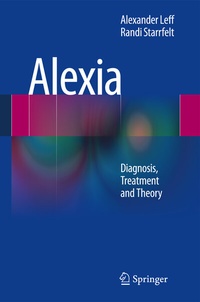
Alexia
Description

This book is a comprehensive review of the main acquired disorders of reading: hemianopic, pure and central alexia. The authors review the diagnostic criteria for each of the different types of disorder, and the efficacy of the therapeutic studies that have attempted to remediate them. The different theoretical models of adult reading, which largely rest on how the reading system responds to injury, are also discussed and evaluated. Focal brain injury caused by stroke and brain tumors are discussed in depth as are the effects of dementia on reading.
This book starts with a chapter on normal reading, followed by chapters on hemianopic alexia, pure alexia and central alexia, each structured in the same way, with: a description of the condition; a historical review of cases to date; psychophysics; consideration of the causative lesions; evidence from functional imaging studies on patients and, most importantly, a review of the evidence base for treating each condition. Finally, there is a chapter on how patient data has informed how we think about reading.
Alexia: Diagnosis, Treatment and Theory is aimed at neuropsychologists (both experimental and clinical), neurologists, speech therapists and others who deal with patients whose reading has been affected by an acquired brain injury, as well as interested students studying language disorders.
Reviews / Votes
From the reviews:
"The book covers various types of reading disorders, treatment recommendations, theoretical paradigms for models of adult reading, and possible causative lesions underlying these disorders. . There are numerous figures that help clarify the text. With its discussion of both theory and treatment, this is a useful book. It is a great resource for neuropsychologists, neurologists, reading specialists, and speech therapists." (Gary B. Kaniuk, Doody's Book Reviews, February, 2014)
More details
Other editions
Additional editions
Persons
Alex Leff, Reader in Cognitive Neurology and Honorary Consultant Neurologist, Institute of Neurology & National Hospital for Neurology and Neurosurgery, University College London, London, UK.
Alex's main clinical and academic interest is cognitive rehabilitation, especially in the field of acquired language disorders.
He sees his research role as continuing to develop mechanistic accounts of how acquired language disorders can be improved by different types of therapy, both pharmacological and behavioral. With an understanding of the neural mechanisms associated with recovery, he thinks that effective, rehabilitation-based interventions are more likely to be developed and translated into common clinical practice. He has an interest in acquired reading disorders and their rehabilitation and has developed several web-based rehabilitation tools to be used by therapists and patients. One (Read-Right) is for patients with hemianopic alexia. With his web-based projects he plans to make scientifically proven behavioral therapies available to suitable patients and their therapists.
Randi Starrfelt, Associate Professor in Neuropsychology, Department of Psychology, University of Copenhagen, Copenhagen, Denmark.
Randi's main clinical and academic interest is in acquired disorders of language and visual recognition.
In her research, she uses methods from experimental psychology and psychophysics to investigate neuropsychological deficits in reading and visual recognition. She is interested in reading in particular, as this is an acquired skill which is learned by instruction, and yet a skill that can be quite selectively affected by brain injury. She thinks that understanding the cerebral basis of reading and written word recognition, how it develops and how it can break down, can potentially inform us about the more general question of how learning can influence the functional organization of the brain.
Content
How do we read?.- Hemianopic alexia.- Pure alexia.- Central alexia.- Alexia theory and therapies: a heuristic.
