

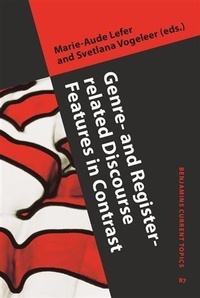
Genre- and Register-related Discourse Features in Contrast
1st Edition
Published on 20. July 2016
169 pages
978-90-272-6680-4 (ISBN)
Description

This volume contributes to filling a gap in corpus-based research by investigating the ways in which linguistic features vary across genres/registers cross-linguistically. It brings together insightful chapters by leading scholars in the field, fruitfully exploiting genre- or register-controlled multilingual parallel and comparable corpora to: (i) problematize cross-register variation in a multilingual perspective, (ii) address methodological and theoretical issues raised by register-oriented contrastive and translation studies, (iii) investigate the cross-linguistic and cross-genre variation of specific linguistic features, such as lexical bundles, sentence-initial adverbials and tag questions, (iv) identify cross-cultural and cross-linguistic dissimilarities in expressing a functional category, viz. Appraisal, in the field of opinion mining. The book offers new cutting-edge research that should be of interest to specialists in contrastive linguistics, translation studies and cross-cultural studies. Originally published as a special issue of Languages in Contrast 14:1 (2014).
More details
Other editions
Additional editions
Marie-Aude Lefer | Svetlana Vogeleer
Genre- and Register-related Discourse Features in Contrast
Book
07/2016
John Benjamins Publishing Co
€107.90
Shipment within 10-15 days
Content
- Intro
- Genre- and Register-related Discourse Features in Contrast
- Editorial page
- Title page
- LCC data
- Table of contents
- Introduction
- References
- Using multi-dimensional analysis to explore cross-linguistic universals of register variation
- 1. Introduction
- 2. Overview of methods for MD analysis
- 3. The oral/literate dimension in MD studies
- 4. Narrative dimensions in MD studies
- 5. Specialized dimensions in MD studies
- 6. Summary and conclusion
- References
- Cross-linguistic register studies
- 1. Introduction
- 2. Register in a theoretical perspective
- 3. Issues in contrastive comparison
- 4. Types of cross-linguistic studies involving register
- 5. Some exemplary corpus findings
- 5.1 The CroCo Corpus
- 5.2 A first approach to contrastive findings
- 5.3 Type 2: Contrastive comparison
- 5.4 Type 3: Contrastive studies of registers
- 5.5 Type 3: Translation-related register studies
- 6. Conclusions and outlook
- Acknowledgements
- References
- A lexical bundle approach to comparing languages
- 1. Introduction
- 2. Quantitative criteria for cross-linguistic bundle comparison
- 3. Data and methodology
- 3.1 Corpora: Two languages and two genres
- 3.2 Bundle selection criteria
- 4. Quantitative analysis
- 4.1 Across-language comparison: English vs. French
- 4.2 Across-genre comparison: parliamentary debates vs. editorials
- 5. Qualitative analysis
- 5.1 Keyness
- 5.1.1 Key stems in parliamentary debates
- 5.1.2 Key stems in editorials
- 5.2 Frequency distribution
- 6. Conclusion
- References
- Discourse-structuring functions of initial adverbials in English and Norwegian news and fiction
- 1. Introduction
- 2. Classification framework
- 3. Material and method
- 4. Discourse motivations for choosing initial position for English adjuncts
- 5. Corpus investigation
- 5.1 Overall frequencies
- 5.2 Semantic types of adjunct in initial position
- 5.3 Realization of initial adjuncts
- 6. Concluding remarks
- Acknowledgements
- References
- Appendix. Corpora used
- Canonical tag questions in English, Spanish and Portuguese
- 1. Introduction
- 2. The data and method
- 3. Discussion of findings
- 3.1 Frequencies
- 3.2 Formal features
- 3.3 Distribution across genres
- 3.4 Functional characteristics
- 4. Conclusions
- Acknowledgements
- References
- Loving and hating the movies in English, German and Spanish
- 1. Introduction
- 2. Appraisal in English and other languages
- 3. Corpus and methodology
- 3.1 Tri-lingual comparable corpus
- 3.2 Annotation methodology
- 4. Results
- 4.1 English
- 4.2 Graduation in English
- 4.3 German
- 4.4 Graduation in German
- 4.5 Spanish
- 4.6 Graduation in Spanish
- 5. Discussion and conclusions
- Acknowledgements
- References
- Index
