

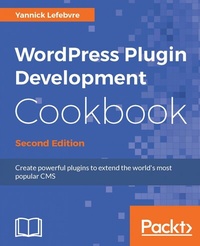
WordPress Plugin Development Cookbook
Create powerful plugins to extend the world's most popular CMS
2nd Edition
Published on 3. June 2024
386 pages
978-1-78829-949-7 (ISBN)
Description

Learn to create plugins for WordPress 4.x to deliver custom projects or share with the community through detailed step-by-step recipes and code examplesKey Features - [*]Learn how to change and extend WordPress to perform virtually any task
- [*]Explore the plugin API through approachable examples and detailed explanations
- [*]Mold WordPress to your project's needs or transform it to benefit the entire community
Book DescriptionWordPress is a popular, powerful, and open Content Management System. Learning how to extend its capabilities allows you to unleash its full potential, whether you're an administrator trying to find the right extension, a developer with a great idea to enhance the platform for the community, or a website developer working to fulfill a client's needs. This book shows readers how to navigate WordPress' vast set of API functions to create high-quality plugins with easy-to-configure administration interfaces. With new recipes and materials updated for the latest versions of WordPress 4.x, this second edition teaches you how to create plugins of varying complexity ranging from a few lines of code to complex extensions that provide intricate new capabilities. You'll start by using the basic mechanisms provided in WordPress to create plugins and execute custom user code. You will then see how to design administration panels, enhance the post editor with custom fields, store custom data, and modify site behavior based on the value of custom fields. You'll safely incorporate dynamic elements on web pages using scripting languages, and build new widgets that users will be able to add to WordPress sidebars and widget areas. By the end of this book, you will be able to create WordPress plugins to perform any task you can imagine. What you will learn - [*]Discover how to register user callbacks with WordPress, forming the basis of plugin creation
- [*]Explore the creation of administration pages and adding new content management sections through custom post types and custom database tables
- [*]Improve your plugins by customizing the post and page editors, categories and user profiles, and creating visitor-facing forms
- [*]Make your pages dynamic using Javascript, AJAX and adding new widgets to the platform
- [*]Learn how to add support for plugin translation and distribute your work to the WordPress community
Who this book is forIf you are a WordPress user, developer, or a site integrator with basic knowledge of PHP and an interest to create new plugins to address your personal needs, client needs, or share with the community, then this book is for you.
- [*]Explore the plugin API through approachable examples and detailed explanations
- [*]Mold WordPress to your project's needs or transform it to benefit the entire community
Book DescriptionWordPress is a popular, powerful, and open Content Management System. Learning how to extend its capabilities allows you to unleash its full potential, whether you're an administrator trying to find the right extension, a developer with a great idea to enhance the platform for the community, or a website developer working to fulfill a client's needs. This book shows readers how to navigate WordPress' vast set of API functions to create high-quality plugins with easy-to-configure administration interfaces. With new recipes and materials updated for the latest versions of WordPress 4.x, this second edition teaches you how to create plugins of varying complexity ranging from a few lines of code to complex extensions that provide intricate new capabilities. You'll start by using the basic mechanisms provided in WordPress to create plugins and execute custom user code. You will then see how to design administration panels, enhance the post editor with custom fields, store custom data, and modify site behavior based on the value of custom fields. You'll safely incorporate dynamic elements on web pages using scripting languages, and build new widgets that users will be able to add to WordPress sidebars and widget areas. By the end of this book, you will be able to create WordPress plugins to perform any task you can imagine. What you will learn - [*]Discover how to register user callbacks with WordPress, forming the basis of plugin creation
- [*]Explore the creation of administration pages and adding new content management sections through custom post types and custom database tables
- [*]Improve your plugins by customizing the post and page editors, categories and user profiles, and creating visitor-facing forms
- [*]Make your pages dynamic using Javascript, AJAX and adding new widgets to the platform
- [*]Learn how to add support for plugin translation and distribute your work to the WordPress community
Who this book is forIf you are a WordPress user, developer, or a site integrator with basic knowledge of PHP and an interest to create new plugins to address your personal needs, client needs, or share with the community, then this book is for you.
All prices
More details
Person
Lefebvre Yannick :
Yannick Lefebvre is a plugin developer who has created multiple plugins on the official WordPress repository. His first creation, Link Library, is used on thousands of sites worldwide. With a background in computer science, he wrote his first plugin in 2004 and quickly started sharing his creations with the community. He is actively involved in the Montreal WordPress community, has presented multiple times at WordCamp Montreal, and offers custom plugin development services. By day, Yannick works for CM Labs Simulations, a company providing software tools and simulators for vehicles and heavy equipment.
Yannick Lefebvre is a plugin developer who has created multiple plugins on the official WordPress repository. His first creation, Link Library, is used on thousands of sites worldwide. With a background in computer science, he wrote his first plugin in 2004 and quickly started sharing his creations with the community. He is actively involved in the Montreal WordPress community, has presented multiple times at WordCamp Montreal, and offers custom plugin development services. By day, Yannick works for CM Labs Simulations, a company providing software tools and simulators for vehicles and heavy equipment.
Content
Table of Contents - Preparing a Local Development Environment
- Plugin Framework Basics
- User Settings and Administration Pages
- The Power of Custom Post Types
- Customizing Post and Page Editors
- Accepting User Content Submission
- Customizing user data
- Creating Custom MySQL Database Tables
- Leveraging javascript, jQuery and AJAX scripts
- Adding New Widgets to WordPress' Library
- Enabling Plugin Internationalization
- Distributing your plugin on wordpress.org
- Plugin Framework Basics
- User Settings and Administration Pages
- The Power of Custom Post Types
- Customizing Post and Page Editors
- Accepting User Content Submission
- Customizing user data
- Creating Custom MySQL Database Tables
- Leveraging javascript, jQuery and AJAX scripts
- Adding New Widgets to WordPress' Library
- Enabling Plugin Internationalization
- Distributing your plugin on wordpress.org

