

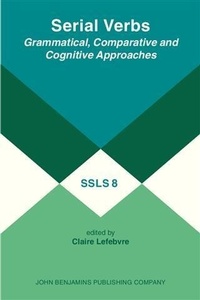
Serial Verbs
Grammatical, Comparative and Cognitive Approaches
1st Edition
Published on 9. August 1991
VIII, 210 pages
978-90-272-7764-0 (ISBN)
Description

The papers in this volume offer several analyses of verb serialization written within various theoretical frameworks: grammatical, comparative and cognitive/functional. They cover a wide range of language families. All authors address two basic questions about verb serialization: First, what is the structure and thematic constitution of the construction? The answers to this question cover the spectrum of the options that are available in current grammatical theory. Second, what aspect of the grammar differentiates between languages which have serial constructions and those which do not? The specific proposals made by the authors are discussed by R. Larson in the concluding paper. Larson opens new perspectives for research on verb serialization by posing the following question: what analogues for verb serialization can be found in the more familiar grammatical apparatus of English? It is suggested that verb serialization finds a clear parallel in the secondary predicate structures of English.
More details
Other editions
Additional editions
Book
08/1991
John Benjamins Publishing Co
€100.70
Shipment within 10-15 days
Content
- SERIAL VERBS: GRAMMATICAL, COMPARATIVE AND COGNITIVE APPROACHES
- Editorial page
- Title page
- Copyright page
- Table of contents
- Preface
- Misumalpan Verb Sequencing Constructions
- 0 Introduction
- 1 Misumalpan clause chaining
- 2 Complementation and the Misumalpan participiale
- 3 Misumalpan serial verb constructions
- 4 Speculations on the grammar of Misumalpan verb sequencing
- 5 Final remarks
- ABBREVIATIONS
- NOTES
- REFERENCES
- Take Serial Verb Constructions in Fon
- 0 Introduction
- 1 Overview of Take serial verb constructions in Fon
- 1.1 General characteristics of Take serial constructions
- 1.2 Syntactic characteristics of Take serial constructions
- 1.3 Previous studies
- 2 Theoretical framework
- 2.1 Lexical Conceptual Structures
- 2.2 The revised X' Theory and the Unique Complement Hypothesis
- 2.3 Revising the format of the Lexical Structure and of the Linking rules
- 2.4 Types of PAS in Fon
- 3 TAKE serial verb constructions
- 3.1 Lexical properties of TAKE verbs (closed class)
- 3.2 Lexical properties of verbs of the open class which combine with TAKE verbs.
- 3.3 The operation of Serialization
- 3.4 Predictions of the analysis
- 3.5 Syntactic projection of derived complex predicates
- 3.6 Functions of the Take-verb
- 3.7 Serialization is a lexical operation
- 3.8 Conclusion
- 4 Discussion: Aspects of variation between PASs among languages
- ABBREVIATIONS
- NOTES
- REFERENCES
- On the Relation of Serialization to Verb Extensions
- 1 Introduction: comparing Bantu with Kwa
- 2 Differences between Instruments and Datives
- 3 Serial Verbs
- 3.1 Object Sharing
- 3.2 SVCs with dative and instrumental verbs
- 4 Instruments and Datives in Bantu Applicatives
- 5 Conclusion
- ABBREVIATIONS
- NOTES
- REFERENCES
- On Deriving Serial Verb Constructions
- 1 Characteristics of SV languages
- 2 The Lexical Process
- 2.1 Two Alternatives in Lexicalization
- 2.2 How Properties in (1) Fall into Ps?
- 3 Interaction of Ps with Other Linguistic Principles / Parameters
- 3.1 Ps and X'-theory
- 3.2 Ps, X'-theory, and Theta-assignment
- 4 Causative Constructions
- 4.1 Decomposition of 'make'
- 4.2 English 'make
- 4.3 'Make' in Head-final Languages
- ABBREVIATIONS
- NOTES
- REFERENCES
- Some Substantive Issues Concerning Verb Serialization: Grammatical vs. Cognitive Packaging
- 1 The phenomenon
- 2 Theoretical issues : grammar vs. cognition
- 3 Empirical issues : grammar vs. behavior
- 4 Methodology
- 4.1 Languages
- 4.2 Text elicitation
- 4.3 Transcription of texts
- 4.4 Phonetic processing of tapes
- 4.5 Pause measurement
- 5 Results of quantitative analysis
- 5.1 Preamble
- 5.2 Tok Pisin
- 5.2.2. Quantitative results: Tok Pisin
- 5.2.2.1. On-Line text
- 5.2.2.2. Post-view text
- 5.3 Kalam
- 5.3.2. Quantitative results: Kalam
- 5.3.2.1. On-Line text
- 5.3.2.2. Post-view text
- 5.4 Tairora
- 5.4.2. Quantitative results: Tairora
- 5.4.2.1. On-Line text
- 5.4.2.2. Post-view text
- 6 Cross-language comparison
- 6.1 Serial-verb density
- 6.2 Pause distribution
- 6.3 The effect of the on-line text-elicitation technique on pause distribution
- 6.4 Adjacency to another verb-stem and the potential for co-lexicalization or co-grammaticalization
- 6.5 Adjacency to object or instrument nouns: potential for grammaticalization as case-markers
- 7 Some tentative conclusions
- 7.1 Empirical methodology
- 7.2 Grammar and culture: typological vs. cognitive variability
- 8 Possible extensions
- 8.1 Other types of verb serialization
- 8.2 The clause-type continuum
- 8.3 Gradual vs. instantaneous grammaticalization
- ABBREVIATIONS
- NOTES
- REFERENCES
- Some Issues in Verb Serialization
- 1 The Serialization Phenomenon
- 1.1 Serialization Structure and Licensing Principles
- 1.2 Serialization Parameters
- 2 Serialization and Secondary Predication
- 2.1 Interpretation
- 2.2 Structure
- 2.3 The Serialization Parameter Revisited
- ABBREVIATIONS
- NOTES
- REFERENCES
