

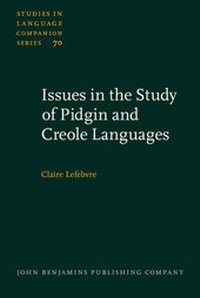
Issues in the Study of Pidgin and Creole Languages
1st Edition
Published on 26. February 2004
XVI, 358 pages
978-90-272-8185-2 (ISBN)
Description

The content of this book is concerned with various issues at stake in Creole studies that are also of interest for general linguistics. These include the general issue of Creole genesis and of the accelerated linguistic change that characterizes the emergence of these languages as compared to ordinary cases of linguistic change, the problem of the development of morphology in incipient Creoles, the problem of the validity of data in linguistic analysis, the issue of multifunctionality as regards the concept of lexical entry, the question of whether Creole languages are semantically more transparent than languages not known as Creoles, the issue of whether Creole languages constitute a typologically identifiable class and the problem of the interaction between the processes involved in the emergence and development of Creole languages. The purpose of this book is to present the major debates that are currently taking place in the field of Creole studies; evaluate the arguments against data (mainly drawn from Haitian Creole); and address the issues at stake within the framework of new paradigms. The various positions on each issue are summarized on the basis of a thorough review of the literature.
More details
Other editions
Additional editions
Claire Lefebvre
Issues in the Study of Pidgin and Creole Languages
Book
02/2004
John Benjamins Publishing Co
€104.94
Shipment within 10-15 days
Person
Content
- Issues in the Study of Pidgin and Creole Languages
- Editorial page
- Title page
- Copyright page
- Table of contents
- LIST OF TABLES
- PREFACE
- LIST OF ABBREVIATIONS
- CHAPTER 1. INTRODUCTION
- 1.1. The perspective of this book
- 1.2. Content of chapters
- 1.3. The use of the words pidgins and creoles
- CHAPTER 2. THE GENESIS OF PIDGIN AND CREOLE LANGUAGES A STATE OF THE ART
- 2.1. The complex problem of pidgin and creole genesis
- 2.2. Competing theories of pidgin and creole genesis whose object of study consists of language varieties
- 2.2.1 The theory of pidgins and creoles as reduced codes
- 2.2.2 The theory of creoles as 'nativised pidgins '
- 2.2.3 The theory of PCs as crystallised varieties of 'imperfect' second language acquisition
- 2.2.4 The theory of PCs as restructured varieties
- 2.2.5 The theory that creoles reflect the properties of Universal Grammar
- 2.2.6 Summary
- 2.3. Shifting the object of study from language varieties to processes involved in language creation and change
- 2.3.1 Relexification
- 2.3.2 Reanalysis and related phenomena
- 2.3.3 Dialect levelling
- 2.3.4 Summary
- 2.4. A unified theory of pidgin and creole genesis
- 2.4.1 Hypothesis and methodology of the UQAM projects
- 2.4.2 The interplay of the processes embedded within a scenario of creole genesis
- 2.4.3 An optimal account of creole genesis
- 2.4.4 Summary
- 2.5. Conclusion
- CHAPTER 3. THE RELEXIFICATION ACCOUNT OF CREOLE GENESIS THE CASE OF HAITIAN CREOLE
- 3.1. The relexification hypothesis of creole genesis
- 3.1.1 The process of relexification
- 3.1.2 The hypothesis
- 3.1.3 The interplay of relexification, reanalysis and dialect levelling in creole genesis and development
- 3.1.4 Word order
- 3.1.5 An optimal account of creole genesis
- 3.1.6 Summary
- 3.2. The test of the hypothesis
- 3.2.1 The historical research
- 3.2.2 The linguistic test
- 3.3. The lexicon
- 3.3.1 Lexical semantics
- 3.3.1.1 Simplex and compound nouns.
- 3.3.1.2 Pronouns.
- 3.3.1.2.1 Personal pronouns.
- 3.3.1.2.2 Possessive adjectives and pronouns.
- 3.3.1.2.3 Logophoric pronouns.
- 3.3.1.2.4 Expletives.
- 3.3.1.3 Reflexives.
- 3.3.1.4 Wh-words.
- 3.3.1.5 Verbs.
- 3.3.1.6 Summary.
- 3.3.2 The syntactic properties of verbs
- 3.3.2.1 Types of argument structures.
- 3.3.2.2 BODY-state verbs.
- 3.3.2.3 WEATHER verbs.
- 3.3.2.4 Reflexive verbs.
- 3.3.2.5 Verbs licensing expletive subjects.
- 3.3.2.6 Raising verbs.
- 3.3.2.7 Existential verbs.
- 3.3.2.8 Control verbs.
- 3.3.2.9 Light verbs.
- 3.3.2.10 Inherent object verbs.
- 3.3.2.11 The case-assigning properties of verbs.
- 3.3.2.12 Double-object verbs.
- 3.3.2.13 Summary.
- 3.3.3 Derivational affixes
- 3.3.4 Functional category lexical entries involved in nominal structure
- 3.3.4.1 The definite det
- 3.3.4.2 The plural marker.
- 3.3.4.3 The indefinite determiner.
- 3.3.4.4 The deictic terms.
- 3.3.4.5 Case markers within the noun phrase.
- 3.3.4.6 Summary.
- 3.3.5. Functional category lexical entries involved in clause structure
- 3.3.5.1 The tense, mood and aspect markers.
- 3.3.5.2 Complementisers and complementiser-like forms.
- 3.3.5.3 Complementisers or resumptives in the context of extracted subjects?
- 3.3.5.4 The nominal operator in relative and factive clauses.
- 3.3.5.5 Clausal conjunction.
- 3.3.5.6 The cleft marker.
- 3.3.5.7 Negation markers.
- 3.3.5.8 Markers expressing the speaker's point of view.
- 3.3.5.9 The determiner in the clause.
- 3.3.5.10 Summary.
- 3.4. Parameters
- 3.4.1 The null subject parameter
- 3.4.2 Verb raising
- 3.4.3 Serial verbs
- 3.4.4 The double-object construction
- 3.4.5 The interpretation of negative quantifiers
- 3.4.6 Verb-doubling phenomena
- 3.4.7 Summary
- 3.5. Conclusion and consequences
- CHAPTER 4. WHAT DO CREOLE STUDIES HAVE TO OFFER TO MAINSTREAM LINGUISTICS?
- 4.1. In what sense do creole studies constitute a field?
- 4.2. What do creole studies have to offer to linguistics?
- 4.3. What progress has been made between 1994 and 1999?
- 4.4. What drawbacks have been overcome?
- 4.4.1 The Tower of Babel
- 4.4.2 Isolating Atlantic creoles from Pacific creoles
- 4.4.3 Isolating the study of pidgin and creole languages from that of mixed languages
- 4.4.4 Setting issues outside the research paradigms of subdisciplines of linguistics
- 4.5. What have creole studies contributed so far and what lies ahead?
- CHAPTER 5. ON DATA
- 5.1. The non-neutral character of linguistic data
- 5.2. How to overcome the limits of particular types of databases
- 5.3. The problem of "inconsistencies" in elicited data
- 5.3.1 The problem of inconsistencies between speakers
- 5.3.2 The problem of inconsistencies within a given speaker
- 5.4. Native speakers as informants
- 5.5. Can data on a given language ever be complete?
- CHAPTER 6. MULTIFUNCTIONALITY AND THE CONCEPT OF LEXICAL ENTRY
- 6.1. Establishing the various functions of multifunctional lexical items
- 6.2. The range of multifunctional lexical items across syntactic categories
- 6.3. Multifunctionality, the monosemy principle and semantic under specification
- 6.4. Categorial under specification
- 6.4.1 Theoretical assumptions
- 6.4.2 The underspecification of major category lexical ite
- 6.4.3 The underspecification of functional category lexical items
- 6.5. An under specification account of Fongbe 'to say': verb and complementiser
- 6.6. On the relationship between multifunctionality and grammaticalis ation
- 6.7. Grammaticalisation and multifunctionality are not synonyms
- 6.8. Apparent cases of grammaticalisation in creole languages
- 6.9. The transfer of substratum multifunctional lexical items into a creole
- CHAPTER 7. ON THE SEMANTIC OPACITY OF CREOLE LANGUAGES
- 7.1. Lexicon
- 7.1.1 Lexical semantics
- 7.1.2 Idiomatic expressions
- 7.1.3 Paradigms of functional categories
- 7.1.4 Phonologically null forms
- 7.1.5 Multifunctionality or cases of categorial neutralisation
- 7.1.6 Summary
- 7.2. Morphology
- 7.2.1 Suffixes that refer to a place of origin
- 7.2.2 The prefix ti -
- 7.2.3 The prefix de-
- 7.2.4 Summary
- 7.3. Syntax: basic word order and movement rules
- 7.4. Interpretive facts
- 7.4.1 The inte rp retation of tense, mood and aspect
- 7.4.2 The interpretation of clauses involving argument alternations
- 7.4.3 Verb doubling phenomena
- 7.4.4 The interpretation of cleft constructions
- 7.4.5 Summary
- 7.5. Language specific versus language universal phenomena
- 7.6. Global evaluation of the Semantic Transparency Hypothesis
- CHAPTER 8. DO CREOLE LANGUAGES REALLY FORM A TYPOLOGICAL CLASS?
- 8.1. What is similar among creole languages?
- 8.2. Why do creole languages tend to be isolating?
- 8.3. Why do creole languages look simple?
- 8.4. Apparent simplicity and hidden complexity
- 8.5. McWhorter's list revisited
- 8.6. Conclusion
- CHAPTER 9. THE INTERPLAY OF RELEXIFICATION AND LEVELLING IN CREOLE GENESIS AND DEVELOPMENT
- 9.1. Relexification and levelling
- 9.2. The linguistic situation in Haiti at the time Haitian Creole was formed
- 9.3. Third person plural pronouns and plural markers
- 9.4. Reflexives
- 9.5. Demonstrative terms
- 9.5.1 The Haitian lexicon that has both sa and sila
- 9.5.2 The Haitian lexicon that has sa but not sila
- 9.5.3 Levelling
- 9.6. Conclusion
- CHAPTER 10. THE EMERGENCE OF PRODUCTIVE MORPHOLOGY IN CREOLE LANGUAGES THE CASE OF HAITIAN CREOLE
- 10.1. Identifying affixes that are potentially native to a creole language
- 10.2. Evaluating the productivity of the affixes identified as potentially native to HC
- 10.2.1 The agentive suffix -è
- 10.2.2 The attributive suffix -è
- 10.2.3 The verbalising suffix -e
- 10.2.4 Inversive and privative de-
- 10.2.5 The diminutive prefix ti-
- 10.2.6 The nominalising suffix -ay
- 10.2.7 Morphological conversion
- 10.2.8 The adverbial suffix -man
- 10.2.9 The place of origin/residence suffixes -wa and -yen
- 10.2.10 The ordinal suffix -yèm
- 10.2.11 Summary
- 10.3. Evaluating other proposals in the literature
- 10.3.1 The hypothesised inversive prefix en-
- 10.3.2 The hypothesised suffix -ét
- 10.3.3 The hypothesised nominalising suffix -man
- 10.3.4 The hypothesised agentive suffix -adó
- 10.3.5 Summary
- 10.4. The emergence of the morphological inventory of H C
- 10.4.1 The inventory of the productive derivational affixes of HC as compared with those of its contributing languages
- 10.4.2 The relexification account of the emergence of the HC morphological inventory
- 10.4.3 Summary
- 10.5. Conclusion: Issues on the morphology of creole languages in light of the HC data
- REFERENCES
- APPENDIX 1. A RESEARCH PROGRAMME ON PC GENESIS FOR THE 21ST CENTURY
- Comparative work
- The relative impact of relexification and reanalysis in PC genesis and development
- Dialect levelling
- APPENDIX 2. THE COMPOSITION OF THE HAITIAN LEXICON
- INDEX OF AUTHORS
- INDEX OF SUBJECTS
