

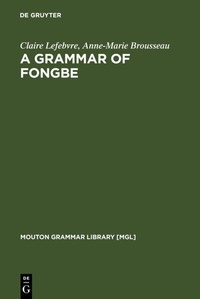
A Grammar of Fongbe
Description

This book is a reference grammar of Fongbe, a language which is part of the Gbe dialect cluster. It is spoken mainly in the former kingdom of Dahomey, which today comprises the southern areas of Benin and Togo. This book has three objectives: First, its main purpose is to provide a thorough description of the grammar of Fongbe. Second, this book provides language-specific syntactic tests which were developed in the course of this research. Finally, we provide the reader with the most exhaustive list possible of references on Fongbe, and on the Gbe languages in general. This book thus attempts to represent a "state of the art" of the language itself, and of the analyses proposed to account for its particular constructions. This book is of particular interest to Africanists, scholars interested in comparative linguistics or in the reconstruction of language families, and creolists who work on the languages spoken in the Caribbean area.
More details
Other editions
Additional editions
Persons
Content
- Intro
- Preface
- List of tables
- 1. Introduction
- 1.1. Fongbe
- 1.2. Aims and limitations of this book
- 1.3. Overview of the major features of the language
- 1.4. Sources of data on the language
- 1.5 Database
- 1.6 Mode of presentation of the data
- 1.7. List of abbreviations
- 2. Overview of the phonology
- 2.1. Segmental inventories
- 2.2. Syllable structures
- 2.3. Tones
- 2.4. Phonological processes
- 2.5. Summary
- 2.6. Orthographic conventions
- Part I Functional categories
- 3. Functional categories involved in the nominal structure
- 3.1. The definite determiner
- 3.2. The plural marker
- 3.3. The indefinite determiner
- 3.4. Bare NPs
- 3.5. Demonstrative determiners
- 3.6. Case markers
- 3.7. Other constituents occurring in the nominal structure
- 3.8. Can NPs be conjoined?
- 3.9. Conclusion
- 4. Pronominal forms
- 4.1. Personal pronouns
- 4.2. Pronominal clitics
- 4.3. Expletives
- 4.4. Possessive forms
- 4.5. Wh-words and Wh-phrases
- 4.6. The -d?éè anaphor
- 4.7. The logophoric pronoun émì
- 4.8. Conclusion
- 5. Tense, mood and aspect
- 5.1. The aspectual classes
- 5.2. The interpretation of bare sentences
- 5.3. Tense, mood and aspect markers
- 5.4. Complex tenses
- 5.5. Summary of tests used to distinguish between the four aspectual classes in Fongbe
- 5.6. The imperative constructions
- 5.7. Conclusion
- 6. Functional categories involved in the structure of the clause
- 6.1. Clausal conjunctions
- 6.2. Complementisers
- 6.3. The nominal operator d?é
- 6.4. Negation markers
- 6.5. Markers expressing the speaker's point of view with respect to the proposition
- 6.6. The form w? 'it is'
- 6.7. Conclusion
- 7. Clause structures
- 7.1. Copular structures
- 7.2. Complement clause structures
- 7.3. Clause structures involving Wh-movement
- 7.4. Factive clause structures
- 7.5. Causal adverbial clause structures
- 7.6. Temporal adverbial clause structures
- 7.7. Purposive clause structures
- 7.8. Conditional clause structures
- 7.9. Concessive clause structures
- 7.10. Conclusion
- Part II Lexical categories
- 8. Morphology
- 8.1. Theoretical assumptions
- 8.2. Inventory of affixes
- 8.3. Reduplication
- 8.4. Conclusion
- 9. Compounds
- 9.1. The lexical category of compounds
- 9.2. Tests to distinguish nominal compounds from nominal phrases
- 9.3. Typology of compound nouns
- 9.4. Semantic fields
- 9.5. Conclusion
- 10. Verbs
- 10.1. Basic characteristics of the semantics of the verbal lexicon
- 10.2. Types of argument structures
- 10.3. The unergative/unaccusative distinction
- 10.4. Argument alternations
- 10.5. The syntactic properties of verbs
- 10.6. Aspectual verbs
- 10.7. Modal verbs
- 10.8. Conclusion
- 11. Prepositions and postpositions
- 11.1. Prepositions
- 11.2. Postpositions
- 11.3. Do prepositions and postpositions constitute a uniform syntactic class?
- 11.4. Conclusion
- 12. Modifiers
- 12.1. Adjectives
- 12.2. Are there genuine adjectives that are colour terms?
- 12.3. Numerals
- 12.4. Quantifiers
- 12.5. Adverbs
- Part III The major syntactic constructions of the language
- 13. Serial verbs
- 13.1. Issues in the study of verb serialisation
- 13.2. Tests distinguishing between simple and sequential serial verb structures, and coordinate structures
- 13.3. The s?´lzé 'to take' serial verb construction
- 13.4. The h?n 'to hold/to carry' serial verb construction
- 13.5. The kplá 'to accompany' serial verb construction
- 13.6. Other verbs that may appear as the first verb of a series
- 13.7. Serial verb constructions involving (lì)l? 'to turn/to go around/to surround'
- 13.8. The d???' 'to say' serial verb construction
- 13.9. Other verbs which may participate in simple serial verb constructions
- 13.10. Other verbs which may participate in sequential serial verb constructions
- 13.11. The aspectual serial verb construction
- 13.12. The comparative serial verb construction
- 13.13. Are there 'too much' and 'enough' serial verb constructions?
- 13.14. Conclusion
- 14. The double object construction
- 14.1. The semantics of the Fongbe double object construction
- 14.2. Theme-goal asymmetries in the double object construction
- 14.3. The differential properties of the double object construction and the serial verb construction
- 14.4. The surface sequence NP PP in Fongbe
- 14.5. The range of verbs participating in the double object construction
- 14.6. Conclusion
- 15. The definite determiner in simple clauses
- 15.1. The definite determiner and the markers that give the speaker's point of view on the proposition
- 15.2. The clausal determiner as an event determiner
- 15.3. The constraint on the realisation of two consecutive determiners
- 15.4. Conclusion
- 16. The so-called verb-doubling phenomena
- 16.1. The problem of the categorial status of the copy
- 16.2. Does the copy project?
- 16.3. Can all types of predicates be involved in the four verb-doubling structures? The stage-level/individual-level distinction
- 16.4. The relationship between the copy and various types of objects
- 16.5. The interpretation of predicate cleft structures
- 16.6. Verb-doubling phenomena and the serial verb construction
- 16.7. Conclusion
- Appendices
- Appendix I: Swadesh list
- Appendix II: Text
- Appendix III: Additional data on d??´ introducing complements of verbs of the SAY-class
- Appendix IV: A sample of idiomatic verbal expressions
- References
- Indexe of authors
- Indexe of subjects
