

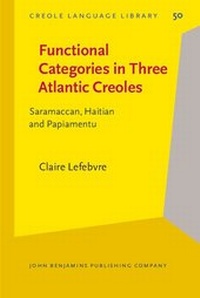
Functional Categories in Three Atlantic Creoles
Saramaccan, Haitian and Papiamentu
1st Edition
Published on 22. July 2015
XVII, 386 pages
978-90-272-6825-9 (ISBN)
Description

This book is about the functional categories of three Caribbean creoles: Saramaccan, Haitian Creole and Papiamentu with two specific goals. The first one is to evaluate the respective contribution of the source languages to the functional categories of these three creoles. The second is to evaluate the degree of similarity/dissimilarity of the functional categories across these creoles. This study is cast within the relabeling-based account of creole genesis. Several lexical items discussed in this book may fulfill more than one grammatical function thus raising the issue of multifuctionality. No such in-depth comparative work of these three creoles with their source languages and of the three creoles among themselves is available elsewhere in the literature. This book is addressed to linguists (including Master and PhD students) interested in syntactic categories and more specifically in functional categories, to creolists and to researchers interested in language contact.
More details
Other editions
Additional editions
Book
07/2015
John Benjamins Publishing Co
€111.30
Shipment within 10-15 days
Person
Content
- Functional Categories in Three Atlantic Creoles
- Editorial page
- Title page
- LCC data
- Dedication page
- Table of contents
- Preface
- List of abbreviations
- 1. Introduction
- 1. Aims of this book
- 2. A coherent set
- 3. General methodological considerations
- 4. Relabeling
- 5. How is word order established in creole genesis?
- 6. Processes that play a role in the development of a creole
- 7. The issue of multifunctionality
- 8. Organization of the book
- 9. Overview of the major findings
- 2. The nominal structures of Saramaccan, Fongbe and English with reference to Haitian Creole
- 1. Introduction
- 1.1 Aim of this chapter
- 1.2 Languages
- 1.3 Theoretical framework
- 1.4 Introduction to the nominal structures of the languages under comparison
- 1.5 A relabeling-based account of Creole genesis
- 1.6 Multifunctionality
- 1.7 Data base
- 1.8 Methodological provisos
- 1.9 Organisation of the chapter
- 2. The definite determiners
- 2.1 The anaphoric property of the definite determiners
- 2.2 The definite determiners in clause structures
- 2.2.1 The definite determiners in relative clauses
- 2.2.2 The definite determiners in factive clauses
- 2.2.3 The definite determiners in temporal and causal clauses
- 2.2.4 The definite determiners in simple clauses
- 2.2.5 The relationship between determiners and tense in clauses
- 2.2.6 Summary
- 2.3 A monosemic approach to Saramaccan dí
- 2.4 The source of the properties of the Saramaccan definite determiner
- 2.5 Conclusion
- 3. The expression and the properties of the category Number
- 3.1 The expression of the category Number and noun omission
- 3.2 The conceptual role of the category Number
- 3.3 The category Number and the third person plural personal pronoun
- 3.4 Are Saramaccan dí and déé part of the same paradigm?
- 3.5 How has the plural marker of Saramaccan acquired its properties?
- 3.6 Conclusion
- 4. Demonstrative terms
- 5. The expression of possession
- 5.1 The basic possessive structure
- 5.2 The grammatical status of the forms occurring in possessive structures
- 5.3 How have the various components of the Saramaccan possessive structure acquired their properties
- 6. Word order in nominal structures
- 7. Conclusion
- 3. Coordinating constructions in Fongbe with reference to Haitian Creole
- 1. Introduction
- 2. The conjunction b?
- 2.1 B?' as a coordinating conjunction
- 2.2 B?' as a complementizer
- 2.3 A unified analysis of b?
- 3. The conjunction bó
- 3.1 Bó as a coordinating conjunction
- 3.2 Bó as a complementizer
- 3.3 A unified account of bó
- 3.4 Does bó constitute a separate lexical entry from b?'?
- 4. The theoretical relevance of the properties of b?' and bó
- 4.1 On the marked character of and-then conjunctions
- 4.2 The disjoint/coreferential subjects distinction
- 4.3 From connective adverb to complementizer through conjunction of coordination
- 5. Can NPs be conjoined?
- 5.1 The kpó?ókpó 'withwith' circumposition
- 5.2 Fongbe and other with-type languages
- 6. Coordinating construction in Haitian Creole
- 6.1 The clausal conjunction epi
- 6.2 Can NPs be conjoined in Haitian Creole?
- 6.3 How did the properties of the Haitian lexical items get to be the way they are?
- 7. Concluding remarks: the typological features of Fongbe
- 4. The multifunctionality of Saramaccan táa
- 1. Introduction
- 2. The functions of Sa táa and táki
- 3. The source of the properties of Sa táa and táki
- 3.1 Sa táa and táki, and English talk
- 3.2 Sa táa and táki and Fongbe ??
- 3.3 Sa táa and táki and the lexical items meaning 'to say' in other Sa substrate languages
- 3.3.1 The multifunctionality of the lexical items meaning 'to say' in the substrate languages of Sa
- 3.3.2 The range of verbs meaning 'to say' and their properties in the Sa substrate languages
- 3.4 Summary
- 4. Early Sa data and the grammaticalization account of the relationship between táki and táa
- 4.1 The properties of 'say'-verbs and related items in early Sa
- 4.2 The grammaticalization account of the relationship between táki and táa
- 4.3 Recapitulation of the data to be accounted for
- 5. A relabeling account of the multifunctionality of Sa táa
- 5.1 The derivation of Sa táa and táki
- 5.2 The source of the phonological representation of táa and táki
- 5.3 Different superstrate labels for the same substrate lexical item
- 5.4 Summary
- 6. The parameters of relabeling and competing approaches to multifunctionality
- 6.1 The monosemy/polysemy debate over multifunctionality
- 6.2 Are the various approaches to multifunctionality equally compatible with the parameters defining
- 6.3 Summary
- 7. Conclusion
- 5. On the properties of Saramaccan fu
- 1. Introduction
- 2. The various functions of fu
- 2.1 Fu occurring as a preposition
- 2.1.1 Fu may select NPs
- 2.1.2 Fu may select purposive clauses
- 2.1.3 Summary
- 2.2 Fu occurring as a mood marker
- 2.2.1 Fu occurring between the subject and the verb
- 2.2.2 Fu occurring with modal verbs
- 2.2.3 Fu occurring before the subject
- 2.2.4 Summary
- 2.3 Fu occurring as a complementizer
- 2.4 Fu occurring as a case marker
- 2.5 Fu is a multifunctional lexical item
- 3. The source of the properties of fu
- 3.1 Review of available accounts
- 3.2 A three-way comparison: Sa fu and corresponding lexical entries in the Sa contributing languages
- 3.2.1 Sa fu and English for
- 3.2.2 Sa fu and Fongbe nú and ní
- 3.2.3 Summary
- 3.3 A relabeling account of the properties of Sa fu
- 3.4 Mismatches between the substrate and the creole lexical entries
- 3.4.1 The 'for this (reason)' discrepancy
- 3.4.2 The (non-)finite property of the purposive clause selected by Sa fu and Fongbe nú
- 3.4.3 A puzzling syntactic difference between Sa fu and Fongbe ní in their function as mood markers
- 3.4.4 The possibility of occurrence of mood markers as conditional clause introducers
- 3.4.5 An innovative function of fu?
- 3.4.6 Summary
- 4. Conclusion
- 6. The multiple facets of Papiamentu ku
- 1. Introduction
- 2. The functions of Pp ku, and the concept of lexical entry
- 2.1 The multifunctional character of ku
- 2.1.1 Ku as a preposition
- 2.1.2 Ku as a conjunction
- 2.1.3 Ku as a complementizer
- 2.1.4 Summary
- 2.2 How many lexical entries are required for ku?
- 2.3 Summary
- 3. The processes involved in the make up of Pp ku1
- 3.1 Relabeling
- 3.1.1 The superstrate language: Portuguese
- 3.1.2 The substrate languages
- 3.1.3 Relabeling
- 3.1.4 Phonological conflation
- 3.1.5 Summary
- 3.2 Leveling
- 3.3 Summary
- 4. The sources of the properties of Pp ku2
- 4.1 Comparison of the properties of Pp ku2 and those of the closest lexical items in the source lang
- 4.1.1 The [+T] indicative complementizer in Portuguese
- 4.1.2 The [+T] indicative complementizer in the Pp substrate languages
- 4.1.3 Summary
- 4.2 The sources of the properties of Pp ku2
- 4.2.1 The source of the semantic and syntactic properties of Pp ku2
- 4.2.2 The source of the phonological properties of Pp ku2
- 4.2.3 Summary
- 5. Conclusion
- 7. On the properties of Papiamentu pa
- 1. Introduction
- 2. The various functions of pa
- 2.1 Pa occurring as a preposition
- 2.1.1 Pa may select NPs
- 2.1.2 Pa may select purposive clauses
- 2.2 Pa occurring as a mood marker
- 2.3 Pa occurring as a complementizer
- 2.4 Pa occurring as a case marker?
- 2.5 Pa is a multifunctional lexical item
- 3. The source of the properties of pa: A three-way comparison
- 3.1 Pp pa and Portuguese para
- 3.2 Pp pa and Fongbe nú and ní
- 3.3 Summary
- 4. A relabeling account of the properties of Pp pa
- 5. Mismatches between the substrate and the creole lexical entries
- 5.1 The 'for this (reason)' discrepancy
- 5.2 The non-finite property of the purposive clause selected by Pp pa
- 5.3 A puzzling syntactic difference between Pp pa and Fongbe ní in their function as mood markers
- 5.4 Mood markers as conditional clause introducers
- 5.5 Pp pa and Fongbe nú as case markers
- 5.6 Summary
- 6. Conclusion
- 8. A new analysis of the Papiamentu clause structure
- 1. Introduction
- 2. Split CP
- 2.1 ForceP
- 2.1.1 The complementizer ku
- 2.1.2 The complementizer pa
- 2.1.3 The morphemes ku and pa head ForceP
- 2.2 TopicP and FocusP
- 2.3 FinP
- 2.4 Summary
- 3. Split INFL
- 3.1 The status of lo in FinP
- 3.2 The status of ta, tabata, a in TP and AspP
- 3.2.1 Tense contexts
- 3.2.2 Ta in gerundial clauses
- 3.2.3 Tense and Aspect
- 3.3 The status of pa in MoodP
- 3.4 Summary
- 4. Conclusion
- 9. The properties of functional categories in the three creoles
- 1. Introduction
- 2. Functional categories occurring in nominal structures
- 2.1 Definite determiners
- 2.2 Possessive phrases
- 2.3 Demonstrative terms
- 2.4 Plural markers
- 2.5 Summary
- 3. Coordination
- 4. Complementizers
- 4.1 Subjunctive complementizers
- 4.2 Indicative complementizers
- 4.3 Summary
- 5. The Tense, Mood and Aspect markers
- 6. Conclusion
- 10. Conclusion
- 1. Introduction
- 2. The similarity between the subsystems of functional categories of the three creoles
- 3. Relabeling
- 4. Other processes that play a role in establishing the properties of functional categories in the d
- 4.1 Grammaticalization
- 4.2 Leveling
- 5. Phenomena that are the result of some process(es)
- 5.1 Restructuring
- 5.2 Extension
- 6. Multifunctionality and the concept of lexical entry
- 7. Conclusion
- References
- Index of authors
- Index of subjects
