

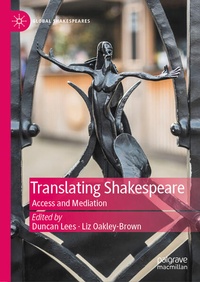
Translating Shakespeare
Description

This edited collection explores the mediation between languages, cultures and people that occurs when Shakespeare is translated - in multiple senses - and who is included and excluded in the process. It features contributions from emerging and established critical and creative writers, who offer analysis of a wide range of global cases, spanning Asia, Latin America and the Middle East, as well as Europe and North America. The collection covers numerous languages, both spoken and written (including Dutch, Mandarin, Spanish, Tamil and Welsh), and visual (American Sign Language), and their uses across various multimodal contexts, from page and stage to film dubbing, radio plays and Netflix shows, and from classrooms to refugee camps.
More details
Other editions
Additional editions
Persons
Duncan Lees is an Assistant Professor in Applied Linguistics at the University of Warwick, UK. His research and teaching combine drama pedagogy and intercultural language education with insights from Ethnomethodology / Conversation Analysis, as well as drawing upon the many years he spent working at a university in southern China. In addition to editing a special issue of the British Shakespeare Association's Teaching Shakespeare in 2020, Duncan's recent publications include work on Shakespeare Lives in China (the British Council's 2016 campaign to mark the 400th anniversary of Shakespeare's death), and on how 'active' Shakespeare pedagogy can be combined with intercultural language education.
Liz Oakley-Brown is Professor in English Literature at Lancaster University, UK. Her teaching and research focuses on fifteenth- and sixteenth-century writing in English. While her research interests are varied, Liz mainly works on the cultural politics of Tudor and Stuart translation, as well as on the topics of embodiment, emotions, Ovidian mythology, the premodern Gothic, and the developing area of surface studies. Her most recent Shakespeare-related publication is the book Shakespeare on the Ecological Surface (2024). In 2022, Liz was awarded the Dean's Award for Outstanding Contribution to Equality, Diversity & Inclusion (EDI).
Content
Chapter 1 - Translating Shakespeare: Access and Mediation.- Chapter 2 - At the Intersections of Disability Justice, Anti-Coloniality and the Violence of Translation: A Reading of Janani's Juliet.- Interlude from an Interview with Preti Taneja Translation: The Personal and the Political.- Chapter 3 - Translation And Translators: Race, Ethnicity and Othello in the Netherlands.- Chapter 4 - Translating (not-)Shakespeare as Intercultural Mediation: Teaching Fletcher's The Island Princess in China.- Chapter 5 - Falstaff in Spain: Intercultural Challenges and Translation Practices.- Chapter 6 - Theatrical Translation as Cannibalistic Practice: Transcreating Shakespeare in North-Eastern Brazil.- Interlude from an Interview with Preti Taneja - 2 Mediation: The Medium and the Message.- Chapter 7 - Prophetic Gestures: Sinister Sign Language in the Flock Theatre's Macbeth .- Chapter 8 - Shakespeare for Free: The Accessibility and Politics of Audio Shakespeare in Anglo-American Contexts.- Chapter 9 - Culture-Specific and Mass-Mediated Translation: Dubbing Trevor Nunn's Twelfth Night into Italian.- Chapter 10 - "Tywysog Cymru": Richard II , The Crown and Streaming Welsh-Anglo Translation.- Interlude from an Interview with Preti Taneja - 3 Access: Why Shakespeare?.- Chapter 11 - Domesticating Shakespeare within the Corpus of Northern Nigerian Literary Writings: A Pedagogical Experiment.
