

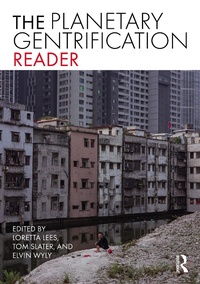
The Planetary Gentrification Reader
1st Edition
Published on 30. December 2022
426 pages
978-1-000-81615-0 (ISBN)
Description

Gentrification is a global process that the United Nations now sees as a human rights issue. This new Planetary Gentrification Reader follows on from the editors' 2010 volume, The Gentrification Reader, and provides a more longitudinal (backward and forward in time) and broader (turning away from Anglo-/Euro-American hegemony) sense of developments in gentrification studies over time and space, drawing on key readings that reflect the development of cutting-edge debates.
Revisiting new debates over the histories of gentrification, thinking through comparative urbanism on gentrification, considering new waves and types of gentrification, and giving much more focus to resistance to gentrification, this is a stellar collection of writings on this critical issue.
Like in their 2010 Reader, the editors, who are internationally renowned experts in the field, include insightful commentary and suggested further reading. The book is essential reading for students and researchers in urban studies, urban planning, human geography, sociology, and housing studies and for those seeking to fight this socially unjust process.
Revisiting new debates over the histories of gentrification, thinking through comparative urbanism on gentrification, considering new waves and types of gentrification, and giving much more focus to resistance to gentrification, this is a stellar collection of writings on this critical issue.
Like in their 2010 Reader, the editors, who are internationally renowned experts in the field, include insightful commentary and suggested further reading. The book is essential reading for students and researchers in urban studies, urban planning, human geography, sociology, and housing studies and for those seeking to fight this socially unjust process.
More details
Edition
1. Auflage
Language
English
Place of publication
London
United Kingdom
Publishing group
Taylor & Francis Ltd
Target group
College/higher education
Professional and scholarly
Illustrations
13 Tables, black and white; 17 Line drawings, black and white; 54 Halftones, black and white; 71 Illustrations, black and white
ISBN-13
978-1-000-81615-0 (9781000816150)
Copyright in bibliographic data and cover images is held by Nielsen Book Services Limited or by the publishers or by their respective licensors: all rights reserved.
Schweitzer Classification
Other editions
Additional editions
Loretta Lees | Tom Slater | Elvin Wyly
The Planetary Gentrification Reader
Book
12/2022
1st Edition
Routledge
€51.50
Shipment within 10-20 days
Loretta Lees | Tom Slater | Elvin Wyly
The Planetary Gentrification Reader
Book
12/2022
1st Edition
Routledge
€207.97
Shipment within 10-20 days
Persons
Loretta Lees is Director of the Initiative on Cities at Boston University, Boston, USA.
Tom Slater is Tom Slater is Professor of Urban Studies at Columbia University, New York City, USA.
Elvin Wyly is Professor of Geography at the University of British
Columbia, x?m??k??y??m (Musqueam) Territory, Vancouver, Canada.
Tom Slater is Tom Slater is Professor of Urban Studies at Columbia University, New York City, USA.
Elvin Wyly is Professor of Geography at the University of British
Columbia, x?m??k??y??m (Musqueam) Territory, Vancouver, Canada.
Content
Introduction
Part One Thinking bout gentrification today
Introduction to Part One
1. What time is gentrification?
Suileman Osman
2. Gentrification
Elvin Wyly
3. Beyond Anglo-American gentrification theory Hyun Bang Shin and Ernesto Lopez-Morales
4. Revisiting 'the changing stage of gentrification'
Manuel B. Aalbers
Part Two Planetary gentrification
Introduction to Part Two
5. Planetary rent gaps
Tom Slater
6. The discursive detachment of race from gentrification in Cartagena de Indias, Colombia
Melissa M. Valle
7. The fire this time: Grenfell, racial capitalism and the urbanisation of empire
Ida Danewid
8. In debt to the rent gap: Gentrification generalized and the frontier of the future
Hamish Kallin
Part Three Gentrification and comparative urbanism
Introduction to Part Three
9. The geography of gentrification: Thinking through comparative urbanism
Loretta Lees
10. Hybrid gentrification in South Africa: Theorising across southern and northern cities
Charlotte Lemanski
11. Comparative approaches to gentrification: Lessons from the rural
Martin Phillips and Darren P. Smith
12. Is comparative gentrification possible? Sceptical voices from Hong Kong
David Ley and Sin Yih Teo
Part Four Gentrification beyond Anglo-America
Introduction to Part Four
13. Prolonging the global age of gentrification: Johannesburg's regeneration policies
Tanja Winkler
14. Desakota and beyond: Neoliberal production of suburban space in Manila's fringe
Arnisson Andre C. Ortega
15. Socio-spatial legibility, discipline, and gentrification through favela upgrading in Rio de Janeiro
Thaisa Comelli, Isabelle Anguelovski, and Eric Chu
16. Housing transformation, rent gap and gentrification in Ghana's traditional houses: Insight from compound houses in Bantama, Kumasi
Lewis Abedi Asante and Richmond Juvenile Ehwi
Part Five Planetary gentrification and digital transformations
Introduction to Part Five
17. Holiday rentals: The new gentrification battlefront
Agustin Cocola-Gant
18. The impacts of Airbnb in Athens, Lisbon and Milan: A rent gap theory perspective
Alberto Amore, Cecilia de Bernardi and Pavlos Arvanitis
19. Platform-mediated short-term rentals and gentrification in Madrid
Alvaro Ardura Urquiaga, Inigo Lorente-Riverola and Javier Ruiz Sanchez
20. Postsocialism and the Tech Boom 2.0: Techno-utopics of racial/spatial dispossession
Erin McElroy
Part Six Resisting planetary gentrification
Introduction to Part Six
21. Resisting gentrification
Sandra Annunziata and Clara Rivas-Alonso
22. Resisting the politics of displacement in the San Francisco Bay Area: Anti-gentrification activism in the Tech Boom 2.0
Florian Opillard
23. A city for all? Public policy and resistance to gentrification in the southern neighborhoods of Buenos Aires
Maria Carla Rodriguez and Maria Mercedes Di Virgilio
24. When art meets monsters: Mapping art activism and anti-gentrification movements in Seoul
Seon Young Lee and Yoonai Han
Part One Thinking bout gentrification today
Introduction to Part One
1. What time is gentrification?
Suileman Osman
2. Gentrification
Elvin Wyly
3. Beyond Anglo-American gentrification theory Hyun Bang Shin and Ernesto Lopez-Morales
4. Revisiting 'the changing stage of gentrification'
Manuel B. Aalbers
Part Two Planetary gentrification
Introduction to Part Two
5. Planetary rent gaps
Tom Slater
6. The discursive detachment of race from gentrification in Cartagena de Indias, Colombia
Melissa M. Valle
7. The fire this time: Grenfell, racial capitalism and the urbanisation of empire
Ida Danewid
8. In debt to the rent gap: Gentrification generalized and the frontier of the future
Hamish Kallin
Part Three Gentrification and comparative urbanism
Introduction to Part Three
9. The geography of gentrification: Thinking through comparative urbanism
Loretta Lees
10. Hybrid gentrification in South Africa: Theorising across southern and northern cities
Charlotte Lemanski
11. Comparative approaches to gentrification: Lessons from the rural
Martin Phillips and Darren P. Smith
12. Is comparative gentrification possible? Sceptical voices from Hong Kong
David Ley and Sin Yih Teo
Part Four Gentrification beyond Anglo-America
Introduction to Part Four
13. Prolonging the global age of gentrification: Johannesburg's regeneration policies
Tanja Winkler
14. Desakota and beyond: Neoliberal production of suburban space in Manila's fringe
Arnisson Andre C. Ortega
15. Socio-spatial legibility, discipline, and gentrification through favela upgrading in Rio de Janeiro
Thaisa Comelli, Isabelle Anguelovski, and Eric Chu
16. Housing transformation, rent gap and gentrification in Ghana's traditional houses: Insight from compound houses in Bantama, Kumasi
Lewis Abedi Asante and Richmond Juvenile Ehwi
Part Five Planetary gentrification and digital transformations
Introduction to Part Five
17. Holiday rentals: The new gentrification battlefront
Agustin Cocola-Gant
18. The impacts of Airbnb in Athens, Lisbon and Milan: A rent gap theory perspective
Alberto Amore, Cecilia de Bernardi and Pavlos Arvanitis
19. Platform-mediated short-term rentals and gentrification in Madrid
Alvaro Ardura Urquiaga, Inigo Lorente-Riverola and Javier Ruiz Sanchez
20. Postsocialism and the Tech Boom 2.0: Techno-utopics of racial/spatial dispossession
Erin McElroy
Part Six Resisting planetary gentrification
Introduction to Part Six
21. Resisting gentrification
Sandra Annunziata and Clara Rivas-Alonso
22. Resisting the politics of displacement in the San Francisco Bay Area: Anti-gentrification activism in the Tech Boom 2.0
Florian Opillard
23. A city for all? Public policy and resistance to gentrification in the southern neighborhoods of Buenos Aires
Maria Carla Rodriguez and Maria Mercedes Di Virgilio
24. When art meets monsters: Mapping art activism and anti-gentrification movements in Seoul
Seon Young Lee and Yoonai Han
