

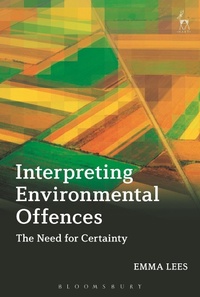
Interpreting Environmental Offences
The Need for Certainty
1st Edition
Published on 30. July 2015
264 pages
978-1-78225-911-4 (ISBN)
Description

This book analyses the interpretation of environmental offences contained in the waste, contaminated land, and habitats' protection regimes. It concludes that the current purposive approach to interpretation has produced an unacceptable degree of uncertainty. Such uncertainty threatens compliance with rule of law values, inhibits predictability, and therefore produces a scenario which is unacceptable to the wider legal and business community.
The author proposes that a primarily linguistic approach to interpretation of the relevant rules should be adopted. In so doing, the book analyses the appropriate judicial role in an area of high levels of scientific and administrative complexity. The book provides a framework for interpretation of these offences. The key elements that ought to be included in this framework-the language of the provision, the harm tackled as drafted, regulatory context, explanatory notes and preamble, and finally, purpose in a broader sense-are considered in this book. Through this framework, a solution to the certainty problem is provided.
The author proposes that a primarily linguistic approach to interpretation of the relevant rules should be adopted. In so doing, the book analyses the appropriate judicial role in an area of high levels of scientific and administrative complexity. The book provides a framework for interpretation of these offences. The key elements that ought to be included in this framework-the language of the provision, the harm tackled as drafted, regulatory context, explanatory notes and preamble, and finally, purpose in a broader sense-are considered in this book. Through this framework, a solution to the certainty problem is provided.
More details
Edition
1. Auflage
Language
English
Place of publication
London
United Kingdom
Publishing group
Bloomsbury Publishing PLC
Target group
College/higher education
ISBN-13
978-1-78225-911-4 (9781782259114)
Copyright in bibliographic data and cover images is held by Nielsen Book Services Limited or by the publishers or by their respective licensors: all rights reserved.
Schweitzer Classification
Other editions
Additional editions
Book
08/2017
Hart Publishing
€69.51
Shipment within 15-20 days
Book
05/2015
Hart Publishing
€141.13
Shipment within 15-20 days
Person
Emma Lees is a University Lecturer in Property and Environmental Law in the Department of Land Economy, University of Cambridge.
Content
1. Introduction
I. Structure
II. Motivation, Scope and Methodology
2. Environmental Criminal Law in Context
I. Property and Environmental Law
II. Human Rights and the Environment
III. Questions of Risk
IV. Jurisdictional Overlap-National Law and EU Law
V. Interpretation and Judicial Reasoning
VI. Criminal Law and Environmental Law
VII. Conclusion
3. Legal Certainty
I. Defining Legal Certainty
II. Transparency and Accessibility in National and European Case Law
III. Certainty in Environmental Law
IV. Conclusions
4. Waste, Nature Conservation and Contaminated Land: The Offences
I. Waste
II. Contaminated Land
III. Nature Conservation
5. Uncertainty in Interpretation
I. Uncertainty in Practice
II. The Teleological Approach in the Courts
6. Identification of the Cause of Uncertainty: The Regulatory Culture
I. Approach of the ECJ
II. Administrative Approach
III. The Ambiguous Role of the Courts
IV. Academic Approaches
V. Conclusions
7. The Solution: A Change in Approach to Interpretation
I. Linguistic Analysis
II. Mischief
III. Seeing the Rules as Part of a Framework
IV. Explanatory and Pre-Legislative Materials
V. Ambiguity-Aims as a Last Resort
VI. Conclusions
8. Practical Implementation of the Solution
I. Environmental Principles
II. Legal Barriers to Taking Such an Approach and Overcoming Them
III. Examples in Practice
9. Conclusions
I. Property/Environmental Law
II. Human Rights and the Environment
III. Question of Risk
IV. Jurisdictional Overlap
V. Interpretation and Legal Reasoning
VI. Environmental/Criminal Law
VII. Conclusion
I. Structure
II. Motivation, Scope and Methodology
2. Environmental Criminal Law in Context
I. Property and Environmental Law
II. Human Rights and the Environment
III. Questions of Risk
IV. Jurisdictional Overlap-National Law and EU Law
V. Interpretation and Judicial Reasoning
VI. Criminal Law and Environmental Law
VII. Conclusion
3. Legal Certainty
I. Defining Legal Certainty
II. Transparency and Accessibility in National and European Case Law
III. Certainty in Environmental Law
IV. Conclusions
4. Waste, Nature Conservation and Contaminated Land: The Offences
I. Waste
II. Contaminated Land
III. Nature Conservation
5. Uncertainty in Interpretation
I. Uncertainty in Practice
II. The Teleological Approach in the Courts
6. Identification of the Cause of Uncertainty: The Regulatory Culture
I. Approach of the ECJ
II. Administrative Approach
III. The Ambiguous Role of the Courts
IV. Academic Approaches
V. Conclusions
7. The Solution: A Change in Approach to Interpretation
I. Linguistic Analysis
II. Mischief
III. Seeing the Rules as Part of a Framework
IV. Explanatory and Pre-Legislative Materials
V. Ambiguity-Aims as a Last Resort
VI. Conclusions
8. Practical Implementation of the Solution
I. Environmental Principles
II. Legal Barriers to Taking Such an Approach and Overcoming Them
III. Examples in Practice
9. Conclusions
I. Property/Environmental Law
II. Human Rights and the Environment
III. Question of Risk
IV. Jurisdictional Overlap
V. Interpretation and Legal Reasoning
VI. Environmental/Criminal Law
VII. Conclusion
