

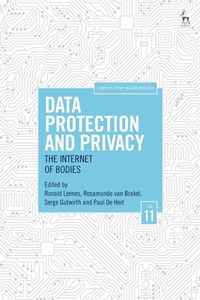
Data Protection and Privacy, Volume 11
The Internet of Bodies
1st Edition
Published on 13. December 2018
344 pages
978-1-5099-2621-3 (ISBN)
Description

The subjects of Privacy and Data Protection are more relevant than ever, and especially since 25 May 2018, when the European General Data Protection Regulation became enforceable.
This volume brings together papers that offer conceptual analyses, highlight issues, propose solutions, and discuss practices regarding privacy and data protection. It is one of the results of the eleventh annual International Conference on Computers, Privacy, and Data Protection, CPDP 2018, held in Brussels in January 2018.
The book explores the following topics: biometrics and data protection in criminal justice processing, privacy, discrimination and platforms for men who have sex with men, mitigation through data protection instruments of unfair inequalities as a result of machine learning, privacy and human-robot interaction in robotized healthcare, privacy-by-design, personal data protection of deceased data subjects, large-scale face databases and the GDPR, the new Europol regulation, rethinking trust in the Internet of Things, fines under the GDPR, data analytics and the GDPR, and the essence of the right to the protection of personal data.
This interdisciplinary book was written while the reality of the General Data Protection Regulation 2016/679 was becoming clear. It discusses open issues and daring and prospective approaches. It will serve as an insightful resource for readers with an interest in computers, privacy and data protection.
This volume brings together papers that offer conceptual analyses, highlight issues, propose solutions, and discuss practices regarding privacy and data protection. It is one of the results of the eleventh annual International Conference on Computers, Privacy, and Data Protection, CPDP 2018, held in Brussels in January 2018.
The book explores the following topics: biometrics and data protection in criminal justice processing, privacy, discrimination and platforms for men who have sex with men, mitigation through data protection instruments of unfair inequalities as a result of machine learning, privacy and human-robot interaction in robotized healthcare, privacy-by-design, personal data protection of deceased data subjects, large-scale face databases and the GDPR, the new Europol regulation, rethinking trust in the Internet of Things, fines under the GDPR, data analytics and the GDPR, and the essence of the right to the protection of personal data.
This interdisciplinary book was written while the reality of the General Data Protection Regulation 2016/679 was becoming clear. It discusses open issues and daring and prospective approaches. It will serve as an insightful resource for readers with an interest in computers, privacy and data protection.
More details
Series
Edition
1. Auflage
Language
English
Place of publication
London
United Kingdom
Publishing group
Bloomsbury Publishing PLC
Target group
College/higher education
ISBN-13
978-1-5099-2621-3 (9781509926213)
Copyright in bibliographic data and cover images is held by Nielsen Book Services Limited or by the publishers or by their respective licensors: all rights reserved.
Schweitzer Classification
Other editions
Additional editions
Ronald Leenes | Rosamunde van Brakel | Serge Gutwirth
Data Protection and Privacy, Volume 11
The Internet of Bodies
Book
11/2023
Hart Publishing
€47.50
Shipment within 15-20 days
Ronald Leenes | Rosamunde van Brakel | Serge Gutwirth
Data Protection and Privacy, Volume 11
The Internet of Bodies
Book
12/2018
Hart Publishing
€106.66
Shipment within 15-20 days
Persons
Ronald Leenes is Professor in regulation by technology at the Tilburg Institute for Law, Technology, and Society, Tilburg University.
Rosamunde van Brakel is a Postdoctoral Researcher at the Law, Science, Technology & Society Research Group, Vrije Universiteit Brussel.
Serge Gutwirth is Professor of Human Rights, Comparative Law, Legal Theory and Methodology at the Law, Science, Technology & Society Research Group, Vrije Universiteit Brussel.
Paul De Hert is Professor of Criminal Law and Co-Director of the Law, Science, Technology & Society Research Group, Vrije Universiteit Brussel and Associate-Professor at the Tilburg Institute for Law, Technology, and Society, Tilburg University.
Rosamunde van Brakel is a Postdoctoral Researcher at the Law, Science, Technology & Society Research Group, Vrije Universiteit Brussel.
Serge Gutwirth is Professor of Human Rights, Comparative Law, Legal Theory and Methodology at the Law, Science, Technology & Society Research Group, Vrije Universiteit Brussel.
Paul De Hert is Professor of Criminal Law and Co-Director of the Law, Science, Technology & Society Research Group, Vrije Universiteit Brussel and Associate-Professor at the Tilburg Institute for Law, Technology, and Society, Tilburg University.
Content
1. You've been Measured, You've been Weighed and You've been Found Suspicious: Biometrics and Data Protection in Criminal Justice Processing
Erik Zouave and Jessica Schroers
2. Grinding Privacy in the Internet of Bodies: An Empirical Qualitative Research on Dating Mobile Applications for Men Who Have Sex with Men
Guido Noto La Diega
3. How Machine Learning Generates Unfair Inequalities and How Data Protection Instruments May Help in Mitigating Them
Laurens Naudts
4. 'Nothing Comes between My Robot and Me': Privacy and Human-Robot Interaction in Robotised Healthcare
Eduard Fosch Villaronga, Heike Felzmann, Robin L. Pierce, Silvia de Conca, Aviva de Groot, Aida Ponce del Castillo and Scott Robbins
5. Navigating Law and Software Engineering Towards Privacy by Design: Stepping Stones for Bridging the Gap
Ivo Emanuilov, Kim Wuyts, Dimitri Van Landuyt, Natalie Bertels, Fanny Coudert, Peggy Valcke, and Wouter Joosen
6. R.I.P.: Rest in Privacy or Rest in (Quasi-)Property? Personal Data Protection of Deceased Data Subjects between Theoretical Scenarios and National Solutions
Gianclaudio Malgieri
7. Massive Facial Databases and the GDPR: Th e New Data Protection Rules Applicable to Research
Catherine Jasserand
8. Europol Regulation, US and Data Protection
Joanna Kulesza
9. Rethinking Trust in the Internet of Things
Georgy Ishmaev
10. Fines under the GDPR
Paul Nemitz
11. Data Analytics and the GDPR: Friends or Foes? A Call for a Dynamic Approach to Data Protection Law
Sophie Stalla-Bourdillon and Alison Knight
12. On Boundaries - Finding the Essence of the Right to the Protection of Personal Data
Maria Grazia Porcedda
13. CPDP 2018 - EDPS Side Event 26 January 2018 'Privacy by Design - Privacy Engineering'
Giovanni Buttarelli
Erik Zouave and Jessica Schroers
2. Grinding Privacy in the Internet of Bodies: An Empirical Qualitative Research on Dating Mobile Applications for Men Who Have Sex with Men
Guido Noto La Diega
3. How Machine Learning Generates Unfair Inequalities and How Data Protection Instruments May Help in Mitigating Them
Laurens Naudts
4. 'Nothing Comes between My Robot and Me': Privacy and Human-Robot Interaction in Robotised Healthcare
Eduard Fosch Villaronga, Heike Felzmann, Robin L. Pierce, Silvia de Conca, Aviva de Groot, Aida Ponce del Castillo and Scott Robbins
5. Navigating Law and Software Engineering Towards Privacy by Design: Stepping Stones for Bridging the Gap
Ivo Emanuilov, Kim Wuyts, Dimitri Van Landuyt, Natalie Bertels, Fanny Coudert, Peggy Valcke, and Wouter Joosen
6. R.I.P.: Rest in Privacy or Rest in (Quasi-)Property? Personal Data Protection of Deceased Data Subjects between Theoretical Scenarios and National Solutions
Gianclaudio Malgieri
7. Massive Facial Databases and the GDPR: Th e New Data Protection Rules Applicable to Research
Catherine Jasserand
8. Europol Regulation, US and Data Protection
Joanna Kulesza
9. Rethinking Trust in the Internet of Things
Georgy Ishmaev
10. Fines under the GDPR
Paul Nemitz
11. Data Analytics and the GDPR: Friends or Foes? A Call for a Dynamic Approach to Data Protection Law
Sophie Stalla-Bourdillon and Alison Knight
12. On Boundaries - Finding the Essence of the Right to the Protection of Personal Data
Maria Grazia Porcedda
13. CPDP 2018 - EDPS Side Event 26 January 2018 'Privacy by Design - Privacy Engineering'
Giovanni Buttarelli
