

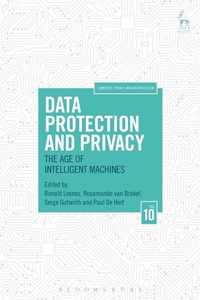
Data Protection and Privacy, Volume 10
The Age of Intelligent Machines
1st Edition
Published on 28. December 2017
256 pages
978-1-5099-1935-2 (ISBN)
Description

The subjects of Privacy and Data Protection are more relevant than ever with the European General Data Protection Regulation (GDPR) becoming enforceable in May 2018.
This volume brings together papers that offer conceptual analyses, highlight issues, propose solutions, and discuss practices regarding privacy and data protection. It is one of the results of the tenth annual International Conference on Computers, Privacy and Data Protection, CPDP 2017, held in Brussels in January 2017.
The book explores Directive 95/46/EU and the GDPR moving from a market framing to a 'treaty-base games frame', the GDPR requirements regarding machine learning, the need for transparency in automated decision-making systems to warrant against wrong decisions and protect privacy, the riskrevolution in EU data protection law, data security challenges of Industry 4.0, (new) types of data introduced in the GDPR, privacy design implications of conversational agents, and reasonable expectations of data protection in Intelligent Orthoses.
This interdisciplinary book was written while the implications of the General Data Protection Regulation 2016/679 were beginning to become clear. It discusses open issues, and daring and prospective approaches. It will serve as an insightful resource for readers with an interest in computers, privacy and data protection.
This volume brings together papers that offer conceptual analyses, highlight issues, propose solutions, and discuss practices regarding privacy and data protection. It is one of the results of the tenth annual International Conference on Computers, Privacy and Data Protection, CPDP 2017, held in Brussels in January 2017.
The book explores Directive 95/46/EU and the GDPR moving from a market framing to a 'treaty-base games frame', the GDPR requirements regarding machine learning, the need for transparency in automated decision-making systems to warrant against wrong decisions and protect privacy, the riskrevolution in EU data protection law, data security challenges of Industry 4.0, (new) types of data introduced in the GDPR, privacy design implications of conversational agents, and reasonable expectations of data protection in Intelligent Orthoses.
This interdisciplinary book was written while the implications of the General Data Protection Regulation 2016/679 were beginning to become clear. It discusses open issues, and daring and prospective approaches. It will serve as an insightful resource for readers with an interest in computers, privacy and data protection.
More details
Series
Edition
1. Auflage
Language
English
Place of publication
London
United Kingdom
Publishing group
Bloomsbury Publishing PLC
Target group
College/higher education
ISBN-13
978-1-5099-1935-2 (9781509919352)
Copyright in bibliographic data and cover images is held by Nielsen Book Services Limited or by the publishers or by their respective licensors: all rights reserved.
Schweitzer Classification
Other editions
Additional editions
Ronald Leenes | Rosamunde van Brakel | Serge Gutwirth
Data Protection and Privacy, Volume 10
The Age of Intelligent Machines
Book
04/2020
Hart Publishing
€54.65
Shipment within 15-20 days
Ronald Leenes | Rosamunde van Brakel | Serge Gutwirth
Data Protection and Privacy, Volume 10
The Age of Intelligent Machines
Book
12/2017
Hart Publishing
€100.47
Shipment within 15-20 days
Persons
Ronald Leenes is Professor of Regulation by Technology at the Tilburg Institute for Law, Technology, and Society, Tilburg University.
Rosamunde van Brakel is Researcher and Doctoral Candidate at the Law, Science, Technology & Society Research Group, Vrije Universiteit Brussel.
Serge Gutwirth is Professor of Human Rights, Comparative Law and Legal Theory and Co-Director of the Law, Science, Technology & Society Research Group, Vrije Universiteit Brussel.
Paul De Hert is full Professor and Co-Director of the Law, Science, Technology & Society Research Group and of the Brussel Privacy Hub, Vrije Universiteit Brussel; and Associated Professor at the Tilburg Institute for Law, Technology, and Society, Tilburg University.
Rosamunde van Brakel is Researcher and Doctoral Candidate at the Law, Science, Technology & Society Research Group, Vrije Universiteit Brussel.
Serge Gutwirth is Professor of Human Rights, Comparative Law and Legal Theory and Co-Director of the Law, Science, Technology & Society Research Group, Vrije Universiteit Brussel.
Paul De Hert is full Professor and Co-Director of the Law, Science, Technology & Society Research Group and of the Brussel Privacy Hub, Vrije Universiteit Brussel; and Associated Professor at the Tilburg Institute for Law, Technology, and Society, Tilburg University.
Content
1. EU Data Protection and 'Treaty-base Games': When Fundamental Rights are Wearing Market-making Clothes
Laima Janciute
2. The 'Risk Revolution' in EU Data Protection Law: We can't Have Our Cake and Eat it, Too
Claudia Quelle
3. No Privacy without Transparency
Roger Taylor
4. Machine Learning with Personal Data
Dimitra Kamarinou, Christopher Millard and Jatinder Singh
5. Bridging Policy, Regulation and Practice? A Techno-Legal Analysis of Three Types of Data in the GDPR
Runshan Hu, Sophie Stalla-Bourdillon, Mu Yang, Valeria Schiavoand Vladimiro Sassone
6. Are We Prepared for the 4th Industrial Revolution? Data Protection and Data Security Challenges of Industry 4.0 in the EU Context
Carolin Moeller
7. Reasonable Expectations of Data Protection in Telerehabilitation-A Legal and Anthropological Perspective on Intelligent Orthoses
Martina Klausner and Sebastian Golla
8. Considering the Privacy Design Issues Arising from Conversation as Platform
Ewa Luger and Gilad Rosner
9. Concluding remarks at the 10th Computers, Privacy and Data Protection Conference: 27 January 2017
Giovanni Buttarelli
Laima Janciute
2. The 'Risk Revolution' in EU Data Protection Law: We can't Have Our Cake and Eat it, Too
Claudia Quelle
3. No Privacy without Transparency
Roger Taylor
4. Machine Learning with Personal Data
Dimitra Kamarinou, Christopher Millard and Jatinder Singh
5. Bridging Policy, Regulation and Practice? A Techno-Legal Analysis of Three Types of Data in the GDPR
Runshan Hu, Sophie Stalla-Bourdillon, Mu Yang, Valeria Schiavoand Vladimiro Sassone
6. Are We Prepared for the 4th Industrial Revolution? Data Protection and Data Security Challenges of Industry 4.0 in the EU Context
Carolin Moeller
7. Reasonable Expectations of Data Protection in Telerehabilitation-A Legal and Anthropological Perspective on Intelligent Orthoses
Martina Klausner and Sebastian Golla
8. Considering the Privacy Design Issues Arising from Conversation as Platform
Ewa Luger and Gilad Rosner
9. Concluding remarks at the 10th Computers, Privacy and Data Protection Conference: 27 January 2017
Giovanni Buttarelli
