

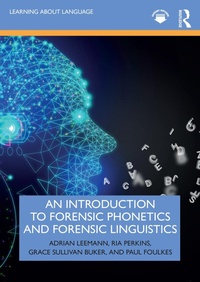
An Introduction to Forensic Phonetics and Forensic Linguistics
1st Edition
Published on 17. December 2024
324 pages
978-1-040-04599-2 (ISBN)
Description

This textbook provides a practical introduction to the fields of forensic phonetics and forensic linguistics. Addressing how these fields are both distinct yet closely related, the book demonstrates how experts from both fields can work together to investigate and deliver justice in complex legal situations.
With pedagogical features including real-life case studies, exercises, and links to further reading, topics covered include:
Profiling from spoken and written texts
Disputed meaning, and how meaning is made and evolves
Interviewing techniques, including working around those who might be considered linguistically vulnerable
Author and speaker determination
Audio enhancement and authentication of recordings
Language analysis in the asylum procedure (LAAP)
Accompanied by online audio and video resources as well as signposting readers to freely available software to aid their studies, this book is the ideal springboard for students beginning work in forensic phonetics, forensic speech science, forensic linguistics, and law and language.
With pedagogical features including real-life case studies, exercises, and links to further reading, topics covered include:
Profiling from spoken and written texts
Disputed meaning, and how meaning is made and evolves
Interviewing techniques, including working around those who might be considered linguistically vulnerable
Author and speaker determination
Audio enhancement and authentication of recordings
Language analysis in the asylum procedure (LAAP)
Accompanied by online audio and video resources as well as signposting readers to freely available software to aid their studies, this book is the ideal springboard for students beginning work in forensic phonetics, forensic speech science, forensic linguistics, and law and language.
Reviews / Votes
"An Introduction to Forensic Phonetics and Forensic Linguistics is an authoritative and timely introduction to the use of linguistic science in the courtroom, providing the theoretical background and a practical discussion of the intricacies of speaker identification, earwitness accuracy, dialect variation, and other evidentiary issues. This book will be of value to experts in the fields of linguistics and phonetics, as a guide to solid forensic practices, and also to those present in the courtroom, as a caution against inferring greater reliability than an expert has claimed. Academics in these fields have been waiting for years for a book of this calibre to appear."Sandra Ferrari Disner, University of Southern California, USA
"This is a well-designed textbook covering a wide range of topics in an engaging and accessible way, with interesting case-studies and plenty of exercises - all with suggested answers. It offers a valuable way to set beginners up to delve more deeply into the legal and scientific challenges of using language as forensic evidence. Highly recommended, not just for classes but for anyone with a general interest in forensic phonetics and linguistics."
Prof. Helen Fraser - Director, Research Hub for Language in Forensic Evidence, University of Melbourne
More details
Series
Edition
1. Auflage
Language
English
Place of publication
London
United Kingdom
Publishing group
Taylor & Francis Ltd
Target group
College/higher education
Product notice
Reflowable
Illustrations
17 Tables, black and white; 23 Line drawings, black and white; 28 Halftones, black and white; 51 Illustrations, black and white
ISBN-13
978-1-040-04599-2 (9781040045992)
Copyright in bibliographic data and cover images is held by Nielsen Book Services Limited or by the publishers or by their respective licensors: all rights reserved.
Schweitzer Classification
Other editions
Additional editions

Book
05/2025
Taylor & Francis
Unfortunately, price unknown
Article exhausted; check different version
Adrian Leemann | Ria Perkins | Grace Sullivan Buker
An Introduction to Forensic Phonetics and Forensic Linguistics
Book
12/2024
1st Edition
Routledge
€196.80
Shipment within 15-20 days
Adrian Leemann | Ria Perkins | Grace Sullivan Buker
An Introduction to Forensic Phonetics and Forensic Linguistics
Book
12/2024
1st Edition
Routledge
€57.80
Shipment within 15-20 days
Persons
Adrian Leemann is Professor of German Sociolinguistics at the University of Bern, Switzerland.
Ria Perkins works as a civil servant for the Ministry of Defence, and is an Honorary Research Fellow at the Aston Institute for Forensic Linguistics in Birmingham, UK.
Grace Sullivan Buker is a Lecturer in Forensic Linguistics and Cross-Cultural Communication at Northeastern University, USA.
Paul Foulkes is Professor of Linguistics and Phonetics at the University of York, UK.
Ria Perkins works as a civil servant for the Ministry of Defence, and is an Honorary Research Fellow at the Aston Institute for Forensic Linguistics in Birmingham, UK.
Grace Sullivan Buker is a Lecturer in Forensic Linguistics and Cross-Cultural Communication at Northeastern University, USA.
Paul Foulkes is Professor of Linguistics and Phonetics at the University of York, UK.
Content
About the authors
Acknowledgments
Copyright credits
Chapter 1: Introduction to the book
Chapter 2: Introduction to phonetic analysis
Chapter 3: Speaker profiling
Chapter 4: Speaker comparison
Chapter 5: Earwitness evidence
Chapter 6: Authentication, enhancement, and speech content determination
Chapter 7: Linguistic analysis in the asylum procedure (LAAP)
Chapter 8: Grounding theory - Introduction to linguistic analysis
Chapter 9: Language and meaning
Chapter 10: Language of the judicial process
Chapter 11: Authorship profiling
Chapter 12: Comparative authorship analysis
Chapter 13: Expert witnesses
Index
Acknowledgments
Copyright credits
Chapter 1: Introduction to the book
Chapter 2: Introduction to phonetic analysis
Chapter 3: Speaker profiling
Chapter 4: Speaker comparison
Chapter 5: Earwitness evidence
Chapter 6: Authentication, enhancement, and speech content determination
Chapter 7: Linguistic analysis in the asylum procedure (LAAP)
Chapter 8: Grounding theory - Introduction to linguistic analysis
Chapter 9: Language and meaning
Chapter 10: Language of the judicial process
Chapter 11: Authorship profiling
Chapter 12: Comparative authorship analysis
Chapter 13: Expert witnesses
Index
