

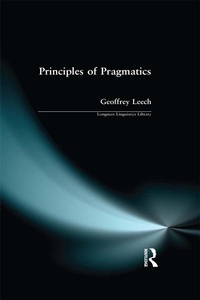
Principles of Pragmatics
Published on 17. February 2016
264 pages
978-1-317-86948-1 (ISBN)
Description

Over the years, pragmatics - the study of the use and meaning of utterances to their situations - has become a more and more important branch of linguistics, as the inadequacies of a purely formalist, abstract approach to the study of language have become more evident. This book presents a rhetorical model of pragmatics: that is, a model which studies linguistic communication in terms of communicative goals and principles of 'good communicative behaviour'.
In this respect, Geoffrey Leech argues for a rapprochement between linguistics and the traditional discipline of rhetoric. He does not reject the Chomskvan revolution of linguistics, but rather maintains that the language system in the abstract - i.e. the 'grammar' broadly in Chomsky's sense - must be studied in relation to a fully developed theory of language use. There is therefore a division of labour between grammar and rhetoric, or (in the study of meaning) between semantics and pragmatics.
The book's main focus is thus on the development of a model of pragmatics within an overall functional model of language. In this it builds on the speech avct theory of Austin and Searle, and the theory of conversational implicature of Grice, but at the same time enlarges pragmatics to include politeness, irony, phatic communion, and other social principles of linguistic behaviour.
In this respect, Geoffrey Leech argues for a rapprochement between linguistics and the traditional discipline of rhetoric. He does not reject the Chomskvan revolution of linguistics, but rather maintains that the language system in the abstract - i.e. the 'grammar' broadly in Chomsky's sense - must be studied in relation to a fully developed theory of language use. There is therefore a division of labour between grammar and rhetoric, or (in the study of meaning) between semantics and pragmatics.
The book's main focus is thus on the development of a model of pragmatics within an overall functional model of language. In this it builds on the speech avct theory of Austin and Searle, and the theory of conversational implicature of Grice, but at the same time enlarges pragmatics to include politeness, irony, phatic communion, and other social principles of linguistic behaviour.
More details
Series
Language
English
Place of publication
London
United Kingdom
Publishing group
Taylor & Francis Ltd
Target group
College/higher education
File size
10,00 MB
ISBN-13
978-1-317-86948-1 (9781317869481)
Copyright in bibliographic data and cover images is held by Nielsen Book Services Limited or by the publishers or by their respective licensors: all rights reserved.
Schweitzer Classification
Other editions
Additional editions
Geoffrey N. Leech
Principles of Pragmatics
Book
04/2016
1st Edition
Routledge
€185.90
Shipment within 10-20 days
Geoffrey N. Leech
Principles of Pragmatics
Book
07/1983
1st Edition
Longman
€82.20
Shipment within 10-20 days
Person
Geoffrey N. Leech
Content
Preface
A note on symbols
1. Introduction
1.1 Historical preamble
1.2 Semantics and pragmatics
1.3 General pragmatics
1.4 Aspects of speech situations
1.5 Rhetoric
2. A set of postulates
2.1 Semantic representation and pragmatic interpretation
2.2 Rules and principles
2.3 Convention and motivation
2.4 The relation between sense and force
2.5 Pragmatics as problem-solving
2.6 Conclusion
3. Formalism and functionalism
3.1 Formal and functional explanations
3.2 Biological, psychological, and social varieties of functionalism
3.3 The ideational, interpersonal, and textual functions of language
3.4 The ideational function: discreteness and determinacy
3.5 Examples of 'overgrammaticization'
3.6 Conclusion
4. The interpersonal role of the Cooperative Principle
4.1 The Cooperative Principle (CP) and the Politeness Principle (PP)
4.2 Maxims and Quantity and Quality
4.3 Maxim of Relation
4.4 The Hinting Strategy and anticipatory illocutions
4.5 Maxim of Manner
5. The Tact Maxim
5.1 Varieties of illocutionary function
5.2 Searle's categories of illocutionary acts
5.3 Tact: one kind of politeness
5.4 Pragmatic paradoxes of politeness
5.5 Semantic representation of ddeclaratives, interrogatives and imperatives
5.6 The interpretation of impositives
5.7 Pragmatic scales
5.8 Tact and condescension
6. A survey of the Interpersonal Rhetoric
6.1 Maxims and politeness
6.2 Metalinguistic aspects of politeness
6.3 Irony and banter
6.4 Hyperbole and litotes
6.5 Conclusion
7. Communicative Grammar: an example
7.1 Communicative Grammar and pragmatic force
7.2 Remarks on pragmatic metalanguage
7.3 Some aspects of negation and interrogation in English
7.4 Implications of politeness
7.5 Conclusion
8. Performatives
8.1 The Performative and Illocutionary-Verb Fallacies
8.2 The speech act theories of Austin and Searle
8.3 Illocutionary performatives: descriptive and non-descriptive approaches
8.4 Illocutionary performartives and oratio obliqua
8.5 The pragmatics of illocutionary performatives
8.6 The performative hypothesis
8.7 The extended performative hypothesis
8.8 Conclusion
9. Speech-act verbs in English
9.1 Locutionary, illocutionary, and perlocutionary
9.2 A survey of speech-act verb clauses
9.3 Is there a separate class of performative verbs?
9.4 A semantic analysis of some illocutionary verbs
9.5 Assertive verbs
9.6 Conclusion
10. Retrospect and prospect
References
Index
A note on symbols
1. Introduction
1.1 Historical preamble
1.2 Semantics and pragmatics
1.3 General pragmatics
1.4 Aspects of speech situations
1.5 Rhetoric
2. A set of postulates
2.1 Semantic representation and pragmatic interpretation
2.2 Rules and principles
2.3 Convention and motivation
2.4 The relation between sense and force
2.5 Pragmatics as problem-solving
2.6 Conclusion
3. Formalism and functionalism
3.1 Formal and functional explanations
3.2 Biological, psychological, and social varieties of functionalism
3.3 The ideational, interpersonal, and textual functions of language
3.4 The ideational function: discreteness and determinacy
3.5 Examples of 'overgrammaticization'
3.6 Conclusion
4. The interpersonal role of the Cooperative Principle
4.1 The Cooperative Principle (CP) and the Politeness Principle (PP)
4.2 Maxims and Quantity and Quality
4.3 Maxim of Relation
4.4 The Hinting Strategy and anticipatory illocutions
4.5 Maxim of Manner
5. The Tact Maxim
5.1 Varieties of illocutionary function
5.2 Searle's categories of illocutionary acts
5.3 Tact: one kind of politeness
5.4 Pragmatic paradoxes of politeness
5.5 Semantic representation of ddeclaratives, interrogatives and imperatives
5.6 The interpretation of impositives
5.7 Pragmatic scales
5.8 Tact and condescension
6. A survey of the Interpersonal Rhetoric
6.1 Maxims and politeness
6.2 Metalinguistic aspects of politeness
6.3 Irony and banter
6.4 Hyperbole and litotes
6.5 Conclusion
7. Communicative Grammar: an example
7.1 Communicative Grammar and pragmatic force
7.2 Remarks on pragmatic metalanguage
7.3 Some aspects of negation and interrogation in English
7.4 Implications of politeness
7.5 Conclusion
8. Performatives
8.1 The Performative and Illocutionary-Verb Fallacies
8.2 The speech act theories of Austin and Searle
8.3 Illocutionary performatives: descriptive and non-descriptive approaches
8.4 Illocutionary performartives and oratio obliqua
8.5 The pragmatics of illocutionary performatives
8.6 The performative hypothesis
8.7 The extended performative hypothesis
8.8 Conclusion
9. Speech-act verbs in English
9.1 Locutionary, illocutionary, and perlocutionary
9.2 A survey of speech-act verb clauses
9.3 Is there a separate class of performative verbs?
9.4 A semantic analysis of some illocutionary verbs
9.5 Assertive verbs
9.6 Conclusion
10. Retrospect and prospect
References
Index
