

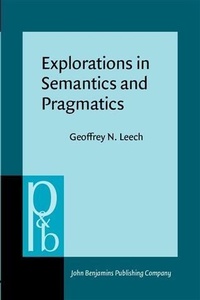
Explorations in Semantics and Pragmatics
1st Edition
Published on 1. January 1980
VIII, 133 pages
978-90-272-8109-8 (ISBN)
Description

The aim of this book is to show the way forward to a coherent view of language in which the achievement of the formalist paradigm is strengthened to the extent that its claims are weakened. A formal theory such as generative grammar is a special theory which is to be subsumed in a general theory of linguistic communication that also includes pragmatics. The tension between the psycho-formalist and the socio-functional views could be resolved in a synthesis whereby both the psychological and social natures of language are fully acknowledged. Semantics and pragmatics, representing these two natures in the study of meaning, have distinct goals, which can be defined more clearly and pursued more effectively to the extent that both their distinctness and their interdependence are recognized.
More details
Other editions
Additional editions
Geoffrey N. Leech
Explorations in Semantics and Pragmatics
Book
01/1980
John Benjamins Publishing Co
€72.08
Shipment within 10-15 days
Content
- EXPLORATIONS IN SEMANTICS AND PRAGMATICS
- Editorial page
- Title page
- Copyright page
- Acknowledgements
- Table of contents
- INTRODUCTION
- 1. GRAMMAR AND RHETORIC WITHIN A FUNCTIONAL VIEW OF LANGUAGE
- 1.0 Preface
- 1.1 Grammar and Rhetoric
- 1.2 Funetionalism and Formalism
- 1.3 Textual and Interpersonal Rhetoric
- 1.4 Via Media: Formalist Functionalism
- 2. NATURAL LANGUAGE AS METALANGUAGE
- 2.0 Preface
- 2.1 Introduction
- 2.2 Metalanguage: Examples and Definitions
- 2.3 The Semantic Representation of Metareference
- 2.4 The Problem of Direct and Indirect Speech
- 2.5 The Problem of Semantic Acceptability in Reporting Sentences
- 2.6 The Problem of Referential Opacity
- 2.7 The Problem of Presuppositions
- 2.8 Conclusion
- 3. METALANGUAGE, PRAGMATICS, AND PERFORMATIVES
- 3.0 Preface
- 3.1 The Performative Hypothesis and the Pragmatic Analysis
- 3.2 Indirect Speech and Modes of Mention
- 3.3 A Sketch of the Pragmatic Analysis
- 3.4 Comparison of the Performative Hypothesis and the Pragmatic Analysis
- 3.5 Conclusion
- 4. LANGUAGE AND TACT
- 4.0 Preface
- 4.1 Introduction
- 4.2 "Direct and Indirect Illocutions" versus "Sense and Force
- 4, 3 Searle 's Approach Compared With the Present One
- 4,4 Gordon and. Lakoff 's Conversational Postulates
- 4.5 Sadock's 'Extended Performative Hypothesis'
- 4,6 Relation between Sense and Force
- 4.7 Explanation of 'Indirectness ' by Conversational Principles
- 4.8 Recapitulation
- 4.9 The Logical Form (Sense) of a Sentence
- 4.10 The Pragmatic Force of a Sentence
- 4.11 Negative Politeness
- 4.12 The Tact Maxim
- 4.13 The Hinting Strategy
- 4.14 Pragmatic Space
- 4.15 Conclusion
- FOOTNOTES
- REFERENCES
