

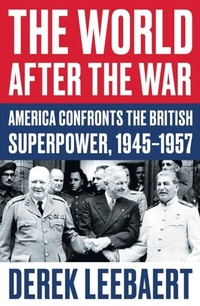
The World After the War
America Confronts the British Superpower, 1945-1957
1st Edition
Published on 1. November 2018
624 pages
978-1-78607-097-5 (ISBN)
Description

One of the great myths of the twentieth century is that after the Second World War Britain simply relinquished its power and America quickly embraced its worldwide political and military commitments. Instead the two allies improvised an uneasy, shifting partnership for twelve long years while most of western Europe lay in turmoil and Russia grew more aggressive.
But in 1957 Washington issued a 'declaration of independence' from British authority. It was then that everything changed, and America assumed leadership of the new world order just taking shape.
Derek Leebaert spins a riveting global narrative of Britain as the original superpower and shows why the Americans kept believing it to be indispensable. It's the story of secret ties, diplomatic quarrels and military interventions that casts political giants Churchill, Truman, Eisenhower and Johnson in a new light. In a volatile world of decolonisation, a uniting Europe and the Suez Crisis, shrewd men in London were leveraging the empire's long-established resources and influence to maintain their grip on power.
The enduring notion of a special relationship, rising tensions with Russia and China, and the sources of much of the world's turmoil can't be understood without knowing what really occurred.
But in 1957 Washington issued a 'declaration of independence' from British authority. It was then that everything changed, and America assumed leadership of the new world order just taking shape.
Derek Leebaert spins a riveting global narrative of Britain as the original superpower and shows why the Americans kept believing it to be indispensable. It's the story of secret ties, diplomatic quarrels and military interventions that casts political giants Churchill, Truman, Eisenhower and Johnson in a new light. In a volatile world of decolonisation, a uniting Europe and the Suez Crisis, shrewd men in London were leveraging the empire's long-established resources and influence to maintain their grip on power.
The enduring notion of a special relationship, rising tensions with Russia and China, and the sources of much of the world's turmoil can't be understood without knowing what really occurred.
Reviews / Votes
'One of the most thoughtful books on the Cold War period that has come my way.' * Norman Stone, <i>Literary Review</i> * 'Fascinating...far from just another story of the British empire's recession.' * <i>The Times</i> * 'Important and engaging... Leebaert aims to give a deathblow to the myth of "hands across the sea"... Riveting.' * <i>Wall Street Journal</i> * 'Leebaert's emphasis is necessary to demolish the common notion that after 1945 a "bankrupt" Britain and its empire faded from the scene, leaving the United States to become "the world's policeman." The idea that a Washington-led world order snapped into place immediately after the war is accepted by any number of renowned historians. Leebaert's thesis should send everyone back to the original sources.' -- Harold Evans, <i>New York Times Book Review</i> 'A brilliant achievement that challenges what we thought we knew about the power imbalance between post-war Britain and the US, the "superpower" that emerged in 1945 - written with intelligence, lucidity and a breathtaking width of knowledge.' -- Christopher Coker, Professor of International Relations, London School of Economics 'A fascinating and provocative account...rich with revealing details, anecdotes and brilliantly wrought portraits of the key personalities.' -- Liaquat Ahamed, author of the Pulitzer Prize-winning <i>Lords of Finance</i> 'In The World After the War, Derek Leebaert offers what for many readers will be a challenging thesis: that in 1945, the United States was hesitant about taking on the mantle of Leader of the Free World, which it later embraced; moreover, in 1945, Great Britain retained the substance and profile of that anachronistic description, a superpower. Only in 1956, after the Suez Crisis, did the US emerge as the Lone Ranger of the planet. Unfortunately, it was not always terribly successful in this guise, as the author argues in this impressively researched book.' -- Kathleen Burk, author of <i>The Lion and the Eagle: The Interaction of the British and American Empires 1783-1972</i> 'Leebaert is a Cold War historian of the first rank as well as a spellbinding narrator. But his greatest virtue...is a dogged pursuit of what really happened even, or especially, when it contradicts conventional wisdom.' -- Walter A. McDougall, Pulitzer Prize-winning historian, University of Pennsylvania 'A nation in decline that persists in imagining itself indispensable is a menace to itself and to others. So it was with Great Britain after World War II. So too it is with the United States today. With sparkling prose and deft characterizations, Derek Leebaert examines the relationship between those two countries - the one on the way down, the other reaching its zenith - in the first decade of the postwar era. The result is both revealing and immensely instructive. This is historical revisionism of the very best sort.' -- Andrew J. Bacevich, author of <i>America's War for the Greater Middle East</i>More details
Language
English
Place of publication
Oxford
United Kingdom
File size
3,58 MB
ISBN-13
978-1-78607-097-5 (9781786070975)
Copyright in bibliographic data and cover images is held by Nielsen Book Services Limited or by the publishers or by their respective licensors: all rights reserved.
Schweitzer Classification
Other editions
Additional editions
Book
11/2018
Oneworld Publications
€57.14
Article exhausted; check different version
Person
Derek Leebaert is the author of Magic and Mayhem: The Delusions of American Foreign Policy and To Dare and to Conquer. He's a founding editor of both International Security and The International Economy, and was a postdoctoral fellow at Harvard. He's led a global management consulting firm for fifteen years and lives in Washington DC.
Content
- COVER
- TITLE
- COPYRIGHT
- CONTENTS
- INTRODUCTION
- I: THEY THOUGHT IT WAS PEACE
- 1. The Three in 1945
- 2. Keynes & Co.
- 3. Entering the Middle East
- 4. False Starts
- II: A CHILLING WORLD
- 5. Warfare States
- 6. Year of the Offensive
- 7. Defending the West
- 8. The Outer Fortress: Protecting the Middle East, Africa, and Asia
- III: CHIPS ON THE TABLE
- 9. Auditing an Empire
- 10. Pivoting to Asia and into Vietnam
- 11. War on the Rim
- 12. Asia's Three Fighting Fronts
- IV: THE GROUND CHANGES
- 13. "Holding the Ring" in Iran and Egypt
- 14. Churchill Is Back
- 15. Stemming the Tide
- 16. Coronations and Crises
- V: A NEW SUPREMACY
- 17. The Break Points of 1954
- 18. Ordering Chaos
- 19. No End of a Lesson
- 20. What Happened Next
- CONCLUSION
- NOTES
- ACKNOWLEDGEMENTS
- INDEX
- A
- B
- C
- D
- E
- F
- G
- H
- I
- J
- K
- L
- M
- N
- O
- P
- Q
- R
- S
- T
- U
- V
- W
- Y
- Z
