

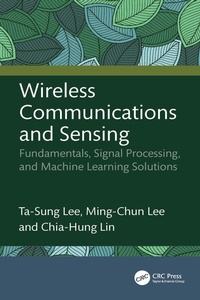
Wireless Communications and Sensing
Fundamentals, Signal Processing, and Machine Learning Solutions
Published on 2. December 2025
436 pages
978-1-040-45268-4 (ISBN)
Description

In this work from leading figures in the field, Lee, Lee, and Lin describe methods of integrated sensing and communication (ISAC) and artificial intelligence-aided radio systems to provide improved efficiency and performance to wireless users using next-generation (6G) communications systems.
The authors provide the tools to master four major considerations of 6G systems: knowledge of communication systems, knowledge of radar systems, understanding of ISAC systems, and machine learning-based enhancements. Wireless Communications and Sensing: Fundamentals, Signal Processing, and Machine Learning Solutions begins by providing preliminary information regarding communication and radar systems, including descriptions of system architecture and design concepts (e.g., wireless propagation, waveforms, MIMO signal processing, and multi-user scenarios) for entry-level readers. Throughout, the authors describe novel artificial intelligence-enabled approaches to aid the design of communication and radar systems. Furthermore, this book also describes the architecture and design concepts of ISAC systems and offers an in-depth discussion of the applications of machine learning to communication, radar, and ISAC systems. Readers will be able to use their comprehensive understanding of this field to enhance ISAC system performance or aid the deployment of ISAC systems in real-world scenarios to fulfill 6G visions.
This book is especially valuable for graduate and higher-level students, scholars, and engineers who want to step into the research areas of integrated sensing and communications and artificial intelligence-aided radio systems. Readers should have at least a bachelor's degree in engineering and have had some exposure to signals and systems, communication theory, and radar principles.
The authors provide the tools to master four major considerations of 6G systems: knowledge of communication systems, knowledge of radar systems, understanding of ISAC systems, and machine learning-based enhancements. Wireless Communications and Sensing: Fundamentals, Signal Processing, and Machine Learning Solutions begins by providing preliminary information regarding communication and radar systems, including descriptions of system architecture and design concepts (e.g., wireless propagation, waveforms, MIMO signal processing, and multi-user scenarios) for entry-level readers. Throughout, the authors describe novel artificial intelligence-enabled approaches to aid the design of communication and radar systems. Furthermore, this book also describes the architecture and design concepts of ISAC systems and offers an in-depth discussion of the applications of machine learning to communication, radar, and ISAC systems. Readers will be able to use their comprehensive understanding of this field to enhance ISAC system performance or aid the deployment of ISAC systems in real-world scenarios to fulfill 6G visions.
This book is especially valuable for graduate and higher-level students, scholars, and engineers who want to step into the research areas of integrated sensing and communications and artificial intelligence-aided radio systems. Readers should have at least a bachelor's degree in engineering and have had some exposure to signals and systems, communication theory, and radar principles.
More details
Language
English
Place of publication
London
United Kingdom
Publishing group
Taylor & Francis Ltd
Target group
College/higher education
Professional and scholarly
Product notice
Reflowable
Illustrations
17 Tables, black and white; 209 Line drawings, black and white; 5 Halftones, black and white; 214 Illustrations, black and white
File size
33,02 MB
ISBN-13
978-1-040-45268-4 (9781040452684)
Copyright in bibliographic data and cover images is held by Nielsen Book Services Limited or by the publishers or by their respective licensors: all rights reserved.
Schweitzer Classification
Other editions
Additional editions
Ta-Sung Lee | Ming-Chun Lee | Chia-Hung Lin
Wireless Communications and Sensing
Fundamentals, Signal Processing, and Machine Learning Solutions
Book
12/2025
1st Edition
CRC Press
€178.40
Shipment within 10-20 days
Persons
Ta-Sung Lee is Senior Vice President, Chair Professor of Department of Electronics and Electronical Engineering, and the Director of the IoT Intelligent Systems Research Center at National Yang Ming Chiao Tung University, Taiwan. He is a Fellow of the IEEE, and obtained his PhD from Purdue University in 1989.
Ming-Chun Lee is associate professor at the Institute of Communications Engineering at National Yang Ming Chiao Tung University, Taiwan. He gained his PhD from the University of Southern California in Electrical Engineering in 2020.
Chia-Hung Lin is a research assistant at North Carolina State University and is completing his PhD in Electrical and Computer Engineering at North Carolina State University, USA.
Ming-Chun Lee is associate professor at the Institute of Communications Engineering at National Yang Ming Chiao Tung University, Taiwan. He gained his PhD from the University of Southern California in Electrical Engineering in 2020.
Chia-Hung Lin is a research assistant at North Carolina State University and is completing his PhD in Electrical and Computer Engineering at North Carolina State University, USA.
Content
1. Introduction I Wireless Communication Basics 2. Wireless Channels and signal models 3. OFDM principles 4. MIMO signal processing in communication systems 5. Interference management and multiple access in communication systems II Radar Sensing Basics 6. Waveform designs and basic signal processing in radar systems 7. MIMO signal processing in radar systems 8. Interference mitigation in radar systems III Integrated Sensing and Communication (ISAC) Systems 9. ISAC systems and architectures 10. ISAC transceiver design principles IV Learning-Based Enhancements 11. Machine learning techniques 12. DL-based signal processing in communication systems 13. DL-based interference mitigation in communication systems 14. DL-based signal processing in radar systems 15. DL-based interference mitigation in radar systems 16. DL-based signal processing in ISAC systems
