
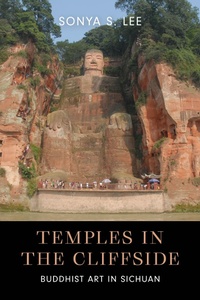
Temples in the Cliffside
Description
Alles über E-Books | Antworten auf Fragen rund um E-Books, Kopierschutz und Dateiformate finden Sie in unserem Info- & Hilfebereich.
Winner of the 2023 IPPY ? Gold ? Religion Nonfiction category, sponsored by the Independent Publisher Book Award
Centuries of monumental sculpture, embedded in the landscape
At sixty-two meters the Leshan Buddha in southwest China is the world's tallest premodern statue. Carved out of a riverside cliff in the eighth century, it has evolved from a religious center to a UNESCO World Heritage Site and popular tourist destination. But this Buddha does not stand alone: Sichuan is home to many cave temples with such monumental sculptures, part of a centuries-long tradition of art-making intricately tied to how local inhabitants made use of their natural resources with purpose and creativity. These examples of art embedded in nature have altered landscapes and have influenced the behaviors, values, and worldviews of users through multiple cycles of revival, restoration, and recreation. As hybrid spaces that are at once natural and artificial, they embody the interaction of art and the environment over a long period of time.
This far-ranging study of cave temples in Sichuan shows that they are part of the world's sustainable future, as their continued presence is a reminder of the urgency to preserve culture as part of today's response to climate change. Temples in the Cliffside brings art history into close dialogue with current discourse on environmental issues and contributes to a new understanding of the ecological impact of artistic monuments.
All prices
More details
Other editions
Additional editions
Person
Sonya S. Lee is professor of Chinese art and visual cultures at the University of Southern California and author of Surviving Nirvana: Death of the Buddha in Chinese Visual Culture.
Content
- Cover
- Title
- Copyright
- Dedication
- Contets
- Acknowledgments
- A Note on Terms and Measures
- Chronology of Chinese Dynasties and Historical Periods
- Introduction
- Part I. Inner/Outer
- Chapter One. The Leshan Buddha, a Calmer of Water
- Chapter Two. Self-Sacrifice and Healing at Baodingshan
- Part II. Users and Sustainability
- Chapter Three. Dazu Site Managers, Land, Community
- Chapter Four. Visitors to Nankan
- Chapter Five. Restorers of Dazu Rock Carvings
- Postscript
- Appendix: Chinese Texts
- Glossary of Chinese Characters
- Notes
- Bibliography
- Index

System requirements
File format: ePUB
Copy protection: Adobe-DRM (Digital Rights Management)
System requirements:
- Computer (Windows; MacOS X; Linux): Install the free reader Adobe Digital Editions prior to download (see eBook Help).
- Tablet/smartphone (Android; iOS): Install the free app Adobe Digital Editions or the app PocketBook before downloading (see eBook Help).
- E-reader: Bookeen, Kobo, Pocketbook, Sony, Tolino and many more (not Kindle).
The file format ePub works well for novels and non-fiction books – i.e., „flowing” text without complex layout. On an e-reader or smartphone, line and page breaks automatically adjust to fit the small displays.
This eBook uses Adobe-DRM, a „hard” copy protection. If the necessary requirements are not met, unfortunately you will not be able to open the eBook. You will therefore need to prepare your reading hardware before downloading.
Please note: We strongly recommend that you authorise using your personal Adobe ID after installation of any reading software.
For more information, see our ebook Help page.
File format: PDF
Copy-Protection: Adobe-DRM (Digital Rights Management)
System requirements:
- Computer (Windows; MacOS X; Linux): Install the free reader Adobe Digital Editions prior to download (see eBook Help).
- Tablet/smartphone (Android; iOS): Install the free app Adobe Digital Editions or the app PocketBook before downloading (see eBook Help).
- E-reader: Bookeen, Kobo, Pocketbook, Sony, Tolino and many more (only limited: Kindle).
The file format PDF always displays a book page identically on any hardware. This makes PDF suitable for complex layouts such as those used in textbooks and reference books (images, tables, columns, footnotes). Unfortunately, on the small screens of e-readers or smartphones, PDFs are rather annoying, requiring too much scrolling.
This eBook uses Adobe-DRM, a „hard” copy protection. If the necessary requirements are not met, unfortunately you will not be able to open the eBook. You will therefore need to prepare your reading hardware before downloading.
Please note: We strongly recommend that you authorise using your personal Adobe ID after installation of any reading software.
For more information, see our eBook Help page.
File format: ePUB
Copy protection: without DRM (Digital Rights Management)
System requirements:
- Computer (Windows; MacOS X; Linux): Use a reader that can handle the file format ePUB, such as Adobe Digital Editions or FBReader – both free (see eBook Help).
- Tablet/Smartphone (Android; iOS): Install the free app Adobe Digital Editions or the app PocketBook (see eBook Help).
- E-reader: Bookeen, Kobo, Pocketbook, Sony, Tolino and many more (not Kindle).
The file format ePUB works well for novels and non-fiction books – i.e., 'flowing' text without complex layout. On an e-reader or smartphone, line and page breaks automatically adjust to fit the small displays.
This eBook does not use copy protection or Digital Rights Management
For more information, see our eBook Help page.
