

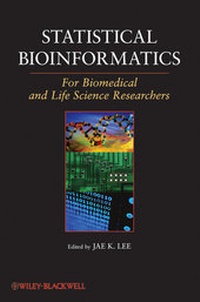
Statistical Bioinformatics
For Biomedical and Life Science Researchers
Published on 5. May 2010
364 pages
978-0-470-56763-0 (ISBN)
Description

This book provides an essential understanding of statisticalconcepts necessary for the analysis of genomic and proteomic datausing computational techniques. The author presents both basic andadvanced topics, focusing on those that are relevant to thecomputational analysis of large data sets in biology. Chaptersbegin with a description of a statistical concept and a currentexample from biomedical research, followed by more detailedpresentation, discussion of limitations, and problems. The bookstarts with an introduction to probability and statistics forgenome-wide data, and moves into topics such as clustering,classification, multi-dimensional visualization, experimentaldesign, statistical resampling, and statistical network analysis.
* Clearly explains the use of bioinformatics tools in lifesciences research without requiring an advanced background inmath/statistics
* Enables biomedical and life sciences researchers tosuccessfully evaluate the validity of their results and makeinferences
* Enables statistical and quantitative researchers to rapidlylearn novel statistical concepts and techniques appropriate forlarge biological data analysis
* Carefully revisits frequently used statistical approaches andhighlights their limitations in large biological data analysis
* Offers programming examples and datasets
* Includes chapter problem sets, a glossary, a list ofstatistical notations, and appendices with references to backgroundmathematical and technical material
* Features supplementary materials, including datasets, links,and a statistical package available online
Statistical Bioinformatics is an ideal textbook forstudents in medicine, life sciences, and bioengineering, aimed atresearchers who utilize computational tools for the analysis ofgenomic, proteomic, and many other emerging high-throughputmolecular data. It may also serve as a rapid introduction to thebioinformatics science for statistical and computational studentsand audiences who have not experienced such analysis tasksbefore.
More details
Other editions
Additional editions
Software
06/2010
Wiley
€128.04
No shipping information available
Book
03/2010
Wiley
€112.00
Article not available at the moment
Person
Jae K. Lee, Ph.D., is a professor of biostatistics and epidemiology in the Department of Health Evaluation Sciences at the University of Virginia School of Medicine, where he designed and teaches a course on Statistical Bioinformatics in Medicine. He earned his doctorate in statistical genetics from the University of Wisconsin, Madison. He was previously a research scientist in the Laboratory of Molecular Pharmacology, National Cancer Institute. Among his current research interests is the integration of statistical and genomic information for the analysis of microarray data.
Content
- Intro
- STATISTICAL BIOINFORMATICS
- CONTENTS
- PREFACE
- CONTRIBUTORS
- 1 ROAD TO STATISTICAL BIOINFORMATICS
- Challenge 1: Multiple-Comparisons Issue
- Challenge 2: High-Dimensional Biological Data
- Challenge 3: Small-n and Large-p Problem
- Challenge 4: Noisy High-Throughput Biological Data
- Challenge 5: Integration of Multiple, Heterogeneous Biological Data Information
- References
- 2 PROBABILITY CONCEPTS AND DISTRIBUTIONS FOR ANALYZING LARGE BIOLOGICAL DATA
- 2.1 Introduction
- 2.2 Basic Concepts
- 2.3 Conditional Probability and Independence
- 2.4 Random Variables
- 2.5 Expected Value and Variance
- 2.6 Distributions of Random Variables
- 2.7 Joint and Marginal Distribution
- 2.8 Multivariate Distribution
- 2.9 Sampling Distribution
- 2.10 Summary
- 3 QUALITY CONTROL OF HIGH-THROUGHPUT BIOLOGICAL DATA
- 3.1 Sources of Error in High-Throughput Biological Experiments
- 3.2 Statistical Techniques for Quality Control
- 3.3 Issues Specific to Microarray Gene Expression Experiments
- 3.4 Conclusion
- References
- 4 STATISTICAL TESTING AND SIGNIFICANCE FOR LARGE BIOLOGICAL DATA ANALYSIS
- 4.1 Introduction
- 4.2 Statistical Testing
- 4.3 Error Controlling
- 4.4 Real Data Analysis
- 4.5 Concluding Remarks
- Acknowledgments
- References
- 5 CLUSTERING: UNSUPERVISED LEARNING IN LARGE BIOLOGICAL DATA
- 5.1 Measures of Similarity
- 5.2 Clustering
- 5.3 Assessment of Cluster Quality
- 5.4 Conclusion
- References
- 6 CLASSIFICATION: SUPERVISED LEARNING WITH HIGH-DIMENSIONAL BIOLOGICAL DATA
- 6.1 Introduction
- 6.2 Classification and Prediction Methods
- 6.3 Feature Selection and Ranking
- 6.4 Cross-Validation
- 6.5 Enhancement of Class Prediction by Ensemble Voting Methods
- 6.6 Comparison of Classification Methods Using High-Dimensional Data
- 6.7 Software Examples for Classification Methods
- References
- 7 MULTIDIMENSIONAL ANALYSIS AND VISUALIZATION ON LARGE BIOMEDICAL DATA
- 7.1 Introduction
- 7.2 Classical Multidimensional Visualization Techniques
- 7.3 Two-Dimensional Projections
- 7.4 Issues and Challenges
- 7.5 Systematic Exploration of Low-Dimensional Projections
- 7.6 One-Dimensional Histogram Ordering
- 7.7 Two-Dimensional Scatterplot Ordering
- 7.8 Conclusion
- References
- 8 STATISTICAL MODELS, INFERENCE, AND ALGORITHMS FOR LARGE BIOLOGICAL DATA ANALYSIS
- 8.1 Introduction
- 8.2 Statistical/Probabilistic Models
- 8.3 Estimation Methods
- 8.4 Numerical Algorithms
- 8.5 Examples
- 8.6 Conclusion
- References
- 9 EXPERIMENTAL DESIGNS ON HIGH-THROUGHPUT BIOLOGICAL EXPERIMENTS
- 9.1 Randomization
- 9.2 Replication
- 9.3 Pooling
- 9.4 Blocking
- 9.5 Design for Classifications
- 9.6 Design for Time Course Experiments
- 9.7 Design for eQTL Studies
- References
- 10 STATISTICAL RESAMPLING TECHNIQUES FOR LARGE BIOLOGICAL DATA ANALYSIS
- 10.1 Introduction
- 10.2 Resampling Methods for Prediction Error Assessment and Model Selection
- 10.3 Feature Selection
- 10.4 Resampling-Based Classification Algorithms
- 10.5 Practical Example: Lymphoma
- 10.6 Resampling Methods
- 10.7 Bootstrap Methods
- 10.8 Sample Size Issues
- 10.9 Loss Functions
- 10.10 Bootstrap Resampling for Quantifying Uncertainty
- 10.11 Markov Chain Monte Carlo Methods
- 10.12 Conclusions
- References
- 11 STATISTICAL NETWORK ANALYSIS FOR BIOLOGICAL SYSTEMS AND PATHWAYS
- 11.1 Introduction
- 11.2 Boolean Network Modeling
- 11.3 Bayesian Belief Network
- 11.4 Modeling of Metabolic Networks
- References
- 12 TRENDS AND STATISTICAL CHALLENGES IN GENOMEWIDE ASSOCIATION STUDIES
- 12.1 Introduction
- 12.2 Alleles, Linkage Disequilibrium, and Haplotype
- 12.3 International HapMap Project
- 12.4 Genotyping Platforms
- 12.5 Overview of Current GWAS Results
- 12.6 Statistical Issues in GWAS
- 12.7 Haplotype Analysis
- 12.8 Homozygosity and Admixture Mapping
- 12.9 Gene × Gene and Gene × Environment Interactions
- 12.10 Gene and Pathway-Based Analysis
- 12.11 Disease Risk Estimates
- 12.12 Meta-Analysis
- 12.13 Rare Variants and Sequence-Based Analysis
- 12.14 Conclusions
- Acknowledgments
- References
- 13 R AND BIOCONDUCTOR PACKAGES IN BIOINFORMATICS: TOWARDS SYSTEMS BIOLOGY
- 13.1 Introduction
- 13.2 Brief overview of the Bioconductor Project
- 13.3 Experimental Data
- 13.4 Annotation
- 13.5 Models of Biological Systems
- 13.6 Conclusion
- 13.7 Acknowledgments
- References
- INDEX
