

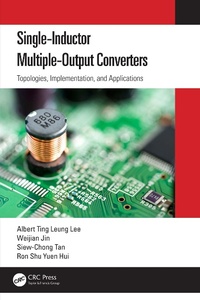
Single-Inductor Multiple-Output Converters
Topologies, Implementation, and Applications
1st Edition
Published on 16. December 2021
314 pages
978-1-000-48772-5 (ISBN)
Description

The book provides a comprehensive overview of Single-Inductor Multiple-Output Converters from both theoretical and practical perspectives. Based on the authors' in-depth research, the volume covers not only conventional SIMO DC-DC converters but also the new generations of SIMO such as SIMO AC-DC converters, SIMO DC-AC converters (or SIMO inverters), and the latest SIMO hybrid converters.
This book offers a holistic and systematic presentation of all types of SIMO converters, encompassing the derivation of the circuit topologies, the definition of key concepts, detailed discussion of theoretical underpinnings, design methodology and control schemes, as well as design considerations and techniques that enable practical implementation. Specific examples of real-world applications of SIMO converters are also provided. The volume offers a comprehensive overview and systematic classification of the traditional and modern topologies of SIMO converters in terms of system architecture, circuit analysis, operating principles, control methods, design considerations and practical implementation. Specifically, the book
presents the mathematical models and design principles necessary for analyzing the behavior of each kind of SIMO converter, and building upon that, introduces and imparts new approaches and techniques when designing such converters, guiding engineering students and power engineers towards achieving low-cost, compact and energy efficient SIMO converters.
offers the design considerations and optimization as well as describing the key applications of SIMO converters.
The book fills a significant niche in the power electronics literature and provides a complete perspective on SIMO converters that hopefully can inspire appreciation and better understanding of the subject matter. It can be directly adopted in undergraduate or graduate coursework as well as postgraduate research programs.
This book offers a holistic and systematic presentation of all types of SIMO converters, encompassing the derivation of the circuit topologies, the definition of key concepts, detailed discussion of theoretical underpinnings, design methodology and control schemes, as well as design considerations and techniques that enable practical implementation. Specific examples of real-world applications of SIMO converters are also provided. The volume offers a comprehensive overview and systematic classification of the traditional and modern topologies of SIMO converters in terms of system architecture, circuit analysis, operating principles, control methods, design considerations and practical implementation. Specifically, the book
presents the mathematical models and design principles necessary for analyzing the behavior of each kind of SIMO converter, and building upon that, introduces and imparts new approaches and techniques when designing such converters, guiding engineering students and power engineers towards achieving low-cost, compact and energy efficient SIMO converters.
offers the design considerations and optimization as well as describing the key applications of SIMO converters.
The book fills a significant niche in the power electronics literature and provides a complete perspective on SIMO converters that hopefully can inspire appreciation and better understanding of the subject matter. It can be directly adopted in undergraduate or graduate coursework as well as postgraduate research programs.
More details
Edition
1. Auflage
Language
English
Place of publication
London
United Kingdom
Publishing group
Taylor & Francis Ltd
Target group
College/higher education
Illustrations
15 Tables, black and white; 135 Line drawings, black and white; 32 Halftones, black and white; 167 Illustrations, black and white
ISBN-13
978-1-000-48772-5 (9781000487725)
Copyright in bibliographic data and cover images is held by Nielsen Book Services Limited or by the publishers or by their respective licensors: all rights reserved.
Schweitzer Classification
Other editions
Additional editions
Albert Ting Leung Lee | Weijian Jin | Siew-Chong Tan
Single-Inductor Multiple-Output Converters
Topologies, Implementation, and Applications
Book
12/2021
1st Edition
CRC Press
€75.30
Shipment within 10-20 days
Albert Ting Leung Lee | Weijian Jin | Siew-Chong Tan
Single-Inductor Multiple-Output Converters
Topologies, Implementation, and Applications
Book
12/2021
1st Edition
CRC Press
€132.50
Shipment within 10-20 days
Persons
Albert Ting Leung Lee (Member, IEEE) is a Lecturer in the Department of Electrical and Electronic Engineering, The University of Hong Kong, Hong Kong. His current research interests include power electronics and control, emerging LED driver technologies, LED lightings, and wireless power transfer.
Weijian Jin (Member, IEEE) received his Ph.D. degree in power electronics with the Department of Electrical and Electronic Engineering, The University of Hong Kong, Hong Kong. His current research interests include power electronics and control, and LED driver technologies.
Siew-Chong Tan (Senior Member, IEEE) is currently a Professor with the Department of Electrical and Electronic Engineering, The University of Hong Kong, Hong Kong. His research interests include the areas of power electronics and control, LED lightings, smart grids, and clean energy technologies.
Ron Shu Yuen Hui (Fellow, IEEE) is currently a Professor with the School of Electrical and Electronic Engineering, Nanyang Technological University, Singapore, and a Chair Professorship at Imperial College London. He has authored or co-authored over 450 research papers including 280 refereed journal publications. Over 60 of his patents have been adopted by industry. His research interests include power electronics, wireless power, sustainable lighting, and smart grid.
Weijian Jin (Member, IEEE) received his Ph.D. degree in power electronics with the Department of Electrical and Electronic Engineering, The University of Hong Kong, Hong Kong. His current research interests include power electronics and control, and LED driver technologies.
Siew-Chong Tan (Senior Member, IEEE) is currently a Professor with the Department of Electrical and Electronic Engineering, The University of Hong Kong, Hong Kong. His research interests include the areas of power electronics and control, LED lightings, smart grids, and clean energy technologies.
Ron Shu Yuen Hui (Fellow, IEEE) is currently a Professor with the School of Electrical and Electronic Engineering, Nanyang Technological University, Singapore, and a Chair Professorship at Imperial College London. He has authored or co-authored over 450 research papers including 280 refereed journal publications. Over 60 of his patents have been adopted by industry. His research interests include power electronics, wireless power, sustainable lighting, and smart grid.
Content
Chapter 1 Introduction to Single-Inductor Multiple-Output Converters
Chapter 2 Single-Inductor Multiple-Output DC-DC Converters
Chapter 3 Single-Inductor Multiple-Output AC-DC Converters
Chapter 4 Single-Inductor Multiple-Output DC-AC Boost Inverters
Chapter 5 Single-Inductor Multiple-Output DC-AC Buck-Boost Inverters
Chapter 6 Gallium Nitride-Based Single-Inductor Multiple-Output DC-AC Boost Inverters
Chapter 7 Single-Inductor Multiple-Output DC?AC/DC Hybrid Converters
Chapter 2 Single-Inductor Multiple-Output DC-DC Converters
Chapter 3 Single-Inductor Multiple-Output AC-DC Converters
Chapter 4 Single-Inductor Multiple-Output DC-AC Boost Inverters
Chapter 5 Single-Inductor Multiple-Output DC-AC Buck-Boost Inverters
Chapter 6 Gallium Nitride-Based Single-Inductor Multiple-Output DC-AC Boost Inverters
Chapter 7 Single-Inductor Multiple-Output DC?AC/DC Hybrid Converters
