

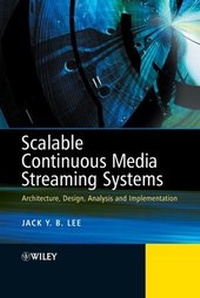
Scalable Continuous Media Streaming Systems
Description

More details
Other editions
Additional editions
Person
Jack Lee is the author of Scalable Continuous Media Streaming Systems: Architecture, Design, Analysis and Implementation, published by Wiley.
Content
Preface.
Acknowledgements.
Part I: Fundamentals.
1. Introduction.
1.1 Elements of a Multimedia System.
1.2 Media Data.
1.3 Media Delivery.
1.4 Streaming versus Download.
1.5 Challenges in Building Continuous Media Streaming Systems.
1.6 Engineering Trade-offs.
1.7 Performance Guarantee.
1.8 Admission Control.
1.9 Summary.
References.
2. Media Compression.
2.1 Introduction.
2.2 Media Multiplexing.
2.3 Temporal Dependencies in Compressed Video.
2.4 Bit-rate Variations.
2.5 Media Adaptation.
2.6 Summary.
References.
3. Continuous Media Storage and Retrieval.
3.1 Structure and Model of Hard Disk.
3.2 Disk Scheduling.
3.3. Improving Disk Throughput.
3.4 Grouped Sweeping Scheme.
3.5 Multi-Disk Storage and Retrieval.
3.6 Disk Zoning.
3.7 Summary.
References.
4. Soft Scheduling.
4.1 Introduction.
4.2 Statistical Capacity Dimensioning.
4.3 Dual-round Scheduling.
4.4. Early-Admission Scheduling.
4.5 Overflow Management.
4.6 Performance Evaluation.
4.7 Related Work.
4.8 Summary.
References.
5. Reliable and Fault-Tolerant Storage Systems.
5.1 Introduction.
5.2 Background.
5.3 System Model.
5.4 Automatic Data Rebuild.
5.5. Track-Based Rebuild.
5.6 Pipelined Rebuild.
5.7 Performance Evaluation.
5.8 Summary.
References.
6. Media Data Streaming.
6.1 Streaming over TCP/UDP.
6.2 Specialized Streaming Protocols.
6.3 Summary.
References.
7. Streaming Variable Bit-Rate Media Streams.
7.1 Introduction.
7.2 Streaming in Mixed-Traffic Networks.
7.3 Monotonic Decreasing Rate Scheduler.
7.4 Performance Evaluation.
7.5 Aggregated Monotonic Decreasing Rate Scheduler.
7.6 Summary.
Appendix.
References.
8. Adaptive Media Streaming.
8.1 Introduction.
8.2 Related Work.
8.3 System Model.
8.4 Client Buffer Occupancy and Network Bandwidth Estimation.
8.5 Rate Adaptation.
8.6 Performance Evaluation.
8.7 Summary.
Note.
References.
Part II: Parallel Server Architectures.
9. Taxonomy and Architectural Alternatives.
9.1 Introduction.
9.2 Parallel Video Distribution Architectures.
9.3 Server Striping Policies.
9.4 Parallel Video Delivery Protocols.
9.5 Summary.
References.
10. A Concurrent-Push Parallel Server Architecture.
10.1 Introduction.
10.2 System Architecture.
10.3 Analysis of the Concurrent-Push Algorithm.
10.4 Asynchronous Grouped Sweeping Scheme.
10.5 Sub-Schedule Striping Scheme.
10.6 Performance Evaluation.
10.7 Summary.
Appendices.
References.
11. Fault-Tolerant Algorithms for the Concurrent-Push Architecture.
11.1 Redundancy Management.
11.2 Forward Erasure Correction.
11.3 Progressive Redundancy Transmission (PRT).
11.4 Analysis of Forward Erasure Correction.
11.5 Analysis of Progressive Redundancy Transmission.
11.6 Redundant Server Scheme.
11.7 Numerical Results.
11.8 Summary.
Appendices.
References.
12. A Staggered-Push Parallel Server Architecture.
12.1 Introduction.
12.2 System Architecture.
12.3 Schedule Assignment.
12.4 Traffic Overlapping.
12.5 Buffer Management.
12.6 Performance Evaluation.
12.7 Network Resource Reservations.
12.8 Summary.
Appendices.
References.
13. FEC versus PRT.
13.1 Introduction.
13.2 System Model.
13.3 Forward Erasure Correction.
13.4 Progressive Redundancy Transmission (PRT).
13.5 Performance Evaluation.
13.6 Summary.
References.
14. Algorithms for Server Rebuild.
14.1 Introduction.
14.2 Disk Migration.
14.3 Reloading Data from Back-up.
14.4 Baseline Rebuild.
14.5 Distributed Rebuild.
14.6 Mixed Distributed Baseline rebuild.
14.7 Numerical Results.
14.8 Summary.
References.
15. Algorithms for System Expansion.
15.1 Introduction.
15.2 Related Work.
15.3 Row-Permutated Data Reorganization.
15.4 Sequential Redundant Data Update.
15.5. Multiple Redundant Nodes Update.
15.6 Summary.
References.
Part III: Multicast Streaming Architectures.
16. Overview of Multicast Streaming.
16.1 Introduction.
16.2 Operational Issues.
16.3 Multicast Media Streaming.
16.4 Techniques for On-Demand Multicast Streaming.
16.5 Summary.
References.
17. Closed-Loop Algorithms.
17.1 Introduction.
17.2 Batching.
17.3 Patching.
17.4 Caching.
17.5 Piggybacking.
17.6 Summary.
References.
18. Open-Loop Architecture.
18.1 Introduction.
18.2 A Taxonomy.
18.3 Performance Bounds.
18.4 A Generalized Consonant Broadcasting Algorithm.
18.5 Performance Comparisons.
18.6 Grouped Consonant Broadcasting.
18.7 Implementation and Benchmarking.
18.8 Summary.
References.
19. A Hybrid Architecture.
19.1 A Super-Scalar Architecture.
19.2 Interactive Controls.
19.3 Performance Modeling.
19.4 Performance Evaluation.
19.5 Implementation and Benchmarking.
19.6 Summary.
Appendix.
References.
20. Efficient Server Design for Hybrid Multicast Streaming.
20.1 Introduction.
20.2 Background.
20.3 A GSS-Based Server Design.
20.4 An Efficient Server Design.
20.5 Performance Evaluation.
20.6 Summary.
References.
Index.
