

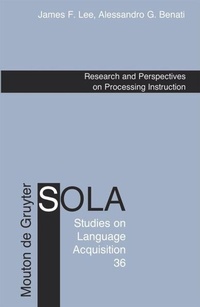
Research and Perspectives on Processing Instruction
Description

This volume tracks the impact Processing Instruction has made since its conception. The authors explain Processing Instruction, both its main theoretical underpinnings as well as the guidelines for developing structured input practices. They review the empirical research conducted to date, so that readers have an overview of new research carried out on the effects of Processing Instruction. The work concludes with reflections on the generalizability and limits of the research on Processing Instruction and offers future directions for Processing Instruction research.
More details
Other editions
Additional editions
Persons
James F. Lee , University of New South Wales, Sydney, Australia; Alessandro G. Benati , University of Portsmouth, UK.
Content
2 - Table of contents [Seite 9]
3 - Introduction [Seite 13]
4 - Chapter 1. The theory of input processing underlying Processing Instruction [Seite 17]
5 - Chapter 2. What makes Processing Instruction effective? [Seite 52]
6 - Chapter 3. How does Processing Instruction compare to other types of instruction? [Seite 84]
7 - Chapter 4. Can Processing Instruction be delivered effectively online as well as in classrooms? [Seite 116]
8 - Chapter 5. Can you increase the positive effects of Structured Input on language development by enhancing it aurally and/or textually? [Seite 129]
9 - Chapter 6. What are the transfer-of-training effects for Processing Instruction? [Seite 143]
10 - Chapter 7. Are the effects of Processing Instruction durative (short-term) and longitudinal (long-term)? [Seite 159]
11 - Chapter 8. How have the effects of Processing Instruction been measured? [Seite 190]
12 - Chapter 9. Conclusion: What does the research on Processing Instruction tell us? [Seite 200]
13 - Backmatter [Seite 211]
