

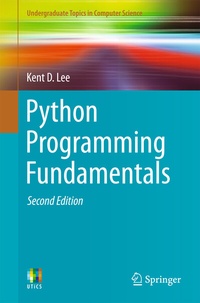
Python Programming Fundamentals
Description

This easy-to-follow and classroom-tested textbook guides the reader through the fundamentals of programming with Python, an accessible language which can be learned incrementally.
Features: incudes numerous examples and practice exercises throughout the text, with additional exercises, solutions and review questions at the end of each chapter; highlights the patterns which frequently appear when writing programs, reinforcing the application of these patterns for problem-solving through practice exercises; introduces the use of a debugger tool to inspect a program, enabling students to discover for themselves how programs work and enhance their understanding; presents the Tkinter framework for building graphical user interface applications and event-driven programs; provides instructional videos and additional information for students, as well as support materials for instructors, at an associated website.
Reviews / Votes
"The book emphasizes hands-on learning, which makes sense when learning programming. An undergraduate student that has a computer with a Python integrated development environment (IDE) and this book can learn a lot and do some interesting projects. The book is also suitable for high school students interested in programming assignments and projects. A highly readable and compact book, students and beginning programmers will like it." (Naga Narayanaswamy, Computing Reviews, September, 2015)
"The introduction is well written and enables you to configure the WingIDE within minutes and start using the book. At the end of each chapter, there are programming tasks, most of which are resolved quite well a few pages after. This is a big plus. . if you have passion for easy-to-install scripting languages and you are interested in Python - the book is quite OK for a start!" (Vitosh, Vitosh Academy, vitoshacademy.com, February, 2015)
More details
Other editions
Additional editions
Previous edition
Person
Content
Introduction.- Decision Making.- Repetitive Tasks.- Using Objects.- Defining Functions.- Event-Driven Programming.- Defining Classes.- Appendix A: Integer Operators.- Appendix B: Float Operators.- Appendix C: String Operators and Methods.- Appendix D: List Operators and Methods.- Appendix E: Dictionary Operators and Methods.- Appendix F: Turtle Methods.- Appendix G: TurtleScreen Methods.- Appendix H: The Reminder! Program.- Appendix I: The Bouncing Ball Program.
