

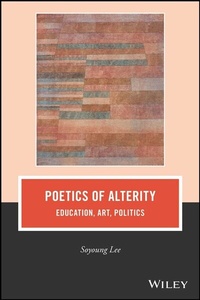
Poetics of Alterity
Description

Education today is commonly oriented towards citizenship and skills for life, with aims of happiness and wellbeing. But this benign image harbours surreptitious forms of control, which ultimately undermine the goods it professes to safeguard and stifle education's very purpose. What release can there be from these constrictions? Release is to be found, as Soyoung Lee eloquently shows, by attending to elements of experience that seem to escape our grip, from challenging aspects of our moral lives to struggles over practicalities of curriculum content. The more robust, more outward-turning orientation she demonstrates emphasises engagement with subject-matter, with problems and forms of narrative, that defy pre-determined formulations and categories. This requires turning towards objects worthy of attention and towards people and their claims on us. The arts and the humanities have special importance as spaces where alterity presents and expresses itself. Lee's dialogue with Heidegger, Levinas, Derrida, and Celan shows how acknowledgement of the other must condition not only practices of teaching and learning but practicalities of our social and political lives. Attending to anxieties inherent in teaching and learning, in school and the wider world, the book's powerful rationale for the curriculum provides nothing less than a new grounding for the humanities.
SOYOUNG LEE is Assistant Professor of Education at Pusan National University, South Korea. She previously worked in primary education. Her main areas of scholarship are phenomenology, poststructuralism, and the philosophy of language, especially in relation to ethics, education in the arts and humanities, and teacher education. Her recent work explores themes of mourning and remembrance.
More details
Other editions
Additional editions
Person
SOYOUNG LEE is Assistant Professor of Education at Pusan National University, South Korea. She previously worked in primary education. Her main areas of scholarship are phenomenology, poststructuralism, and the philosophy of language, especially in relation to ethics, education in the arts and humanities, and teacher education. Her recent work explores themes of mourning and remembrance.
Content
List of Figures vii
Foreword ix
Introduction 1
1 Poetics of the Encyclopaedia: Knowledge, Pedagogy, and Research Today 15
2 Thinking in Nearness: Seven Steps on the Way to a Heideggerian Approach to Education 43
3 From Heidegger to Translation and the Address of the Other 67
4 'Ethics is an Optics': Ethical Practicality and the Exposure of Teaching 91
5 Covering the Wound: Education and the Work of Mourning 115
6 Problems of Knowledge: Reading a Poem, Reading the Immemorial 143
7 Wandering Words, Words in Faith: Speak You Too 179
References 215
Index 225
