

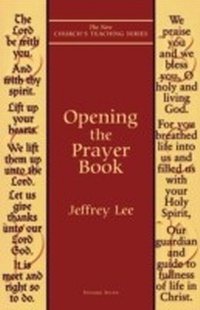
Opening the Prayer Book
1st Edition
Published on 25. January 1999
214 pages
978-1-56101-338-8 (ISBN)
Description

What Roger Ferlo did for the Bible in Opening the Bible, volume 2 of The New Church's Teaching Series, Jeffrey Lee now does for the prayer book in volume 7 of the series. Opening the Prayer Book introduces us to the history and liturgies of The Book of Common Prayer, and helps us understand why the prayer book is such an important aspect of Anglican self-understanding.
Lee begins with the fundamental question, "What is common prayer?" He explores some of the ways in which our worship according to The Book of Common Prayer affects who we are as a church, and the way it shapes our lives of faith. In chapter 2 Lee turns to the development of patterns of liturgy from the time of Jesus to the Reformation, tracing changes in the primary liturgies of baptism, eucharist, and daily prayer. The American prayer book is the focus of chapter 3, from the earliest revisions in the new nation through the liturgical scholarship that led to the substantial theological and liturgical changes in the 1979 Book of Common Prayer.
Chapter 4 begins a survey of the pages of the prayer book itself. Lee examines in particular the liturgies of Holy Week and Easter, baptism and eucharist, and the daily office, with a view to understanding the way the parts of the services are rooted in the historical prayers of the church and at the same time reflect the living tradition of Christians today. This theme is further developed in chapter 5, which focuses on the prayer book and our common life. Here Lee discusses questions of how a common prayer book can be responsive to a growing variety of pastoral situations and diverse cultures in a fast-changing world. The final chapter addresses the future of the prayer book within the Anglican Communion, in light of demands for further revision and for greater freedom to adapt the prayer book to local needs and beliefs.
As with each book in The New Church's Teaching Series, recommended resources for further reading and questions for discussion are included.
Lee begins with the fundamental question, "What is common prayer?" He explores some of the ways in which our worship according to The Book of Common Prayer affects who we are as a church, and the way it shapes our lives of faith. In chapter 2 Lee turns to the development of patterns of liturgy from the time of Jesus to the Reformation, tracing changes in the primary liturgies of baptism, eucharist, and daily prayer. The American prayer book is the focus of chapter 3, from the earliest revisions in the new nation through the liturgical scholarship that led to the substantial theological and liturgical changes in the 1979 Book of Common Prayer.
Chapter 4 begins a survey of the pages of the prayer book itself. Lee examines in particular the liturgies of Holy Week and Easter, baptism and eucharist, and the daily office, with a view to understanding the way the parts of the services are rooted in the historical prayers of the church and at the same time reflect the living tradition of Christians today. This theme is further developed in chapter 5, which focuses on the prayer book and our common life. Here Lee discusses questions of how a common prayer book can be responsive to a growing variety of pastoral situations and diverse cultures in a fast-changing world. The final chapter addresses the future of the prayer book within the Anglican Communion, in light of demands for further revision and for greater freedom to adapt the prayer book to local needs and beliefs.
As with each book in The New Church's Teaching Series, recommended resources for further reading and questions for discussion are included.
More details
Series
Edition
1. Auflage
Language
English
Place of publication
New York
United States
Publishing group
Bloomsbury Publishing Plc
Target group
Professional and scholarly
ISBN-13
978-1-56101-338-8 (9781561013388)
Copyright in bibliographic data and cover images is held by Nielsen Book Services Limited or by the publishers or by their respective licensors: all rights reserved.
Schweitzer Classification
Other editions
Additional editions
Jeffrey Lee
Opening the Prayer Book
Book
01/1999
Rowman & Littlefield Publishers
€14.50
Shipment within 3-4 weeks
Person
Jeffrey Lee is an Episcopal priest who has served parishes in Wisconsin and Indiana. A speaker, retreat and conference leader with a particular interest in liturgy, he is also active in the renewal of the diaconate, publishing articles and serving on the board of the North American Association for the Diaconate.
Content
- Cover
- Title Page
- Copyright Page
- Table of Contents
- Series Preface
- Acknowledgments
- Chapter 1: What is Common Prayer?
- What is Common Prayer?
- A Way of Being Church
- Varieties of Common Prayer
- Revising Our Common Prayer
- The Future
- Chapter 2: The Pattern of Prayer
- Things Old and New
- Worship in the Time of Jesus
- Early Christian Liturgies
- Christian Initiation
- The Eucharist
- Daily Prayer
- Chapter 3: The Prayer Book is Born
- Worship by the Book
- The Work of the People Becomes The Work of the Clergy
- The Reformation
- The Prayer Book is Born
- The Prayer Book Tradition
- Chapter 4: The American Prayer Book
- An Independent Church
- The First American Prayer Book
- Nineteenth-Century Revisions
- 1928 and Beyond
- The Liturgical Movement
- Ongoing Revision and the 1979 Prayer Book
- Chapter 5: A Baptismal Church
- The Three Days of Easter
- Holy Baptism
- Chapter 6. The Eucharist and Daily Office
- Gathering in the Lord's Name
- The Liturgy of the Word
- The Holy Communion
- The Daily Office
- Pastoral Offices
- Other Prayer Book Material
- Chapter 7: Liturgy in Action
- Prayer: Private, Personal, Communal
- At Home wit Ritual
- Sacramental Minimalism
- The Fundamentals of Liturgy
- Making Liturgy
- Pastoral Liturgy and the Mission of the Church
- Chapter 8: Looking Toward the Future
- The Prayer Book and Culture
- Ordered Freedom
- Liturgical Spirituality: Variety and the Steady Beat
- Exploring the Boundaries
- Common Prayer and Paschal Life
- Endnotes
- Resources
- Questions for Discussion
