

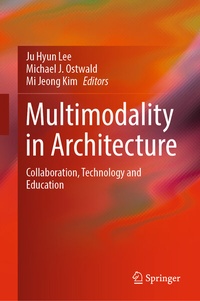
Multimodality in Architecture
Description

This book examines multimodality in architecture and its impacts on collaborative, technical and educational processes or systems.
Multimodality is becoming increasingly critical in contemporary architectural practice and education. Creative design teams face new challenges when they embrace new modes of communication, technology, and knowledge development processes. From diverse online modes of communication to shared digital environments, generative AI and advanced hardware solutions, new modes of information creation, sharing, and application are changing the ways architects and designers work.
The book presents new research which empowers international researchers and designers to work more effectively in a diverse range of digital environments.
More details
Other editions
Additional editions
Persons
Dr Ju Hyun Lee is Associate Professor of Architecture and Computational Design at UNSW, Sydney. He has made significant research contributions in the fields of architectural computing and design cognition and has held multiple academic roles in Australia and South Korea. He completed postdoctoral research at UoN. He is Chair of AKA.N and Co-Director of Advanced Architectural Analytics lab. He is co-author with Michael J. Ostwald of Grammatical and Syntactical Approaches in Architecture (IGI Global 2020) and co-author with Michael J. Ostwald and Ning Gu of Design Thinking: Creativity, Collaboration and Culture (Springer 2020).
Professor Michael J. Ostwald is Professor of Architectural Analytics at UNSW, Sydney. He has a PhD in architectural history and theory and a DSc in design mathematics and computing. Michael completed postdoctoral research on geometry at UCLA, CCA and Harvard, and he has held academic positions in Australia, Hong Kong, New Zealand and Italy. He is Editor-in-Chief of the Nexus Network Journal (Springer) and on the editorial boards of ARQ (Cambridge) and Architectural Theory Review (Taylor and Francis). He has authored seventeen books about architecture, design and mathematics.
Professor Mi Jeong Kim is a Professor of the School of Architecture at Hanyang University in Korea. She received her PhD from the KCDCC at the University of Sydney and worked as a postdoc fellow at UC Berkeley before joining Kyung Hee University. She was previously a visiting fellow at NYU, MIT, and Curtin University. She is Editor-in-Chief of Journal of the Korean Institute of Interior Design and on the editorial boards of International Journal of Architectural Research. Her research interests include sensing architecture, human-building interaction, design education and strategies for creativity, smart homes, and communities.
Content
Digital Design Collaboration.- Real-time Decision Making in The Design and Operation of Adaptive Buildings.- Project Management and collaboration methodology in a new flexible working environment.- Exploration of Virtual Architectural Design Studios - a case study in an Australian university.- Collaborative learning environment based on the continuity of reality and virtual reality.- Computational Support on Design Collaboration in Early Design Phase.- Building Information Modelling.- BIM-enabled design collaboration in distributed environments.- AI-assisted BIM techs development project.- Development of BIM-based building maintenance system for architectural heritages.- Dynamic evolution of collaboration network on BIM-based projects in Hong Kong.- Computer Supported Collaborative Design (CSCD).- Towards Mul-Sensory Design: Collaborative Placemaking through Immersive Environments.- Augmented Reality-based Historical Architecture Repair History Data Visualization and Management System.- Implementation of Smart Space Using Brain Wave and Game Engine in Digital Twin.- Machine Learning and Optimisation Approaches to Automated Design Generation: A Case Study of Residential Building Layouts in Saudi Arabia.- Section IV - Design Across Cultures.- Exploring the complexities of cross-cultural collaborations through the dialogue of two international practices.- Culture and environment in open spaces within large dense urban living blocks.- Pattern languages as means of cultural exchange.- ENCLAVE : Testing City for Korean Reunification.- Cultural diversity in the built environment: the importance of diverse, inclusive and sustainability.
