

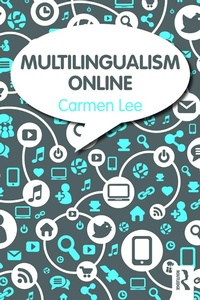
Multilingualism Online
Published on 13. September 2016
184 pages
978-1-317-47918-5 (ISBN)
Description

By the co-author of Language Online, this book builds on the earlier work while focusing on multilingualism in the digital world. Drawing on a range of digital media - from email to chatrooms and social media such as Facebook, Instagram, and YouTube - Lee demonstrates how online multilingualism is closely linked to people's offline literacy practices and identities, and examines the ways in which people draw on multilingual resources in their internet participation. Bringing together central concepts in sociolinguistics and internet linguistics, the eight chapters cover key issues such as:
language choice
code-switching
identities
language ideologies
minority languages
online translation.
Examples in the book are drawn from both all the major languages and many lesser-written ones such as Chinese dialects, Egyptian Arabic, Irish, and Welsh. A chapter on methodology provides practical information for students and researchers interested in researching online multilingualism from a mixed methods and practice-based approach.
Multilingualism Online is key reading for all students and researchers in the area of multilingualism and new media, as well as those who want to know more about languages in the digital world.
language choice
code-switching
identities
language ideologies
minority languages
online translation.
Examples in the book are drawn from both all the major languages and many lesser-written ones such as Chinese dialects, Egyptian Arabic, Irish, and Welsh. A chapter on methodology provides practical information for students and researchers interested in researching online multilingualism from a mixed methods and practice-based approach.
Multilingualism Online is key reading for all students and researchers in the area of multilingualism and new media, as well as those who want to know more about languages in the digital world.
Reviews / Votes
"A timely addition to the growing scholarship on language use in digital contexts. In this book, Lee elegantly weaves together topics ranging from linguistic diversity to code-switching to online translation. Written in a highly engaging style, Multilingualism Online is the first comprehensive work to engage with these topics since Danet & Herring?s The Multilingual Internet (2007); at the same time, Lee shows us just how much has changed over the last decade -- both in terms of technological affordances as well as in our digital practices." Camilla Vasquez, University of South Florida, USA Camilla Vasquez, South Florida, was very positive.Definitely the book could be used as a core or supplementary text for any of the above courses (Sociolinguistics, Literacy, Multilingualism, New Media Studies. And any other courses related to language and new media in departments such as: Linguistics, World Languages, Language Education, Literacy, English, Communication, Sociology). If the course taught were specifically about Multilingualism in the Digital Age, or specifically about Sociolinguistics in the Digital Age, this would be the perfect core text. ... I think it is excellent: clear, thorough, convincing, and covers a range of related (and relevant) issues. This book definitely fits a gap in the market. I would strongly recommend publication.
Caroline Tagg, Birmingham University, UK was also very supportive: Overall, I think this is a competent and comprehensive coverage of the issues related to multilingualism online, which will prove very useful for students and for researchers wanting an introduction to the field.
She had a number of suggestions which Carmen has responded to well (see extras). All quite minor and uncontentious.
Vincent Ooi, National University of Singapore provided a rather unhelpful report in which he basically advised her to make the book more scholarly and ideally edited, which was not her brief and isnt the kind of book I wanted. Language Online is a successful model and I wanted something accessible and engaging on this topic which can be used across subjects.
More details
Language
English
Place of publication
London
United Kingdom
Publishing group
Taylor & Francis Ltd
Target group
College/higher education
Illustrations
4 s/w Tabellen, 7 s/w Zeichnungen
4 Tables, black and white; 7 Line drawings, black and white
File size
1,57 MB
ISBN-13
978-1-317-47918-5 (9781317479185)
Copyright in bibliographic data and cover images is held by Nielsen Book Services Limited or by the publishers or by their respective licensors: all rights reserved.
Schweitzer Classification
Other editions
Additional editions
Person
Content
Contents
List of Tables and Figures *
Acknowledgements *
Foreword to Multilingualism Online by Mark Sebba *
Chapter 1 Multilingualism Online: Background and Approach *
Chapter 2 Linguistic Diversity and Language Choice Online *
Chapter 3 Written Code-switching Online *
Chapter 4 Multilingual Practices and Identities Online *
Chapter 5 Representations of Multilingualism on the Internet *
Chapter 6 Minority Languages and the Internet *
Chapter 7 Online Translation as Multilingual Practices *
Chapter 8
Researching Multilingualism Online: Current Trends and Future Perspectives *
Epilogue to Multilingualism Online by Susan Herring
Appendix 1 *
Bibliography *
List of Tables and Figures *
Acknowledgements *
Foreword to Multilingualism Online by Mark Sebba *
Chapter 1 Multilingualism Online: Background and Approach *
Chapter 2 Linguistic Diversity and Language Choice Online *
Chapter 3 Written Code-switching Online *
Chapter 4 Multilingual Practices and Identities Online *
Chapter 5 Representations of Multilingualism on the Internet *
Chapter 6 Minority Languages and the Internet *
Chapter 7 Online Translation as Multilingual Practices *
Chapter 8
Researching Multilingualism Online: Current Trends and Future Perspectives *
Epilogue to Multilingualism Online by Susan Herring
Appendix 1 *
Bibliography *
