

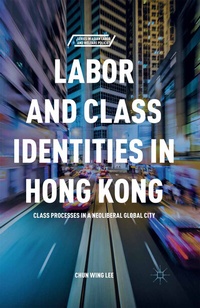
Labor and Class Identities in Hong Kong
Description

Based on numerous qualitative interviews, this cutting edge book investigates how Hong Kong's economic structure and neoliberal policies have contributed to class inequality in China's global city. Inspired by Bourdieu's approach to class, the author examines class stratification in education, works, and political attitudes and argues that the lack of explicit class identifications among the people does not imply irrelevance of class. Relying upon empirical field data to question the applicability of the reflexive modernization theory, the text debates whether individualization makes class a redundant concept in advanced capitalist societies.
More details
Other editions
Additional editions
Person
Chun Wing Lee is Lecturer at Hong Kong Community College, the Hong Kong Polytechnic University, China. He obtained his PhD in Sociology from the University of Manchester, UK. His research interests include class analysis, social movement, and the political/sociological aspects of sports.
Content
2. Studying Class Processes in Hong Kong: Approach and Method
3. Education and Childhood
4. Work
5. Class, Politics, and Democratization
6. Class Identification
7. Hong Kong-China Integration, Neoliberalization, and the Young Lower Class in Hong Kong
8. Classed Experience in a Neoliberal Global City
