

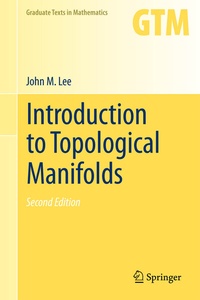
Introduction to Topological Manifolds
Description

This book is an introduction to manifolds at the beginning graduate level. It contains the essential topological ideas that are needed for the further study of manifolds, particularly in the context of differential geometry, algebraic topology, and related fields. Its guiding philosophy is to develop these ideas rigorously but economically, with minimal prerequisites and plenty of geometric intuition.
Although this second edition has the same basic structure as the first edition, it has been extensively revised and clarified; not a single page has been left untouched. The major changes include a new introduction to CW complexes (replacing most of the material on simplicial complexes in Chapter 5); expanded treatments of manifolds with boundary, local compactness, group actions, and proper maps; and a new section on paracompactness.
This text is designed to be used for an introductory graduate course on the geometry and topology of manifolds. It should be accessible to any student who has completed a solid undergraduate degree in mathematics. The author's book Introduction to Smooth Manifolds is meant to act as a sequel to this book.
Reviews / Votes
From the reviews of the second edition:
"An excellent introduction to both point-set and algebraic topology at the early-graduate level, using manifolds as a primary source of examples and motivation. . The author has . fulfilled his objective of integrating a study of manifolds into an introductory course in general and algebraic topology. This text is well-organized and clearly written, with a good blend of motivational discussion and mathematical rigor. . Any student who has gone through this book should be well-prepared to pursue the study of differential geometry . ." (Mark Hunacek, The Mathematical Association of America, March, 2011)
"This book is designed for first year graduate students as an introduction to the topology of manifolds. . The book can be read with advantage by any graduate student with a good undergraduate background, and indeed by many upper class undergraduates. It can be used for self study or as a text book for a fine geometrically flavored introduction to manifolds. One which provides excellent motivation for studying the machinery needed for more advanced work." (Jonathan Hodgson, Zentralblatt MATH, Vol. 1209, 2011)
More details
Other editions
Additional editions
Previous edition
Person
Content
Preface.- 1 Introduction.- 2 Topological Spaces.- 3 New Spaces from Old.- 4 Connectedness and Compactness.- 5 Cell Complexes.- 6 Compact Surfaces.- 7 Homotopy and the Fundamental Group.- 8 The Circle.- 9 Some Group Theory.- 10 The Seifert-Van Kampen Theorem.- 11 Covering Maps.- 12 Group Actions and Covering Maps.- 13 Homology.- Appendix A: Review of Set Theory.- Appendix B: Review of Metric Spaces.- Appendix C: Review of Group Theory.- References.- Notation Index.- Subject Index.
