

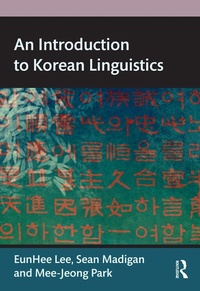
An Introduction to Korean Linguistics
Published on 30. October 2015
286 pages
978-1-317-38991-0 (ISBN)
Description

An Introduction to Korean Linguistics is a valuable and comprehensive text for those with an interest in Korean linguistics.
This book provides an in-depth introduction to the basics of Korean linguistics, and modern linguistic theory, in an accessible style. It features a step-by-step approach designed to lead the reader through the linguistic make-up of the language, from the basics of its sound system and sentence structure to the semantics of modern spoken Korean.
Features include:
Detailed chapters covering the core areas in the field of linguistics, including phonetics, phonology, morphology and syntax
Clear and accessible explanations which effectively demonstrate the intricacies and subtleties of the Korean language
Suggested readings for those interested in expanding their knowledge of a specific topic
Exercises designed to complement the factual and analytical issues covered in each chapter
A comprehensive glossary of central terms and a companion website offering a wealth of additional materials.
Korean is an invaluable language for the study of theoretical and comparative linguistics as it provides important examples and counter-examples to key issues, making An Introduction to Korean Linguistics an essential text for students and professional linguists alike.
This book provides an in-depth introduction to the basics of Korean linguistics, and modern linguistic theory, in an accessible style. It features a step-by-step approach designed to lead the reader through the linguistic make-up of the language, from the basics of its sound system and sentence structure to the semantics of modern spoken Korean.
Features include:
Detailed chapters covering the core areas in the field of linguistics, including phonetics, phonology, morphology and syntax
Clear and accessible explanations which effectively demonstrate the intricacies and subtleties of the Korean language
Suggested readings for those interested in expanding their knowledge of a specific topic
Exercises designed to complement the factual and analytical issues covered in each chapter
A comprehensive glossary of central terms and a companion website offering a wealth of additional materials.
Korean is an invaluable language for the study of theoretical and comparative linguistics as it provides important examples and counter-examples to key issues, making An Introduction to Korean Linguistics an essential text for students and professional linguists alike.
More details
Language
English
Place of publication
London
United Kingdom
Publishing group
Taylor & Francis Ltd
Target group
College/higher education
Illustrations
64 s/w Zeichnungen, 69 s/w Abbildungen, 33 s/w Tabellen, 5 s/w Photographien bzw. Rasterbilder
33 Tables, black and white; 64 Line drawings, black and white; 5 Halftones, black and white; 69 Illustrations, black and white
File size
3,72 MB
ISBN-13
978-1-317-38991-0 (9781317389910)
Copyright in bibliographic data and cover images is held by Nielsen Book Services Limited or by the publishers or by their respective licensors: all rights reserved.
Schweitzer Classification
Other editions
Additional editions
Eunhee Lee | Sean Madigan | Mee-Jeong Park
An Introduction to Korean Linguistics
Book
11/2015
1st Edition
Routledge
€193.45
Shipment within 15-20 days
Eunhee Lee | Sean Madigan | Mee-Jeong Park
An Introduction to Korean Linguistics
Book
11/2015
1st Edition
Routledge
€72.70
Shipment within 15-20 days
Persons
EunHee Lee is Associate Professor in the Department of Linguistics at the University at Buffalo, The State University of New York, USA.
Sean Madigan is a lecturer in the Department of Linguistics and Cognitive Sciences at Dartmouth University, USA.
Mee-Jeong Park is Associate Professor of Korean Language and Linguistics at the University of Hawaii at Manoa, USA.
Sean Madigan is a lecturer in the Department of Linguistics and Cognitive Sciences at Dartmouth University, USA.
Mee-Jeong Park is Associate Professor of Korean Language and Linguistics at the University of Hawaii at Manoa, USA.
Content
Chapter 1: Introduction Chapter 2: Phonetics Chapter 3: Phonology Chapter 4: Morphology Chapter 5: Syntax Chapter 6: Semantics
