

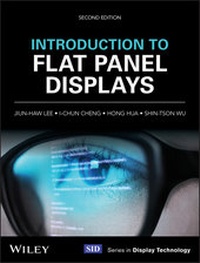
Introduction to Flat Panel Displays
Description

Introduction to Flat Panel Displays¯, 2nd Edition is the leading introductory reference to state-of-the-art flat panel display technologies. The 2nd edition has been newly updated to include the latest developments for high pixel resolution support, high brightness, improved contrast settings, and low power consumption. The 2nd edition has also been updated to include the latest developments of head-mounted displays for virtual and augmented reality applications.
Introduction to Flat Panel Displays introduces and updates both the fundamental physics and materials concepts underlying flat panel display technology and their application to smart phones, ultra-high definitions TVs, computers, and virtual and augmented reality systems.
The book includes new information on quantum-dot enhanced LCDs, device configurations and performance, and nitrate-based LEDs. The authors also provide updates on technologies like:
* OLED materials, including phosphorescent, TTA, and TADF OLEDs
* White light OLED and light extraction
* OLED for mobile and TV
* Light and flexible OLED
* Reflective displays, including e-paper technology
* Low power consumption displays
The perfect reference for graduate students and new entrants to the display industry, Introduction to Flat Panel Displays offers problem and homework sets at the end of each chapter to measure retention and learning.
More details
Other editions
Additional editions
Persons
Series Editor: Ian Sage, Abelian Services, Malvern, UK
Jiun-Haw Lee, National Taiwan University, Taiwan
Jiun-Haw Lee received his Ph.D. in electrical engineering in from the National Taiwan University, Taipei, Taiwan. From 2000 to 2003, Dr Lee was a director at the RiTdisplay Corporation, before joining the faculty of National Taiwan University in the Graduate Institute of Electro-optical Engineering and the Department of Electrical Engineering, where he is currently an associate professor. His research interests include organic light emitting device (OLED), display technologies, and solid-state lighting.
I-Chun Cheng, National Taiwan University, Taiwan
Dr. Cheng received a Ph.D. in electrical engineering from Princeton University in 2004. Following her degree, she became a postdoctoral research associate at Princeton University. She joined the faculty of National Taiwan University in 2007, where she is currently an associate professor at the Department of Electrical Engineering and Graduate Institute of Photonics and Optoelectronics. She has primarily worked in the field of metal oxide semiconductor thin-film device technology, photoelectrochemical solar cells and flexible large-area electronics.
Hong Hua, University of Arizona, USA
Dr. Hua is currently a Full Professor with the College of Optical Sciences (OSC) and joint faculty with the Department of Electrical and Computer Engineering and Department of Computer Science at the University of Arizona. Dr. Hong Hua received her Ph.D. degree in optical engineering from Beijing Institute of Technology (BIT), Beijing, China, in 1999, with the dissertation titled ?Techniques of Immersion Enhancement and Interaction for Virtual Reality? (with honor). She received her B.S. in optical engineering and Minor B.S. degree in computer science from BIT in 1994.
Shin-Tson Wu, University of Central Florida, USA
Content
Series Editor's Foreword xiii
1 Flat Panel Displays 1
1.1 Introduction 1
1.2 Emissive and non-emissive Displays 4
1.3 Display Specifications 4
1.3.1 Physical Parameters 5
1.3.2 Brightness and Color 7
1.3.3 Contrast Ratio 8
1.3.4 Spatial and Temporal Characteristics 8
1.3.5 Efficiency and Power Consumption 9
1.3.6 Flexible Displays 9
1.4 Applications of Flat Panel Displays 9
1.4.1 Liquid Crystal Displays 10
1.4.2 Light-Emitting Diodes 10
1.4.3 Organic Light-Emitting Devices 11
1.4.4 Reflective Displays 11
1.4.5 Head-Mounted Displays 12
1.4.6 Touch Panel Technologies 12
References 13
2 Color Science and Engineering 15
2.1 Introduction 15
2.2 Photometry 16
2.3 The Eye 18
2.4 Colorimetry 22
2.4.1 Trichromatic Space 22
2.4.2 CIE 1931 Colormetric Observer 24
2.4.3 CIE 1976 Uniform Color System 27
2.4.4 CIECAM 02 Color Appearance Model 30
2.4.5 Color Gamut 31
2.4.6 Light Sources 32
2.4.6.1 Sunlight and Blackbody Radiators 32
2.4.6.2 Light Sources for Transmissive, Reflective, and Projection Displays 33
2.4.6.3 Color Rendering Index 34
2.5 Production and Reproduction of Colors 34
2.6 Display Measurements 35
Homework Problems 36
References 36
3 Thin Film Transistors 39
3.1 Introduction 39
3.2 Basic Concepts of Crystalline Semiconductor Materials 39
3.2.1 Band Structure of Crystalline Semiconductors 40
3.2.2 Intrinsic and Extrinsic Semiconductors 43
3.3 Classification of Silicon Materials 46
3.4 Hydrogenated Amorphous Silicon (a-Si:H) 46
3.4.1 Electronic Structure of a:Si-H 47
3.4.2 Carrier Transport in a-Si:H 48
3.4.3 Fabrication of a-Si:H 48
3.5 Polycrystalline Silicon 49
3.5.1 Carrier Transport in Polycrystalline Silicon 49
3.5.2 Fabrication of Polycrystalline-Silicon 50
3.6 Thin-Film Transistors 52
3.6.1 Fundamentals of TFTs 52
3.6.2 a-Si:H TFTs 55
3.6.3 Poly-Si TFTs 55
3.6.4 Organic TFTs 56
3.6.5 Oxide Semiconductor TFTs 57
3.6.6 Flexible TFT Technology 59
3.7 PM and AM Driving Schemes 61
Homework Problems 67
References 67
4 Liquid Crystal Displays 71
4.1 Introduction 71
4.2 Transmissive LCDs 72
4.3 Liquid Crystal Materials 74
4.3.1 Phase Transition Temperatures 75
4.3.2 Eutectic Mixtures 75
4.3.3 Dielectric Constants 77
4.3.4 Elastic Constants 78
4.3.5 Rotational Viscosity 79
4.3.6 Optical Properties 80
4.3.7 Refractive Indices 80
4.3.7.1 Wavelength Effect 80
4.3.7.2 Temperature Effect 82
4.4 Liquid Crystal Alignment 83
4.5 Homogeneous Cell 84
4.5.1 Phase Retardation Effect 85
4.5.2 Voltage Dependent Transmittance 86
4.6 Twisted Nematic (TN) 87
4.6.1 Optical Transmittance 87
4.6.2 Viewing Angle 89
4.6.3 Film-Compensated TN 90
4.7 In-Plane Switching (IPS) 91
4.7.1 Device Structure 92
4.7.2 Voltage-Dependent Transmittance 92
4.7.3 Viewing Angle 92
4.7.4 Phase Compensation Films 93
4.8 Fringe Field Switching (FFS) 95
4.8.1 Device Configurations 95
4.8.2 n-FFS versus p-FFS 96
4.9 Vertical Alignment (VA) 98
4.9.1 Voltage-Dependent Transmittance 98
4.9.2 Response Time 99
4.9.3 Overdrive and Undershoot Addressing 101
4.9.4 Multi-domain Vertical Alignment (MVA) 102
4.10 Ambient Contrast Ratio 103
4.10.1 Modeling of Ambient Contrast Ratio 103
4.10.2 Ambient Contrast Ratio of LCD 103
4.10.3 Ambient Contrast Ratio of OLED 104
4.10.4 Simulated ACR for Mobile Displays 105
4.10.5 Simulated ACR for TVs 105
4.10.6 Simulated Ambient Isocontrast Contour 106
4.10.6.1 Mobile Displays 106
4.10.6.2 Large-Sized TVs 108
4.10.7 Improving LCD's ACR 109
4.10.8 Improving OLED's ACR 110
4.11 Motion Picture Response Time (MPRT) 112
4.12 Wide Color Gamut 114
4.12.1 Material Synthesis and Characterizations 115
4.12.2 Device Configurations 116
4.13 High Dynamic Range 118
4.13.1 Mini-LED Backlit LCDs 118
4.13.2 Dual-Panel LCDs 120
4.14 Future Directions 121
Homework Problems 123
References 124
5 Light-Emitting Diodes 135
5.1 Introduction 135
5.2 Material Systems 138
5.2.1 AlGaAs and AlGaInP Material Systems for Red and Yellow LEDs 140
5.2.2 GaN-Based Systems for Green, Blue, UV and UV LEDs 141
5.2.3 White LEDs 143
5.3 Diode Characteristics 146
5.3.1 p- and n-Layer 147
5.3.2 Depletion Region 148
5.3.3 J-V Characteristics 150
5.3.4 Heterojunction Structures 152
5.3.5 Quantum-Well, -Wire, and -Dot Structures 152
5.4 Light-Emitting Characteristics 154
5.4.1 Recombination Model 154
5.4.2 L-J Characteristics 155
5.4.3 Spectral Characteristics 156
5.4.4 Efficiency Droop 159
5.5 Device Fabrication 160
5.5.1 Epitaxy 161
5.5.2 Process Flow and Device Structure Design 165
5.5.3 Extraction Efficiency Improvement 166
5.5.4 Packaging 168
5.6 Applications 169
5.6.1 Traffic Signals, Electronic Signage and Huge Displays 169
5.6.2 LCD Backlight 170
5.6.3 General Lighting 172
5.6.4 Micro-LEDs 173
Homework Problems 175
References 175
6 Organic Light-Emitting Devices 179
6.1 Introduction 179
6.2 Energy States in Organic Materials 180
6.3 Photophysical Processes 182
6.3.1 Franck-Condon Principle 182
6.3.2 Fluorescence and Phosphorescence 183
6.3.3 Jablonski Diagram 185
6.3.4 Intermolecular Processes 186
6.3.4.1 Energy Transfer Processes 186
6.3.4.2 Excimer and Exciplex Formation 188
6.3.4.3 Quenching Processes 188
6.3.5 Quantum Yield Calculation 189
6.4 Carrier Injection, Transport, and Recombination 191
6.4.1 Richardson-Schottky Thermionic Emission 192
6.4.2 SCLC, TCLC, and P-F Mobility 193
6.4.3 Charge Recombination 195
6.4.4 Electromagnetic Wave Radiation 195
6.5 Structure, Fabrication and Characterization 197
6.5.1 Device Structure of Organic Light-Emitting Device 198
6.5.1.1 Two-Layer Organic Light-Emitting Device 198
6.5.1.2 Matrix Doping in the EML 200
6.5.1.3 HIL, EIL, and p-i-n Structure 202
6.5.1.4 Top-Emission and Transparent OLEDs 204
6.5.2 Polymer OLED 205
6.5.3 Device Fabrication 206
6.5.3.1 Thin-film Formation 207
6.5.3.2 Encapsulation and Passivation 210
6.5.3.3 Device Structures for AM Driving 211
6.5.4 Electrical and Optical Characteristics 212
6.5.5 Degradation Mechanisms 214
6.6 Triplet Exciton Utilization 219
6.6.1 Phosphorescent OLEDs 219
6.6.2 Triplet-Triplet Annihilation OLED 221
6.6.3 Thermally Activated Delayed Fluorescence 222
6.6.4 Exciplex-Based OLED 223
6.7 Tandem Structure 224
6.8 Improvement of Extraction Efficiency 226
6.9 White OLEDs 229
6.10 Quantum-Dot Light-Emitting Diode 231
6.11 Applications 233
6.11.1 Mobile OLED Display 233
6.11.2 OLED TV 234
6.11.3 OLED Lighting 235
6.11.4 Flexible OLEDs 235
6.11.5 Novel Displays 236
Homework Problems 236
References 237
7 Reflective Displays 245
7.1 Introduction 245
7.2 Electrophoretic Displays 245
7.3 Reflective Liquid Crystal Displays 249
7.4 Reflective Display Based on Optical Interference (Mirasol Display) 253
7.5 Electrowetting Display 254
7.6 Comparison of Different Reflective Display Technologies 256
Homework Problems 256
References 257
8 Fundamentals of Head-Mounted Displays for Virtual and Augmented Reality 259
8.1 Introduction 259
8.2 Human Visual System 262
8.3 Fundamentals of Head-mounted Displays 265
8.3.1 Paraxial Optical Specifications 265
8.3.2 Microdisplay Sources 272
8.3.3 HMD Optics Principles and Architectures 275
8.3.4 Optical Combiner 280
8.4 HMD Optical Designs and Performance Specifications 286
8.4.1 HMD Optical Designs 286
8.4.2 HMD Optical Performance Specifications 290
8.5 Advanced HMD Technologies 298
8.5.1 Eyetracked and Fovea-Contingent HMDs 299
8.5.2 Dynamic Range Enhancement 302
8.5.3 Addressable Focus Cues in HMDs 305
8.5.3.1 Extended Depth of Field Displays 307
8.5.3.2 Vari-Focal Plane (VFP) Displays 308
8.5.3.3 Multi-Focal Plane (MFP) Displays 309
8.5.3.4 Head-Mounted Light Field (LF) Displays 315
8.5.4 Head-Mounted Light Field Displays 316
8.5.4.1 InI-Based Head-Mounted Light Field Displays 317
8.5.4.2 Computational Multi-Layer Head-Mounted Light Field Displays 321
8.5.5 Mutual Occlusion Capability 323
References 328
9 Touch Panel Technology 337
9.1 Introduction 337
9.2 Resistive Touch Panel 338
9.3 Capacitive Touch Panel 339
9.4 On-Cell and In-Cell Touch Panel 344
9.5 Optical Sensing for Large Panels 347
Homework Problems 348
References 348
Index 351
1
Flat Panel Displays
1.1 INTRODUCTION
Displays provide a man-machine interface through which information can be passed to the human visual system. The information may include pictures, animations, and movies, as well as text. One can say that the most basic functions of a display are to produce, or re-produce, colors and images. The use of ink to write, draw, or print on a paper as in a painting or a book might be regarded as the longest established display medium. However, the content of such a traditional medium is static and is typically difficult or impossible to modify or update. Also, a natural or artificial source of light, is needed for reading a book or viewing a picture. In contrast, there are now many electronic display technologies, which use an electronic signal to create images on a panel and stimulate the eyes. In this chapter, we first introduce flat panel display (FPD) classifications in terms of emissive and non-emissive displays, where non-emissive displays include both transmissive and reflective displays. Then, specifications of FPDs will be outlined. Finally, the FPD technologies described in the later chapters of this book will be briefly introduced.
Displays can be subdivided into emissive and non-emissive technologies. Emissive displays emit light from each pixel which forms a part of the image on the panel. On the other hand, non-emissive displays modulate light by means of absorption, reflection, refraction, and scattering, to display colors and images. For a non-emissive display, a light source is needed. Such non-emissive displays can then be further classified into transmissive and reflective types. In historical terms, one of the most successful technologies for home entertainment has been the cathode ray tube (CRT), which enabled the widespread adoption of television (TV). It exhibits the advantages of being self-emissive and offering wide viewing angle, fast response, good color saturation, long lifetime, and good image quality. However, one of its major disadvantages is its size and bulk. The depth of a CRT is roughly equal to the length or width of the panel. For example, for a 19 in. (38.6 cm × 30.0 cm) CRT with aspect ratio of 4 : 3 the depth of a monitor is about 40 cm. Hence, it is hardly portable; its bulky size and heavy weight limit its applications.
In this book, we introduce various types of FPDs. As the name implies, these displays have a relatively thin profile, several centimeters or less, which is largely independent of the screen diagonal. Specifying a display or the design and optimization of a display-based product require selection of an appropriate technology, and are strongly dependent on the application and intended conditions of use. These issues, together with the intense pace of FPD development, which has made available many options and variations of the different display types, have made a thorough understanding of displays essential for product engineers. The options can be illustrated by some typical examples. For instance, the liquid crystal display (LCD) is presently the dominant FPD technology and is available with diagonal sizes ranging from less than 1 in. (microdisplay) to over 100 in. Such a display is usually driven by thin-film-transistors (TFTs). The liquid crystal cell acts as a light modulator which does not itself emit light. Hence, a backlight module is usually used behind a transmissive LCD panel to form a complete display module. In most LCDs, two crossed polarizers are employed which can provide a high contrast ratio. However, the use of polarizers limits the maximum optical transmittance to about 35-40%, unless a polarization conversion scheme is implemented. Moreover, at oblique angles the optical performance of the assembly is degraded by two important effects. Firstly the projections of optic axes of two crossed polarizers onto the E vector of the light are no longer perpendicular to each other when light is incident at an oblique angle, so it is difficult to maintain a good dark state in the display over a wide viewing cone. Secondly, the liquid crystal (LC) is a birefringent medium, which means that electro-optic effects based on switching an LC are dependent on the relative directions of the incident light and the LC alignment in the cell. Hence, achieving a wide viewing angle and uniform color rendering in an LCD requires special care. To achieve wide-view, multi-domain architectures and phase compensation films (either uniaxial or biaxial) are commonly used; one for compensating the light leakage of crossed polarizer at large angles and another for compensating the birefringent LC layer. Using this phase compensation technique, transmissive multi-domain LCDs exhibit a high contrast ratio, high resolution, crisp image, vivid colors (when using quantum dots or narrow-band light emitting diodes), and a wide viewing angle. It is still possible for the displayed images to be washed out under direct sunlight. For example, if we use a smartphone or notebook computer in the high ambient light conditions found outdoors in clear weather, the images may not be readable. This is because the reflected sunlight from the LCD surface is much brighter than that transmitted from the backlight, so the ambient contrast ratio is greatly reduced. A broadband anti-reflection coating and adaptive brightness control help improve the sunlight readability.
Another approach to improve sunlight readability is to use reflective LCDs [1]. A reflective LCD uses ambient light to illuminate the displayed images. It does not need a backlight, so its weight, thickness, and power consumption are reduced. A wrist watch is such an example. Most reflective LCDs have inferior performance compared to transmissive ones in terms of contrast ratio, color saturation, and viewing angle. Moreover, in fully dark conditions a reflective LCD is not readable at all. As a result, its application is rather limited.
To overcome the sunlight readability issue while maintaining high image quality, a hybrid display termed a transflective liquid crystal display (TR-LCD) has been developed [2]. In a TR-LCD, each pixel is subdivided into two sub-pixels which provide, respectively, transmissive (T) and reflective (R) functions. The area ratio between T and R can be adjusted depending on the applications. For example, if the display is mostly used out of doors, then a design which has 80% reflective area and 20% transmissive area might be used. In contrast, if the display is mostly used indoors, then we can use 80% transmissive area and 20% reflective area. Within this TR-LCD family, there are various designs: double cell gap versus single cell gap, and double TFTs versus single TFT. These approaches attempt to solve the optical path-length disparity between the T and R sub-pixels. In the transmissive mode, the light from the backlight unit passes through the LC layer once, but in the reflective mode the ambient light traverses the LC medium twice. To balance the optical path-length, we can make the cell gap of the T sub-pixels twice as thick as that of the R sub-pixels. This is the dual cell gap approach. The single cell gap approach, however, has a uniform cell gap throughout the T and R regions. To balance the different optical path-lengths, several approaches have been developed, e.g. dual TFTs, dual fields (providing a stronger field for the T region and a weaker field in the R region), and dual alignments. Although TR-LCDs can improve sunlight readability, the fabrication process is much more complicated and the performance inferior to transmissive devices. Therefore, TR-LCD has not been widely adopted in products.
Light-emitting diodes (LEDs) consist of a semiconductor p-n junction, fabricated on a crystalline substrate. Under a forward bias, electrons and holes are injected into the device where they recombine and emit light. The emission wavelength of the LED is determined by the bandgap of the semiconductor. For longer wavelength (such as red and yellow) emission, an AlGaInP-based semiconductor is needed. Three group III (Al, Ga, and In) and one group IV (P) atoms are needed to allow tuning of the emission wavelength and lattice-matching to the substrate (e.g. GaAs). However, for shorter wavelength (green and blue) emission, it was not easy to find a lattice-matched substrate. Besides, there were other technological difficulties in fabricating nitride-based LEDs such as p-type doping and InGaN growth. In recognition of their successful demonstration of the InGaN-based blue LED, Professor Isamu Akasaki, Professor Hiroshi Amano, and Professor Shuji Nakamura were awarded the Nobel Prize in Physics in 2014. By combining the blue LED with phosphors, white emission is possible from a single chip. LEDs have been used for many display and lighting applications, such as traffic lights, very large diagonal (over 100 in.) signage, backlights of LCD, and general lighting, due to their long lifetime and high efficiency. A detailed description of LEDs from the viewpoints of materials, devices, fabrication, and applications will be presented in Chapter 5.
In Chapter 6, organic light-emitting devices (OLEDs) will be introduced. The operating principle of OLEDs is quite similar to that of the LED. It is also an electroluminescence (EL) device, but fabricated from organic materials rather than a semiconductor. In contrast to LEDs, it is not necessary to fabricate OLEDs on a crystalline...
