

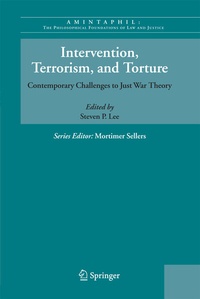
Intervention, Terrorism, and Torture
Description

Just war theory is the traditional approach taken to questions of the morality of war, but war today is far from traditional. War has been deeply affected in recent years by a variety of social and technological developments in areas such as international terrorism, campaigns of genocide and ethnic cleansing, the global human rights movement, economic globalization, and military technology. This book asks whether just war theory is adequate to the challenges these developments pose. Just war theory provides rules for determining when it is justified to fight a war. But some have argued that the nature of contemporary war makes these rules obsolete. For example, genocidal and aggressive regimes may require the use of military force that is not strictly in self-defense, as just war theory requires. In addition, the theory provides rules for determining what the limits are on justified conduct in war. But the random violence of terrorism and the deliberately inflicted violence of torture seem endemic to our age, yet take us beyond the limits set by these rules of conduct in war. By carefully examining the phenomena of intervention, terrorism, and torture from a number of different perspectives, the essays in this book explore this set of issues with insight and clarity.
More details
Other editions
Additional editions
Content
JUST WAR THEORY AND THE CHALLENGES IT FACES (p. 3)
The extent to which the world changed on 9/11, with the terrorist attacks on New York and Washington, is a matter of debate. But, even if the attacks did not themselves introduce significant changes, it is clear that they highlighted and accelerated changes that were already underway in the role of military violence.
This volume is an examination of the moral implications of those changes. The chapters consider how these changes should be understood in moral terms. Traditionally, matters of the morality of military violence have been understood and assessed in terms of Just War Theory (JWT).
This volume examines the extent to which recent changes in the role of military violence pose challenges to JWT. How has the role of military violence changed, and what are the moral implications? There are different ways in which this question might be approached.
In this introduction, I will approach it by asking whether JWT is adequate to handle the challenges, or whether instead it needs to be revised or abandoned in favor of a different approach. What does it mean to ask whether JWT is adequate to the contemporary challenges?
JWT has always been understood not as an abstract moral theory, but as a practical guide for political leaders and military personnel in their decisions about the employment of military violence. The adequacy of JWT is bound up with its continuing ability to serve this practical function.
If the contemporary changes have left the theory unable to provide practical guidance, the theory is now inadequate. JWT consists of a set of rules and norms that seek to control military violence, to limit or restrict its exercise. It is a theory of limited war.
Unlike doctrines of pacifism, it does not seek to outlaw all war, it assumes that some military violence is morally justified. It accepts the assumption that in a world of sovereign states without an overarching governing authority, military violence must be available to states, at least to protect themselves from aggression.
At the same time, unlike doctrines of realism, JWT does not assume that any use of military violence that furthers a belligerent’s national interests is justified, it seeks to impose moral limits on military violence.
It assumes that even in a world of sovereign states, states have some mutual moral obligations not to interfere with each other. As a theory of limited war, JWT is in a middle position, so to speak, between pacifism and realism, allowing some uses of military violence and disallowing others.
Its adequacy is tied to its ability to maintain that sometimes precarious middle position, not to move too close to, or collapse into, either realism or pacifism. If JWT moves too close to realism, it is not serving its moral function. If it moves too far from realism, it is not serving its practical action-guiding function because military decision-makers will simply ignore rules that require too great a sacrifice of national self-interest.
The just war rules have been developed over time in response to given social, political, and technological realities, and, as these realities change, the question arises whether the rules remain adequate, whether they retain their action-guiding function.
