

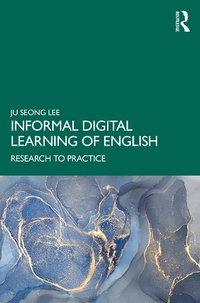
Informal Digital Learning of English
Research to Practice
1st Edition
Published on 27. December 2021
190 pages
978-1-000-50787-4 (ISBN)
Description

In today's digital era, increasing numbers of youth around the world learn English outside classrooms, frequently with the use of technology. This timely book brings together research and theory on the increasingly common phenomenon of Informal Digital Learning of English (IDLE) among students of all ages and across a wide range of contexts globally. By examining the positive impact of IDLE on students' reading, writing, listening, and speaking abilities, as well as the unique challenges that result, Lee synthesizes research in one accessible and comprehensive volume in this rapidly developing domain.
This book addresses key concepts, including Computer Assisted Language Learning, the impact on standardized assessment, and the role of classroom learning. Lee offers empirically tested activities, pedagogical recommendations, and lesson plans to engage ESL/EFL students. The research overview and practical offerings make this an ideal text for courses in TESOL on online education, language teaching online, digital learning, community and language, and applied linguistics.
This book addresses key concepts, including Computer Assisted Language Learning, the impact on standardized assessment, and the role of classroom learning. Lee offers empirically tested activities, pedagogical recommendations, and lesson plans to engage ESL/EFL students. The research overview and practical offerings make this an ideal text for courses in TESOL on online education, language teaching online, digital learning, community and language, and applied linguistics.
Reviews / Votes
"Insightful and invaluable, Ju Seong Lee's book puts the spotlight firmly where it belongs: on the daily, informal digital practices that underpin most language learning and use."--Hayo Reinders, Anaheim University, USA
"For years, researchers have observed language learners who thrive in digital environments. This book delves into this phenomenon and explores how the use of these social spaces support specific learning outcomes. Those who are interested in transforming their language instruction will definitely want this book."
--Greg Kessler, Ohio University, USA
"Informal digital learning improves English learning."
--Adnan Mohamed, Washington State University, USA "Insightful and invaluable, Ju Seong Lee's book puts the spotlight firmly where it belongs: on the daily, informal digital practices that underpin most language learning and use."
Hayo Reinders, Anaheim University, USA
"For years, researchers have observed language learners who thrive in digital environments. This book delves into this phenomenon and explores how the use of these social spaces support specific learning outcomes. Those who are interested in transforming their language instruction will definitely want this book."
Greg Kessler, Ohio University, USA
"This exciting and well-researched new book provides a comprehensive and compelling case for the revolutionary potential of Informal Digital Learning of English for ESL curriculum and teaching worldwide. This book lays the foundation for second language pedagogy in the twenty-first century. It is a must-read for researchers and graduate students interested in how technology can truly transform language education, now and in the foreseeable future."
Mark Dressman, University of Illinois at Urbana-Champaign, USA
"Informal digital learning improves English learning."
Adnan Mohamed, Washington State University, USA
"Ju Seong Lee's (2022) Informal Digital Learning of English: Research to Practice is essential reading for those who wish to understand this rapidly emerging phenomenon in English-language learning.
A strength of Informal Digital Learning of English: Research to Practice is that it provides empirically tested activities, pedagogical recommendations, and lesson plans for how language teachers could implement IDLE in their curriculum and teaching practices. Additionally, the robust empirical studies discussed in the book employ a variety of research methodologies to reveal the benefits of IDLE in the context of CALL. The book is particularly informative and valuable for researchers and practitioners interested in experimenting with IDLE approaches in students' daily social spaces and introducing informal digital practices into language learning.
Informal Digital Learning of English: Research to Practice is written in a straightforward style by a leading author in the field. By synthesising seminal works, theories, and pedagogy, Lee explains how both novice and experienced educators can implement IDLE. The chapters are comprehensive, data-rich, relevant, and informative for language teachers and researchers alike. This book is a valuable reference point for understanding IDLE and promoting its advancement."
Lucas Kohnke, Language Learning & Technology, 26(1)
"[T]he author of the book...provide[s] a practical book for language teachers. [T]his book is very essential for both language teachers and learners considering the relationship between the requirements of today's digital era and language learning."
Sevval Ertok, Language Education & Technology (LET Journal), 2(1)
More details
Edition
1. Auflage
Language
English
Place of publication
London
United Kingdom
Publishing group
Taylor & Francis Ltd
Target group
College/higher education
Illustrations
28 Tables, black and white; 10 Line drawings, black and white; 10 Illustrations, black and white
ISBN-13
978-1-000-50787-4 (9781000507874)
Copyright in bibliographic data and cover images is held by Nielsen Book Services Limited or by the publishers or by their respective licensors: all rights reserved.
Schweitzer Classification
Other editions
Additional editions
Book
12/2021
1st Edition
Routledge
€62.90
Shipment within 15-20 days
Book
12/2021
1st Edition
Routledge
€206.00
Shipment within 15-20 days
Person
Ju Seong Lee is Assistant Professor of English Language Education at the Education University of Hong Kong.
Content
Chapter 1. Introduction
Chapter 2. Trends in Computer Assisted Language Learning (CALL)
Chapter 3. Informal Digital Learning of English (IDLE)
Chapter 4. IDLE-related concepts
Chapter 5. IDLE and language learning outcomes
Chapter 6. IDLE in the Classroom
Chapter 7. Preparing teachers for integrating IDLE into the classroom
Chapter 8. Conclusion
Chapter 2. Trends in Computer Assisted Language Learning (CALL)
Chapter 3. Informal Digital Learning of English (IDLE)
Chapter 4. IDLE-related concepts
Chapter 5. IDLE and language learning outcomes
Chapter 6. IDLE in the Classroom
Chapter 7. Preparing teachers for integrating IDLE into the classroom
Chapter 8. Conclusion
